8.4 and 8.5 Enzymes speeding up processes and regulation of enzymes
 Call Kai
 Learn
 Practice Test
 Spaced Repetition
 Match
 Flashcards
 Knowt Play
1/59

There's no tags or description
Looks like no tags are added yet.
60 Terms
a catalyst
a chemical agent that speeds up a reaction without being consumed by the reaction
an enzyme
biological catalyst
Example of an enzyme
hydrolysis of sucrose by the enzyme sucrase is an example of an enzyme catalyzed reaction
Free energy of activation
activation energy (EA), the initial energy needed to start a chemical reaction
Activation energy is often supplied in the form of
thermal energy that the reactant molecules absorb from their surroundings
Enzymes catalyze reactions
by lowering the activation energy (EA) barrier
enzymes do not
affect the change in free energy, and they cannot make an endergonic reaction
Enzymes speed up reactions that would
eventually occur in the absence of the enzymes
Enzymes are very specific for the
reactions that they catalyze so they determine which chemical processes will be going on in the cell at any given time
the reactant that an enzyme acts on is called
a substrate
when the enzyme binds to its substrate it forms
enzyme substrate complex
the active site
the region on the enzyme where the substrate binds and catalytic reaction occurs
inducted fit
changes the shape of the activation site, by bringing chemical groups within the activation site into positions that enhance their ability to catalyze the reaction

what is this
Induced fit
the change caused by induced fit allows
for additional weak bonds to from causing the active site to enfold the substrate and hold it in place
In what ways does the activation site lower the EA
orienting substrates correctly
straining substrate bonds
providing a favorable microenviroment
covalent bonding the substrate
Enzyme activity can be affected by
temp and pH
certain chemicals
Cofactors
non protein enzyme helpers that are necessary for activity
Cofactors can be
inorganic (ionic metals)
or small organic molecules
coensyme
a cofactor that is an organic molecule
most vitamins
are important because they act as coenzymes or raw materials from which coenzymes are made
Competitive inhibitors
bind directly to the active site and compete with the normal substrate of the enzyme
noncompetitive inhibitors
bind to another part of an enzyme other than the active site, it causes the active site to change shape and makes it less effective

what is happening with the enzymes
competitive inhibition
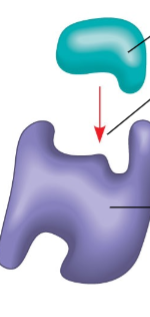
what is happening with the enzymes
normal binding

what is happening with the enzymes
noncompetitive inhibition
Nearly enzyme produced by the cell
is a protein that is encoded by a gene
Changes in DNA sequencing
lead to a change in the amino acid composition of the enzyme
altered amino acids in enzymes may alter their
substrate specifically
Under new environmental conditions
a new form of an enzyme might be favored over the old form
Chemical chaos
is what would result if a cells metabolic pathways are not regulated
the two ways a cell can regulate metabolic pathways
switching on or off the genes that encode specific enzymes
regulating the activity of enzymes, and controlling the activity of enzymes already produced
Allosteric regulation
can inhibit OR stimulate an enzymes activity
allosteric regulation occurs when
a regulatory molecule binds to a protein at one site and affects the proteins function at another site
Most enzymes involved in allosteric regulation
have a quaterinary structure, more than one poly peptide chain each with there own active site
the enzyme complex oscillates between two different shapes
one catalytically active and the other inactive
binding of an activator molecule
stabilizes the active form of an enzyme
the binding of an inhibitor molecule
stabilizes the inactive form of the enzyme
cooperativity
a form of allosteric regulation that can amplify the response of an enzyme that increases activity
in cooperativity a substrate molecule binding to one active site in a multisubunit enzyme triggers
a shape change in all sub units, and increasing catalytic activity at the other sites
Cooperativity is allosteric
because by binding a substrate to one active site affects catalysis in a different active site

what is this
cooperativity- binding of one substrate to the active site of one subunit locks them all into conformation

what is this
allosteric activator- stabilizes active form, binds to regulatory site

what is this
allosteric inhibitor- stabilizes inactive form
Feedback inhibition
the end product of the metabolic pathway binds and inhibits the function of an enzyme that acts earlier in the pathway
Feedback inhibition prevents
a cell from wasting chemical resources by synthesizing more products than needed
Structures within the cell
help bring order to metabolic pathways
some enzymes act as
structural components of membranes
in eukaryotic cells
some enzymes reside in specific organelles

what type of reaction is this
exergoinic
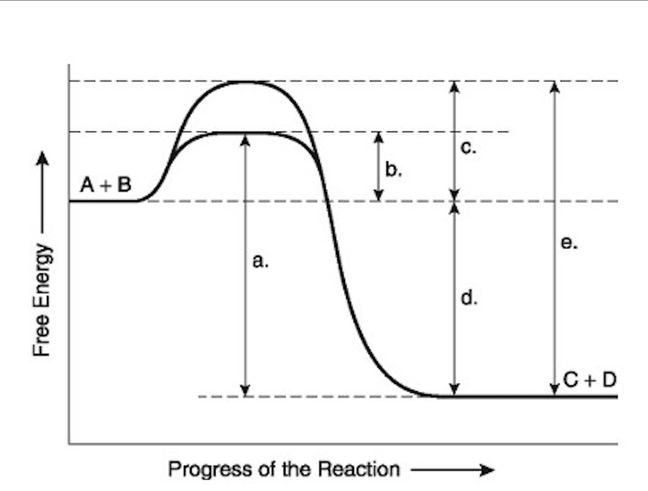
what is this reactions ∆G
-∆G

what represents the forward reaction of A + B —→ C + D
d, because that is the area where the bonds have broken and are beginning to form into the products, which is the definition of forward reaction

Which of the following represents the activation energy for the enzyme catalyzed A + B → C + D
b, it is the lower of the two activation energies (the humps) because enzymes lower activation energy
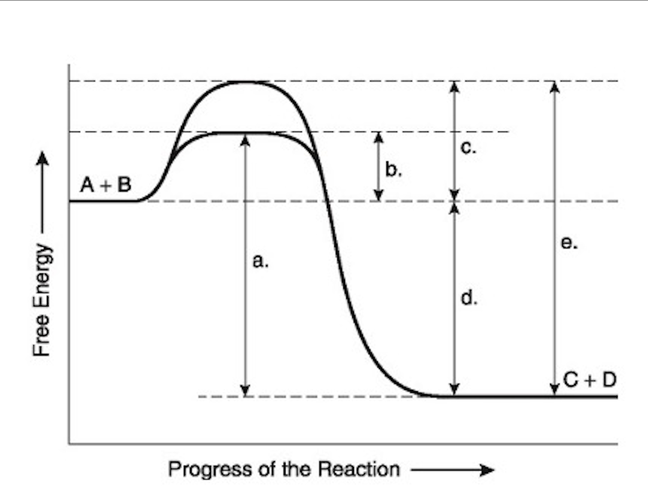
which represents the activation energy needed for a reversed enzyme activated reaction C + D → A + B
a, it is the amount of energy required to get to the lower hump (which represents enzyme activation energy)

difference between free energy of reactants and products (in forward or reversed)
d, the free energy of the reactants does not start at the hump (that is activation energy) it instead starts at the line that bisects the graph.

what represents the activation energy for a noncatalyzed (no enzyme) forward reaction
c, it is the larger of the two humps (more activation energy) because without an enzyme the energy does not decrease
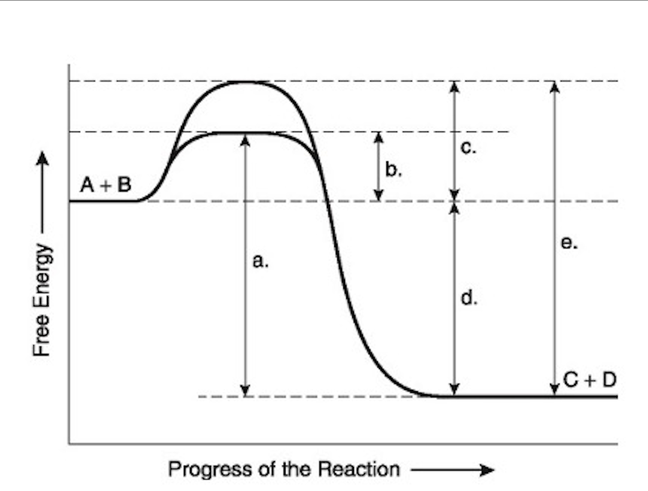
what would be the same in an enzyme catalyzed or a non catalyzed forward reaction
d, this is the measure of the difference in free energy at the beginning and end of the reaction, this does not change. The enzymes that help with activation energy do not change free energy

which represents the activation energy needed for the non catalyzed reverse reaction C + D → A + B
e, in order to get over the larger hump (bigger activation energy) from all the way at the bottom with the products you need a lot of energy
cooperativity is specific too
multi subunit enzymes, and it binds to one of the active sites to lock the rest into active