Psychology Exam 1
 Call Kai
 Learn
Learn Practice Test
 Spaced Repetition
 Match
Match Flashcards
 Knowt Play
1/99

There's no tags or description
Looks like no tags are added yet.
Name | Mastery | Learn | Test | Matching | Spaced | Call with Kai | Chat |
|---|
No analytics yet
Send a link to your students to track their progress
100 Terms
What is psychology? How can psychology be studied from different levels of analysis?
Psychology is the study of the mind, brain, and behavior
You can look at a single question from different viewpoints, theres many different ways to explain the same thing:
Societal level
Behavioral level
Mental level
Physiological level
Neurochemical level
Molecular level
What are some of the current debates in the field?
Nature v. Nurture
Nature: our genetics determine our behavior. Our personality traits and abilities are in our “nature”
Nurture: our environment, upbringing, and life experiences determine our behavior. We are “nurtured” to behave in certain ways
How much free will do you have
How in control of your happiness are you? Or is it something more encoded within us?
What discipline did Psychology come from?
Psychology originated in philosophy
Many philosophers wrote about human development, interpersonal relationships, and other contemporary topics
Wilhelm Wundt established psychology and laboratory science in 1879 by setting up a lab
Defined psychology as a separate science that tests hypotheses and uses the scientific method, whereas philosophers used intellect and intuition to create theories
What are the aims of the different theoretical perspectives that have shaped psychology?
Six primary schools of thought have shaped modern psychology:
Structuralism: aimed to identify the most basic elements or “structures” of psychological experience through introspection
Introspection: reporting on moment-to-moment experiences and thoughts
Functionalism: aimed to understand the adaptive purposes of thought and behavior (why do we do what we do?)
Behaviorism: aimed to uncover how animals learn behaviors through environmental experiences, and why people behave differently under different conditions
Cognitive: aimed to demonstrate how mental processes shape our behavior
Psychoanalysis: aimed to uncover mental processes that may be operating below conscious awareness
Attempts to uncover the role of early life experiences
Humanistic and positive psychology: aimed at understanding how individuals find meaning and meet their full potential
What are some of the current trends in psychology?
Psychology keeps up with whatever the current issues are:
Child mental health, personalized medicine, artificial intelligence, AI neuroscience, digital companions (chatbots)
More relevant to individuals rather than assuming things about you
What type of education do you need to be a psychologist?
Complete an undergraduate major and a PhD in psychology
What are the different types (e.g., clinical) of psychologists?
Clinical psychologists:
Perform assessment, diagnosis, and treatment of mental disorders
Conduct research on people with mental disorders
Counseling psychologists:
Work with people experiencing temporary or relatively common life problems such as career uncertainty, relationship conflict, grief, and loss concerns
School psychologists:
Work with teachers, parents, and children to remedy students’ behavioral, emotional, and learning difficulties
Forensic Psychologists:
Work in prisons, jails, and other settings to assess and diagnose inmates and assist with their rehabilitation and treatments
Conduct research on eyewitness testimony or jury decision-making
Industrial-Organizational Psychologists:
Work in companies and businesses to help select productive employees, evaluate performance, and examine the effects of different work settings
Design equipment and work spaces to maximize employee performance
What are the characteristics of the scientific method?
Empiricism: objective observations of the world
Replication: demonstrating and observing a phenomenon more than once
Publication: making observations available to everyone so that others can evaluate the claims
How do psychologists consider and approach claims about behavior?
They are skeptical: they examine the evidence behind claims
They are open-minded: they are willing to consider new ideas, but they will not accept those ideas unless the evidence supports them
They understand that they can be fooled and they design research that protects against it
What are ways that psychologists get fooled into believing what is NOT true?
Repetition of false information
Desire for easy answers and quick fixes
Selective perception and memory
Inferring causation from correlation
Exaggeration of a truth
What are the goals of the scientific study of behavior?
Describe behavior
Ex: 5% of preschoolers exhibit aggressive behavior
Predict behavior
Preschoolers who watch more violent TV shows exhibit more aggressive behavior
Identify causes of behavior
Control and change behavior
Explain behavior
What is observational, experimental, and correlational research?
To achieve description and prediction:
Observational research: objectively observe and record behavior
Correlational research: measure two variables and determine if a relationship exists between them
To achieve identifying causes of behavior and explaining behavior:
Experimental research: control or manipulate one variable (independent variable), determine if changing the IV causes changes in the other/DV
What is a scientific theory? What is a hypothesis? How does support for hypotheses affect our use of theories?
Scientific theory: a systematic body of ideas that organizes what is known about a topic from past observations and makes predictions about future observations
Theories are used to generate hypotheses: a prediction about the outcome of our research
If our hypothesis is supported, we have evidence of the correctness of the theory
What is peer review?
Research manuscripts are evaluated by other knowledgeable researchers in the field
Reviewers provide feedback, revisions are made
Ensures only high-quality research is published
What are variables?
A quality or characteristic that can take on different values for different observations
What is the difference between a manipulated and measured variable?
Manipulated: can control and manipulate in an experiment
Measured: have a particular value
What are operational definitions?
Psychologists use operational definitions of variables that define variables in terms of the operations performed to measure them, as many psychological variables are often abstract and cannot be observed directly
This makes measurements clear to others so that they understand what was done
What is a sample? What is a population?
Sample: small group measured
Population: large group of interest
What is a biased sample?
A sample that is not like the population because of the way the sample was formed
The results for the sample are different than what is expected from the population
What is random sampling? What is biased sampling?
Random sampling: all members of the population have an equal chance of being selected for the sample
Likely to be similar to the population, but not guaranteed
Biased sampling: a sample collected in a way that some members of the intended group have a lower or higher chance of being chosen than others
How are naturalistic observational studies performed?
Researcher makes observations of people/animals in their normal environments without intervening in the situation
Might conceal themselves or remain visible
What is the purpose of a coding scheme? How is a coding scheme created and used?
A way to categorize and quantify behaviors
Operationally define behaviors of interest
Count the number of times those behaviors were observed
Example:
Aggressive behavior = behavior intended to harm another person, behavior intended to damage objects, etc
Non-aggressive behavior = behavior that is helpful/cooperative
Then count how many times the subject engages in a particular behavior
What is the case study approach?
Sometimes, individuals will have rare or unusual conditions
A sample of individuals with that condition might not be available
Case study: detailed observation of a single individual
Provides a description of the condition and its development
Case studies are of limited usefulness because of the lack of comparative information (what would have happened if the conditions were any different?)
Can help provide direction for future research
How can we use correlational research to predict behavior?
Correlational research: identifies relationships between variables and can allow you to predict the value of one variable when you know the value of the other
A computational procedure: measure 2 variables and compute a correlation
What are correlation coefficients?
Results of correlational research
Tells you how strongly two variables are related and the form of that relationship
“Pearson product-moment correlation coefficient”
Quantifies the degree of linear relationship between 2 variables, symbolized by r
Between -1 and 1
Linear relationship
How can we interpret the strength and direction of a correlation?
The closer to -1 or 1, the stronger and more linear the relationship is
The closer to 0, the less likely there is a linear relationship
What is meant by “correlation is not causation”?
If two variables (A and B) are correlated:
Changes in A may cause changes in B
Changes in B may cause changes in A
Changes in some third variable C may cause changes in A and B
A and B may be related by coincidence
Spurious correlation: when two variables are connected, but just by coincidence
What does experimental research allow researchers to do?
It is when one variable is manipulated to measure another
Experimental research allows a researcher to identify causal relationships between variables
What are the differences between experimental and correlational research?
Correlational research utilizes two measured variables, while experimental research manipulates one variable to measure another
What is an independent variable? What is a dependent variable?
IV: the manipulated variable
DV: the measured variable (response variable)
What is “random assignment”?
Creating groups that are statistically equivalent (on average) by randomly assigning people to different groups
You can create two equivalent groups by randomly assigning people to one group or the other
How is random assignment different from random sampling?
Random assignment assigns people to a random group to create equivalent groups
Random sampling chooses a sample from a population so that the sample is similar to the population
What is a confound?
Any factor that covaries perfectly with the IV
Provide alternative explanations for differences in the DV
In psychological measurement, what is reliability? What is validity?
Reliability: When we make a specific measurement, do we get the same answer every time?
Validity: Are we really measuring what we think we’re measuring? (also called construct validity)
Why do we need statistics in behavioral research?
Different people behave differently in identical situations, there is variability in the world
Allows you to figure out if the difference between groups is due to chance or a real difference representing an effect of the IV
What is a p-value?
Probability that you would obtain the difference that you obtained just by chance (if the IV really had no effect
Small p-values (usually <0.05) conclude that the difference is a real effect of the IV
What is meant by statistical significance?
The difference between groups is so large that it was likely not due to chance, but due to differences in the IV
What are the core ethical principles of research with humans?
Beneficence: maximize the benefits to society while minimizing harm to research participants
Autonomy: allow research participants to give concent to participate in research. Don’t force or coerce people to participate
Justice: don’t conduct research on a small segment of the population (one type of person). Ensure that the people bearing the burden of participating are representative of those who can benefit from the research.
What are measures of central tendency?
Single numbers that describe a data set by finding its typical or middle value: mean, median, and mode
What are descriptive statistics?
Brief informational numbers or graphs that summarize the main features of a specific data set
Mean, median, mode (central tendency)
Variability measurements
What are inferential statistics?
A branch of statistics that uses information from a small sample to make predictions, test ideas, or draw conclusions about a larger population
Who was Phineas Gage and what does his story suggest about the brain?
A rail-road worker in the 1800s who experienced an injury
A metal rod went through his head, and he survived
His memories and abilities were still intact, but many aspects of his personality changed
Suggested that certain areas of the brain control distinct aspects of human behavior and mental processing
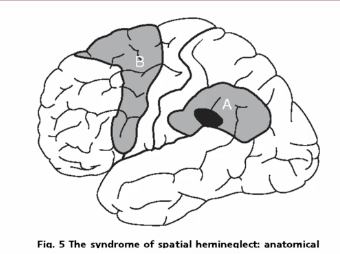
What is “Hemispatial neglect”?
Caused by damage (usually a stroke) in the brain’s cerebral cortex on one side
In the parietal lobe, close to the temporal lobe (gray region marked ‘A’ and especially the black spot within it
Patient is unaware of the left half of the world and usually doesn’t realize that they’re unaware
Who was H.M. and what does his story suggest about the brain?
Had severe epilepsy
Underwent surgery to remove temporal lobes, which had unusual electrical activity
No longer had seizures following the procedure, but was no longer able to form memories (hippocampus)
Gave another clue as to how the brain is organized, but also served as a warning that damaging or removing parts of the brain can have detrimental effects
What is the Central Nervous System?
The brain and the spinal cord
What is the Peripheral Nervous System?
Nerves connecting the CNS to the rest of the body
What is the somatic nervous system?
Controls voluntary muscle movement (PNS)
Responsible for:
Communicating information about our environment via sensory fibers
Up to the CNS which makes an assessment of our environment, and communicates a set of →
Actions (both voluntary and involuntary) which are executed via motor fibers
Our actions, in turn, expose us to new information and the cycle continues
What is the autonomic nervous system?
Controls involuntary movement (such as heartbeat, pupils, hormones) (PNS)
What are the sympathetic and parasympathetic branches of the autonomic nervous system?
Sympathetic nervous system
Fight or flight
Increase function of systems needed to do the thing right now
Decrease function of systems that can wait for better times
Parasympathetic nervous system
Rest and digest
Relaxed
What are the key components of the endocrine system?

How do your endrocrine glands operate when you are stressed?
Brain, including the hypothalamus, detects a stressor that →
Hypothalamus directs pituitary to release a hormone into the bloodstream that increases the function of adrenal glands
Adrenal glands release more cortisol into the bloodstream
Cortisol changes the way multiple systems work, such as the release of glucose from the liver to power muscles, and changes brain function (memory, attention)
Brain eventually detects elevated cortisol, tells hypothalamus to stop, and the feedback loops slows things down again to baseline
How does the brain vary across species?
The central nervous system follows the same plan across a wide variety of animal species
Differences in size and wrinkles mostly have to do with differences in the amount of cortex
Mammalian brain structure and organization is highly similar across species
What are the names the lobes of the brain?
Frontal
Parietal
Temporal
Insular
Occipital
What are the main functions of each of the lobes?
Frontal: complex thought, planning, control of movement, map of the body’s muscles
Plans and executes our intentions
Parietal: touch, spatial awareness, map of the body’s skin surface
Helps us understand where our body is and what it is touching and seeing
Temporal: hearing, object memory
Necessary for auditory processing, knowing what things are, and emotional memory
Insular: taste, awareness of internal organs
Occipital: vision
Turns information about light into lines, borders, surfaces
What area of the brain may have contributed to HM’s difficulties?
Temporal lobe, specifically the hippocampus and amygdala
What is aphasia?
A language disorder caused by damage to the parts of the brain that control how you speak, understand, read, and write
What are Wernicke’s aphasia symptoms?
Damage in temporal lobe, cant understand but can speak
Saying many words that don’t make sense
Unable to understand the meaning of words
Able to speak well in long sentences, but they don’t make sense
Using the wrong words or nonsense words
Unable to understand written words
Trouble writing
Frustration
What area of the brain is disrupted in hemispatial neglect?
Parietal lobe
What is the somatotopic map in the “somatosensory cortex”?
An organized, point-for-point representation of the body's surface mapped across the brain tissue:
Heavily distorted: the more area is devoted to a body part, the more sensitive it is to touch
In parietal lobe
What is proprioception?
Sense of where/how our body is moving, helps with:
Knowing where our body parts are
Understanding how much force to use
Coordination between body parts and senses
How does the frontal lobe execute our intentions?
The motor cortex in the frontal lobe is right next to the somatosensory cortex in the parietal lobe
The somatosensory cortex processes sensory signals and executes body movements
These can communicate very quickly
What is Broca’s aphasia?
Damage in the frontal lobe, can’t speak but can understand
Difficulty forming complete sentences
Leaving out words like “is” or “the”
Saying something that doesn’t resemble a sentence
Trouble understanding sentences
Making mistakes in following directions like “left, right, under, and after”
Using a word that’s close to what you intend, but is not the exact word
What are the functions that the prefrontal cortex regulates?
Executive functions, which are high-level mental skills used to plan, focus attention, regulate emotions, and make decisions
How is the insula different from the other lobes? What are the functions?
The insula is a distinct, hidden fifth lobe of the cerebral cortex tucked deep within the lateral sulcus (Sylvian fissure), unlike the other outer lobes that are fully exposed on the surface of the brain
Maps internal body sensations, helps generate emotional feelings, and plays a major role in self-awareness
How are the subcortical regions different from the cortex? What is the limbic system?
The subcortical regions lie deep inside the brain, sitting beneath the cerebral cortex
Support memory, emotions, motivation, etc
The major subcortical forebrain structures are often called the limbic system (regulating emotion, memory, and basic survival drives)
What type of memories is the hippocampus essential in forming?
Represents and distinguishes different times and places
Essential for forming memories about “what happened to us, when, and where”
Also called episodic memories
What is the amygdala? What is the impact of losing amygdala function?
Processes: What emotional content did this experience have?
Lack of function can be seen as a “lack of fear,” but it can diminish the ability of both strong good and bad things to affect our decisions and memories
What brain regions are important for motivation and habit formation?
The limbic system, specifically basal ganglia
Motivation: nucleus accumbens
Habits: caudate and putamen
What do the thalamus and hypothalamus do?
Thalamus: a relay between cortical and subcortical regions (but a very complex one)
Hypothalamus: communicates information and from endocrine/hormone systems (stress, feeding, reproduction)
Homeostasis
Which areas of the brain produce a lot of dopamine? What does dopamine do?
Midbrain: contains several clusters of cells that release neurotransmitters all over the brain
Dopamine teaches us about how to get more of things we like (by increasing motivation and action initiation)
Not the same as the experience of pleasure
What regions of the brain are part of the hindbrain?
Pons, medulla oblongata: automate fundamental behaviors for life
Cerebellum: fine motor coordination

What are the parts of a neuron?
Dendrites: receive input (chemical and electrical) from other neurons; enough input will make the cell “fire”
Cell body: integrates information from dendrites; contains DNA and protein machinery to make receptors, grow, etc
Axon: when the cell fires, transmits electricity down to all cells it communicates with (faster when myelin is wrapped around)
Terminals: release neurotransmitters (chemical messengers) when electrical activity reaches them)

What is myelin?
From glia, “white matter” is made of fat, insulate the nerve fibers
Speeds up the transmission of signals between neurons
What is glia?
Non-neuronal cells in the central and peripheral nervous systems that support, nourish, and protect neurons
The myelin sheet is not a glial cell itself, but is produced and wrapped around nerve axons by glial cells
How do neurons send messages to other neurons?
Neurons tend to be organized; for example, in the cerebral cortex they are in layers
Different layers get different mixes of inputs from different regions and send them to different outputs; with organization, complexity is possible pretty quickly
The dendrites and cell bodies are located within a brain region, but the axons and terminals can go all over

How do neurons generate action potentials?
Neurons maintain a negative voltage state
A stimulus raises the membrane potential
When sufficient stimulation occurs, positive ions enter the cell and depolarize the cell to a positive voltage
Then repolarizes to the resting state
This process triggers the neighboring axon to depolarize and travel
An action potential travels down an axon to cause the release of neurotransmitters
What is the synapse?
The space between an axon terminal and the receiving neuron
What happens when neurotransmitters leave the synapse?
An action potential travels down an axon to cause the release of neurotransmitters from the terminals
Neurotransmitters cross the synapse to activate receptors, which let in positive ions that change the charge of the neuron from - to +
What’s the difference between an agonist and antagonist?
Agonist: an external chemical that mimics the endogenous neurotransmitter
Antagonist: an external chemical that prevents the receptor from being activated by blocking activity of endogenous neurotransmitters
What are endogenous opioids?
Released in small doses, linked to the experience of pleasure and pain relief (made in body)
What do sensory neurons do? Motor neurons? Interneurons?
Sensory neuronsdetect environmental stimuli and transmit that information to the central nervous system
Motor neurons carry commands from the central nervous system to muscles and glands to trigger action
Interneurons connect sensory and motor neurons within the brain and spinal cord to process and integrate the signals
What are the three primary portions of the brain visible in early development in the womb?
The three primary portions of the brain visible in early development (during the fourth to fifth week of pregnancy) arethe forebrain, the midbrain, and thehindbrain
How does the size of the cortex vary across species?
As total brain size increases, the cerebral cortex disproportionately enlarges and takes up a greater fraction of the total brain volume
What is the difference between an excitatory and an inhibitory signal?
Excitatory: Messages that increase the chance that a neuron will fire an action potential
Inhibitory: Messages that decrease the chance a neuron will fire an action potential
What is neural plasticity? What is phantom limb syndrome?
Neural plasticity is the nervous system's ability to change, reorganize, and form new connections in response to new experiences, learning, or injury
Phantom limb syndrome is a condition where a person continues to feel sensations or pain in a limb that has been amputated or is no longer physically present.
What are our five main senses?
Vision
Hearing
Touch
Smell
Taste
Why is the study of sensation and perception part of psychology? In what ways do the study of sensation and perception contribute to the study of behavior?
Sensation and perception are processes of identifying objects and events in the world so that we can move through our environment and take action
This overlaps with biology, consciousness, and cognitive psychology
Studying it:
Helps us understand behavior and mental activity, which depend on our ability to gather information about the world
How our sensory systems should work and how to fix problems when they don’t
Design better and more effective ways of presenting information to people
What is sensation?
Occurs in an organism when physical energy produces a change in a specialized element of the nervous system called “receptors”
“I see a spot of light”
What is perception?
The result of psychological processes in which sensations are interpreted and organized to give meaning to the objects or events that produced the sensations
“I see the moon”
What is transduction?
Converting physical stimulus to neural signals that the brain can interpret
What are the different ways to measure perception?
Phenomenological methods: present a stimulus, ask the person to describe it
Less useful for complex stimuli; not very precise and doesn’t work for animals
Psychophysics: the study of the relationship between physical stimuli and the resulting psychological experiences
Objective measurement (quantification) of the stimulus AND the response
What is the field of psychophysics?
The study of the relationship between physical stimuli and the resulting psychological experiences
What is the difference between detection and discrimination?
Detection: what is the “weakest” stimulus we can detect
Discrimination: what is the smallest difference between stimuli that we can discriminate
Answered by psychophysics
What is an absolute threshold?
The lowest level of physical energy or sensory input—such as light, sound, or touch—that a person can detect at least 50% of the time

What is an action potential?
Brief electrical signal carried by a neuron
When do neurons fire action potentials?
When incoming signals cause the internal voltage to rise and cross a specific limit called the threshold
What does it mean to say that an action potential is an "all-or-none" event?
Action potentials in a neuron are always the same “size” (same change in electrical potential), either happens or it doesnt
When measuring the absolute threshold in a detection task, what introduces uncertainty to our decision as to whether or not a signal is present?
Noise
External: environmental sounds, etc
Neural/internal:
Neurons fire action potentials when stimulated; therefore, neurons encode different intensities by changing their firing rate
Spontaneous activity (noise in the neural potential): neurons fire action potentials in the absence of stimulation
What do the terms hit, miss, false alarm, and correct rejection refer to in Signal Detection Theory?
Signal detection theory: a way to measure sensitivity and bias

What is Weber’s Law as it applies to discrimination?
The just noticeable difference (JND) in the intensity of a stimulus is proportional to the intensity of the standard stimulus
More change needed to notice a difference when starting stimulus intensity is high
