Exam 2 Multiple Choice practice
 Call Kai
 Learn
 Practice Test
 Spaced Repetition
 Match
 Flashcards
 Knowt Play
1/17

There's no tags or description
Looks like no tags are added yet.
18 Terms
Consider the total free energy change for nucleation for the case of a cubic nucleus of edge length a (instead of a sphere of radius r). Is the nucleation barrier for a cubic nucleus larger or smaller than that for a spherical nucleus?
Larger
A sphere has the smallest surface area for a given volume. Acube has a larger surface-area-to-volume ratio. Therefore, a cubic nucleus has a larger nucleation energu barrier than a spherical nucleus. (Spheres are the most energy-efficient shape for nucleation because they minimize surface area)
Once a system is at a state of equilibirum, a shift from equilibrium may result by alteration of which of the following?
pressure
temperature
composition
all of the above
All of the above
A system at equilibrium can be shifted by changing
Pressure: changes equilibirum condictions, especially for systems involving gases or volume changes
Temperature: Changes the equilibrium constant and can favor one phase over another
Composition: changing concentration of components shifts the equilibrium
Which type of the following alloying elements is most effective in strengthening of allows?
intersitial atoms
substitutional atoms
impurities with similar atomic radius
impurities with a similar electronegativity
Interstitial atoms
The fit into spaces between the larger host atoms in a crystal lattice, causing significan lattice distortion, making it more difficult for dislocations to move.
The following materials are examples of matastable phases EXCEPT:
diamond
glass
martensite
quartz
Quartz
A matestable phase is a phase that is not the most thermodynamically stable state but can exist for along time because transforming requires overcoming an energy barrier.
Diamond: Metastable form of carbon. Graphite is more stable at ordinary conditions.
Glass: Metastable, amorphous material.
Martensite: Metastable phase formed during rapid cooling of steel.
Quartz: A stable crystalline form of silicon dioxide under ordinary conditions.
what is the driving force for the nucleation of a solid phase from a liquid state?
Undercooling
Undercooling occurs when a liquid is cooled below its equilibrium freezing temperature without immediately solidifying. This creates a thermodynamic driving force for solidification. The greater the undercooling, the greater the difference in free energy between the liquid and solid phases.
Based upon the Avrami rate euqtaion, at what stage is the growth rate the fastest?
When 50% of the transformation is complete
The Avrami equation describes how the fraction of a material transformed changes over time: X = 1 - exp(-ktn)
Major elements of fracture mechanics are the following parameters EXCEPT:
sample size
crack length
resistance to cracking
applied stress
Sample size
The three important parameters in fracture mechanics are:
Crack length: Larger cracks generally increase the likelihood of fracture.
Applied stress: Higher applied stress increases the likelihood of crack propagation.
Resistance to cracking: Describes how well a material resists crack growth.
Hot working takes place at a temperature above a metal’s:
Recrystallization temperature
At this temperature, new strain-free grains form while the material is being deformed. This allows the metal to undergo significant deformation without accumulating as much work hardening.
The following statements about binary phase diagrams are true EXCEPT:
peritectic phase diagram is formed when melting temperatures are widely different
lowest melting temperature of an alloy can be obtained at a eutectic composition
eutectoid reaction is a congruent transformation
melting temperature increases when intermediate phase is formed
eutectoid reaction is NOT a congruent transformation
in steel, a eutectic reaction is γ → α + Fe3C

The figure depicts a brittle material featuring four eliptical flaws, each featuring the same radius of curvature at their tips. Based on the loading type and the loading axis illustrated, which flaw is most likely to propogate first?
A
The material is being pulled vertically, so the tensile stress acts in the vertical direction. A crack is most likely to propagate when its long axis is perpendicular to the applied tensile stress.
A: Long horizontal flaw, perpendicular to the loading direction.
B: Short horizontal flaw, also perpendicular to the loading direction.
C and D: Vertical flaws, generally parallel to the loading direction.
A is the most dangerous because it is the longest flaw oriented perpendicular to the applied stress.

The pressure-temperature phase diagram for H2O is shown. What is the number of degrees of freedom at point C?
0
F = C - P + 2
H2O is a pure substance so C = 1
At point C there are three phases, so P = 3

The microstructure shown in the image is obtained from a 1.4 wt% C steel. What is the name of a phase indicated by the arrow A?
Pearlite
A steel containing 1.4 wt.% carbon is hypereutectoid steel because its carbon content is greater than the eutectoid composition. The microstructure contains:
Pearlite: Alternating layers of ferrite and cementite.
Proeutectoid cementite: Cementite that forms before the eutectoid reaction.
Arrow A points toward the dark, layered structure, which is pearlite.

The microstructure shown in the image is obtained from a 1.4 wt% C steel. What is the name of a phase indicated by the arrow B?
Cementite
Arrow B points toward the lighter region between the pearlite colonies.
In hypereutectoid steel, proeutectoid cementite forms along prior austenite grain boundaries.
what is KIC?
Fracture toughness under plane strain condition
It measures the material's resistance to crack propagation under plane-strain conditions.
The subscript I refers to Mode I loading, which is opening-mode crack loading.
The C indicates that the value is measured under critical conditions.
For a given crystal structure, the slip plane is defined as the plane having:
The most dense atomic packing
Slip occurs when atomic planes slide past one another during plastic deformation.
Slip generally occurs along planes with the highest atomic packing density because these planes allow atoms to move past one another more easily.
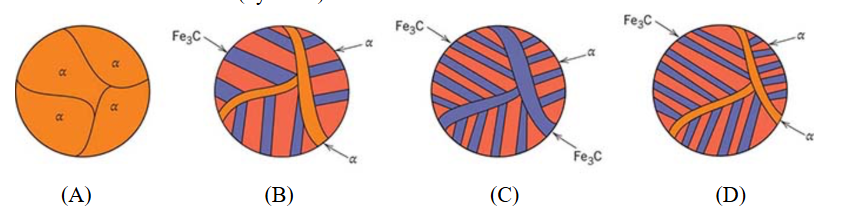
Schematic room-temperature microstructures for four iron-carbon alloys are as follows. Rank these microstructures from the hardest to softest
C > D > B > A
The four structures contain different amounts and arrangements of ferrite and cementite.
A: Mostly ferrite. Ferrite is soft and ductile, making this the softest structure.
B: Hypoeutectoid steel. Contains proeutectoid ferrite and pearlite.
D: Eutectoid steel. Contains mostly pearlite, which is harder than ferrite.
C: Hypereutectoid steel. Contains pearlite and proeutectoid cementite. Cementite is very hard, making this the hardest structure.
The general trend is that increasing carbon content increases the amount of hard cementite and pearlite, increasing hardness.
A peritectic reation involves which of the following combinations of phase fields:
one liquid one solid
one liquid and two solids
two liquids and one solid
three solids
One liquid and two solids
A peritectic reaction involves one liquid phase and one solid phase reacting to produce a different solid phase.
L + α → β
At a eutectic point on a binary temperature-composition phase diagram, how many phases may be present when the system is at equilibrium?
3
Liquid, alpha solid, beta solid
L → α + β