human nutrition
 Call Kai
 Learn
 Practice Test
 Spaced Repetition
 Match
 Flashcards
 Knowt Play
1/37

There's no tags or description
Looks like no tags are added yet.
38 Terms
what is a balanced diet?
a diet that contains all the nutrients needed by the body in the correct proportions to maintain health
what are the components of a balanced diet?
carbohydrates, proteins, lipids, vitamins, minerals, water and dietary fibre
what are the sources and functions of carbohydrates?
bread, pasta, rice, potatoes, sugar
provides glucose, which is used in cellular respiration to release energy
what are the sources and functions of protein?
meat, fish, eggs, pulses, cheese
required for growth and repair of tissues
what are the sources and functions of lipids?
butter, oil, nuts, cheese
long term store of energy; insulation - reduces heat loss through the surface of the body; protects organs from mechanical damage
what are the sources and functions of vitamin A?
liver, orange fruit and veg: carrots, butternut squash, sweet potatoes, mangoes, apricots
required to make pigments found in retina cells in the eye; also protects surface of the eye
deficiency can cause night blindness
what are the sources and functions of vitamin C?
oranges, lemons, grapefruits, peppers, spinach
needed for making collagen, which helps maintain healthy connective tissue
deficiency can cause scurvy
what are the sources and functions of vitamin D?
oily fish, eggs, fortified foods such as milk and cereal products
helps with the absorption of calcium and so required for healthy bones and teeth
deficiency can cause rickets in children, and poor teeth
what are the sources and functions of calcium?
milk, cheese, yoghurt
needed for bone and teeth strength
deficiency can cause rickets in children
what are the sources and functions of iron?
red meat e.g. liver; spinach, kale
required for the production of haemoglobin and therefore the efficient transfer of oxygen
deficiency can cause anemia
what are the sources and functions of water?
drinking water, cucumber, tomatoes, oranges, melon
needed for cell reactions to take place; helps regulate body temperature through sweating
what are the sources and functions of dietary fibre?
spinach, cabbage, oats, barley
non digestible so provides bulk against which muscles of the digestive system can contract. Aids peristalsis.
deficiency can cause constipation
how does age affect energy requirements?
children and teenagers need more energy for growth
older adults may need less energy as growth has stopped and activity levels or muscle mass may be lower
how do activity levels affect energy requirements?
more active people need more energy as their muscles contract more frequently, so they require more energy for movement
how does pregnancy affect activity levels?
energy requirements will increase in order to support the growth of the fetus
energy needs also increase due to the extra mass of the baby
what is the alimentary canal?
the alimentary canal is a continuous passage running from the mouth to the anus through which food travels
what is the function of the alimentary canal?
its function is to ingest food, digest food into small, soluble molecules, absorb digested nutrients into the blood, and egest undigested material from the body
what is the function of the mouth?
mechanical digestion: teeth break up large food pieces into smaller pieces to increase the surface area to volume ratio (food bolus)
salivary glands produce saliva to lubricate the food bolus so it can be swallowed easily
salivary glands produce saliva, which contains amylase, which breaks down starch into glucose
what is the function of the oesophagus?
it is a muscular tube connecting the mouth to the stomach
it transports food bolus down the oesophagus and into the stomach through peristalsis
what is the function of the stomach?
releases gastric juice from the stomach lining when it detects food in the stomach
gastric juice is made up of pepsin, which breaks down proteins, and hydrochloric acid, which makes stomach acidic in order for pepsin to work and to kill any ingested bacteria
its muscular walls perform peristaltic contractions that churn food, making it into smaller particles and forming a semi liquid mixture called chyme
what is the function of the duodenum?
the duodenum is the first part of the small intestine
it receives chyme from the stomach and mixes it with bile
carbohydrases, proteases and lipases digest food in the duodenum
peristalsis occurs here to push the chyme forward to continue the digestive process
what is the function of the ileum?
the ileum is the part of the small intestine where most absorption of digested nutrients take place
it absorbs glucose and amino acids into the blood capillaries
fatty acids enter the intestinal lining before reaching the blood
it absorbs digested soluble molecules into the blood
it is lined with villi to maximise absorption
what is the function of the colon?
it absorbs excess water and some mineral ions from the remaining gut contents
what is the function of the rectum?
the last part of the large intestine
it stores faeces temporarily before they are removed from the body through the anus during egestion
what is the function of the pancreas?
produces protease, amylase and lipase enzymes and secretes these into the small intestine
diagram of the digestive system

how is food moved through the gut?
Peristalsis - the wave-like contractions created by circular muscles and longitudinal muscles that squeeze food through the alimentary canal
what are digestive enzymes?
biological catalysts that speed up the chemical breakdown of large, insoluble food molecules into smaller, soluble molecules that can be absorbed
how are carbohydrates (starch) broken down?
broken down by carbohydrases (amylase and maltase)
starch → maltose by amylase
maltose → glucose by maltase
how are proteins broken down?
broken down by proteases in the stomach and small intestine
proteins → amino acids
how are lipids broken down?
broken down by lipases
lipids → glycerol + fatty acids
where is bile produced and stored?
the liver produces bile
the gallbladder stores bile
the duodenum receives bile from the gallbladder
what are the functions of bile?
neutralises stomach acid - food leaving the stomach is acidic as it contains hydrochloric acid. bile is alkaline, so it neutralises the stomach acid and helps create the optimum pH for enzymes in the small intestine
emulsifies large drops of fat. This increases the surface area which allows lipase to chemically break down the lipid into glycerol and fatty acids faster
what is absorption?
the movement of the products of digestion through the wall of the small intestine into the blood or lymph
how is the small intestine adapted for absorption?
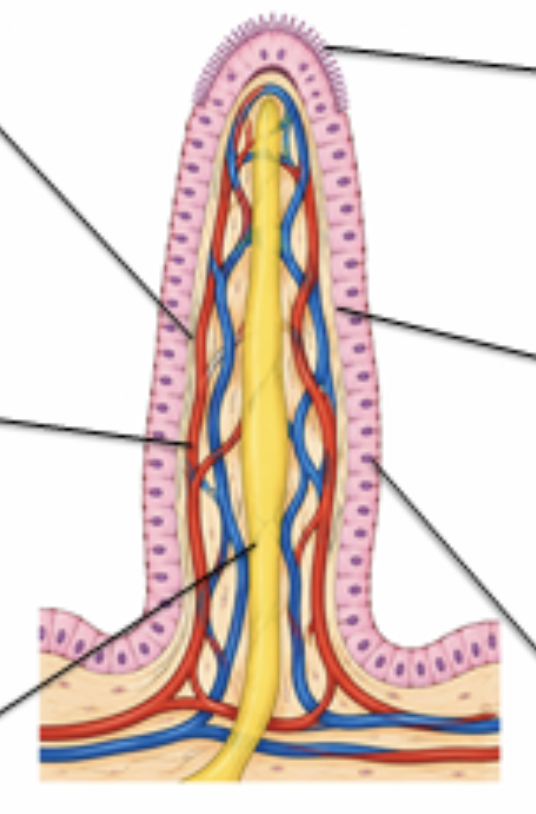
It is lined with villi
villi have many adaptions to increase the rate of absorption:
they have microvilli, which increases the surface area and therefore increases the diffusion of digested soluble molecules into the blood
it has a thin epithelial layer, which reduces the distance molecules have to travel and therefore increases the absorption of all products of digestion
it has mitochondria rich epithelial cells, which provide ATP for the active transport of glucose and amino acids
it has a continuous blood flow, so glucose and amino acids can be transported away from the small intestine
it has a dense capillary network, so glucose and amino acids can pass into the blood for transport around the body
It has a lacteal, so glycerol and fatty acids can pass into the lymph for transport around the body
diagram of a villus
required practical - investigate the energy content of food
1) measure 20cm3 of water into a boiling tube
2) record the initial temperature of the water using a thermometer
3) record the initial mass of the food sample using a scale
4) secure the food on a mounted needle
5) ignite the food with a Bunsen burner and position it beneath the boiling tube at a fixed distance to heat the water
6) record the final temperature once the food stops burning
formula: energy transferred (J) = temperature increase (degrees C) x mass of water (g) x specific heat capacity of water (4.2)

experiment inaccuracies
Heat lost to the surroundings - Not all the energy heats the water - use insulation
Incomplete combustion - Some of the food's chemical energy is not released - Ensure the food burns as completely as possible
Food sample burns inconsistently - Results may not be comparable - Keep the distance between the food and container constant