Chapter 7: Energy and Metabolism
 Call Kai
 Learn
 Practice Test
 Spaced Repetition
 Match
 Flashcards
 Knowt Play
1/53

Earn XP
Description and Tags
EENG304, LIU
54 Terms
What do growing cells use energy for? Nongrowing cells?
Growing cells: to grow and reproduce.
Nongrowing cells: to maintain themselves.
What is the ultimate source of almost all energy that powers life?
The sun ☀. Plants and other photosynthetic organisms
capture 0.02% of its energy that reaches earth.
What is energy? how is it expressed?
Is the capacity to do work
Expressed in kilojoules (kj) or heat energy.
Unit of heat energy = 4.184 kJ
Can heat energy do cell work?
No, since cells are too small to have regions that differ in temperature
How does thermal energy flow?
higher temperature to lower temperature.
What energy conversions do organisms carry out? Define each.
Between potential energy and kinetic energy.
Potential energy: stored (position) energy.
Kinetic energy: energy of motion
Is mass a form of energy?
Yup
Are all forms of energy interconvertible?
Yup
What does photosynthesis convert?
Radiant energy to chemical energy.
What is thermodynamics?
The study of energy and its transformation, governs all activities of the universe.
In thermodynamics, what does the term “system” refer to?
The object scientists are studying.
What are the 2 types of systems?
Closed system: no energy exchange with surroundings.
Open systems: exchange energy with surroundings (ex. organisms).
What is the first law of thermodynamics?
Energy cannot be created or destroyed but can be transferred and changed in form. This law is a version if law of conservation of energy.
How do organisms interact with energy according to the first law?
Organisms capture energy from their surroundings.
What is the second law of thermodynamics?
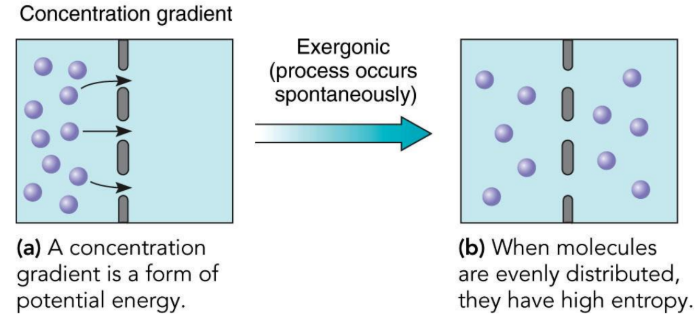
The total entropy (disorder, S) of an isolated system (the universe) always increases over time.
What happens when energy is converted from one form to another?
Some usable energy is converted into heat, hence it is not 100% efficient. Dissipated heat contribute to entropy, through random motion.
What happens to free energy as entropy increases?
Free energy decreases. G = H -TS
G (free energy)
H (enthalpy, potential (total) energy of system)
T (absolute temperature in Kelvin units)
S (entropy)
Equation for chemical reactions
ΔG = ΔH - TΔS
ΔG: Change in free energy
ΔH: change in enthalpy
ΔS: change in entropy
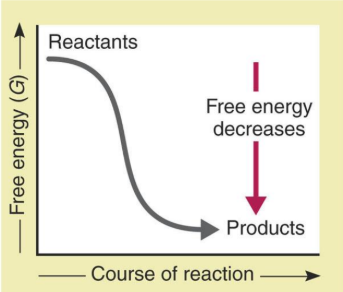
Exergonic Reactions
ΔG is negative (G decreases), are spontaneous (release free energy that can perform work)
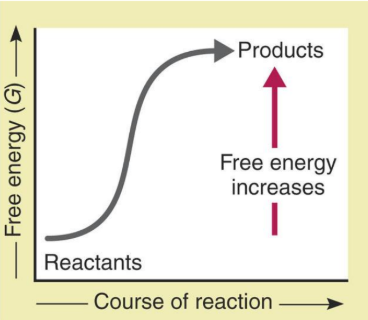
Endergonic Reactions
ΔG is positive (G increases), are not spontaneous
Coupled Reaction
Input of free energy required to drive an
endergonic reaction is supplied by an exergonic
reaction
Dynamic Equilibrium
in a chemical rxn, rate of change is exactly the same in both
directions, no work is done (difference of G between reactants and products=0 )
Shifting Equilibrium
• Increase reactant concentration
-reaction shifts to the right
-more product molecules are formed
-equilibrium is re-established
What is ATP and what does it do?
Adenosine triphosphate
role: Immediate energy currency of cells , donates energy of 3rd phosphate group.
How is ATP formed?
by phosphorylation of adenosine diphosphate (ADP) (endergonic process)
Catabolism
Degradation of large complex molecules into smaller, simpler molecules; exergonic.
Anabolism
Synthesis of complex molecules from simpler molecules; endergonic.
How does ATP link exergonic and endergonic rxns?
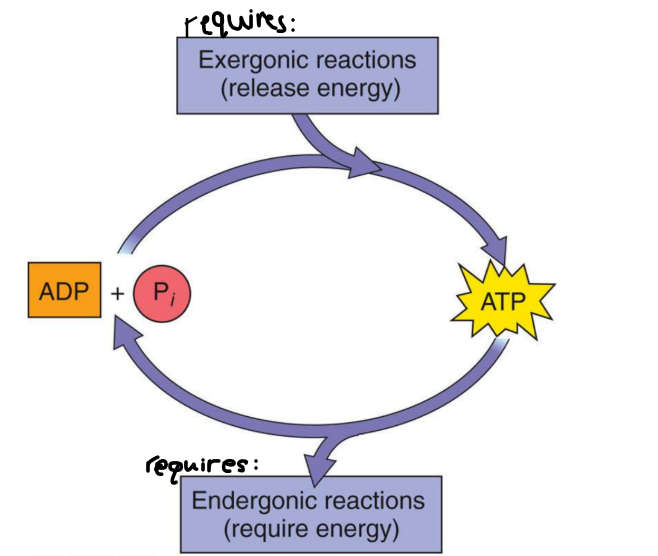
What are redox rxns?
Reactions that transfer energy.
When is a substance oxidized? reduced?
Oxidized: When it gives up one or more electrons to another substance.
Reduced: When it receives one or more electrons from another substance.
What are the electron carriers and their role?
NAD+ (Nicotinamide adenine dinucleotide) and NADP+
• accept electrons as part of hydrogen atoms and reduce to form NADH and NADPH.
What do reduced electron carriers (NADH and NADPH) do?
NADH and NADPH transfer electrons and energy to other acceptors.
What is an enzyme and what does it do?
A biological catalyst that increases the speed of a chemical reaction without being consumed.
The enzyme that converts cAMP into AMP is…
phosphordiesterase
Some enzymes consist only of a protein.Other enzymes have two components: True or False
True
What are those 2 components?
A protein called the apoenzyme and a chemical component called a cofactor (may be organic or inorganic).
When does this enzyme function?
only when the two are combined.
Some enzymes require a specific metal ion as cofactor: True or false
True
What are two common inorganic cofactors?
Magnesium ions and calcium ions.
What do most trace elements function as?
Cofactor.
ex: iron, copper, zinc, manganese…
AMP and cAMP are…
Isomers
What do enzymes do to activation energy (EA)?
Lower activation energy, which is the energy used to start a reaction.
What happens when a substrate binds to an enzyme’s active site?
It forms an ES complex and changes the shapes of both enzyme and substrate.
What does induced fit do in the enzyme–substrate complex?
helps break and form bonds
What happens to the enzyme’s active site before and after substrate binding?
Before binding, the active site is a furrow where the substrate will bind.
Binding induces a change in the conformation of the active site.
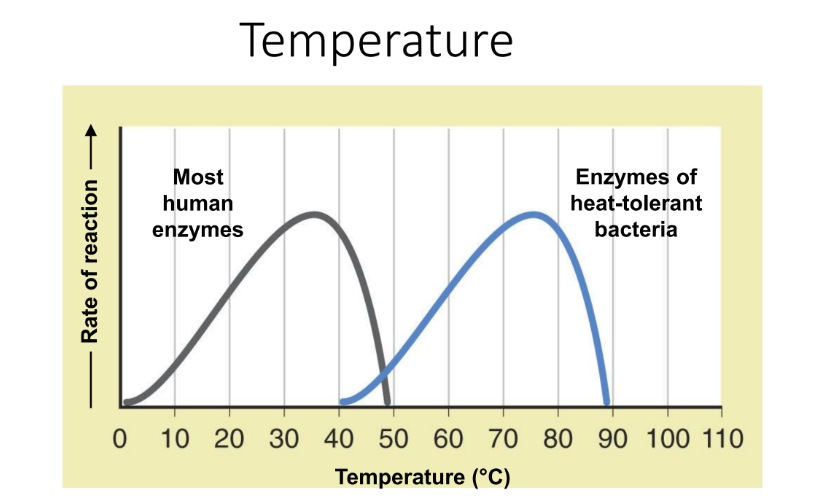
Enzyme activity abruptly falls after it exceeds the optimal
temperature because the enzyme, being a protein, denatures.
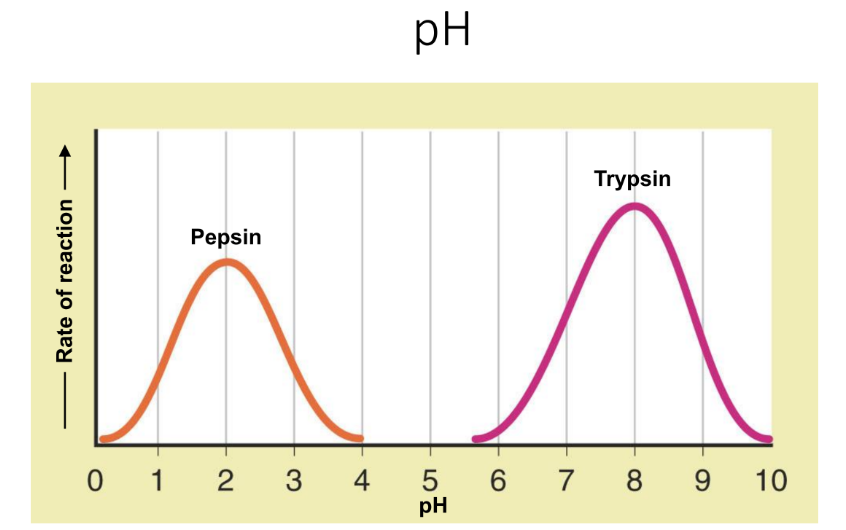
Enzyme activity is very sensitive to pH.
Pepsin is a protein-digesting enzyme in the very acidic stomach juice. Trypsin, secreted by the pancreas into the slightly basic small intestine, digests polypeptides. Rate of reaction.
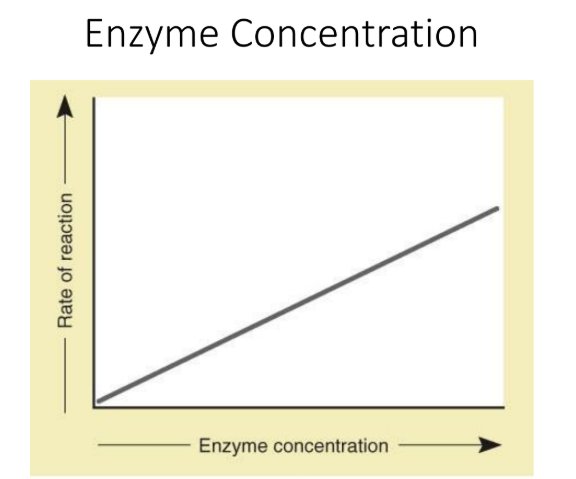
The rate of the rxn is directly proportional to concentration of enzymes.
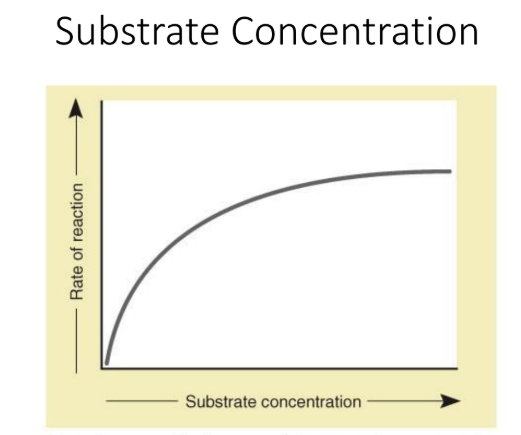
When [substrate] is low, the rate of rxn is directly proportional to [substrate].
When [substrate] is high, the rate of rxn does not increase further, because the enzymes become saturated.
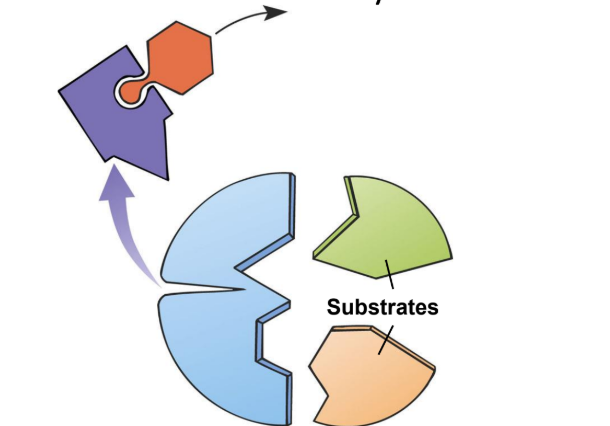
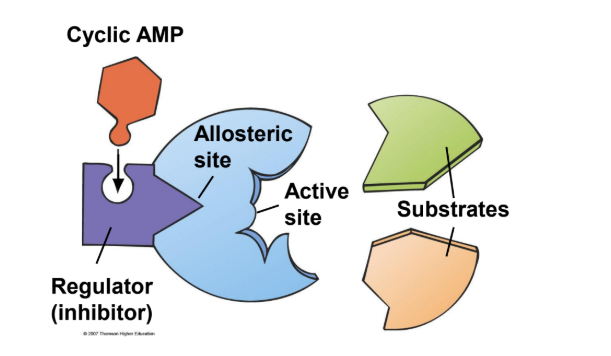
Where do allosteric regulators bind? and what is their effect?
To allosteric sites (of allosteric enzymes), which are noncatalytic.
They change the enzyme’s activity.
Inactive vs Active Form of the Enzyme
What are the two main types of enzyme inhibition?
Reversible (competitive and noncompetitive) and irreversible inhibition.
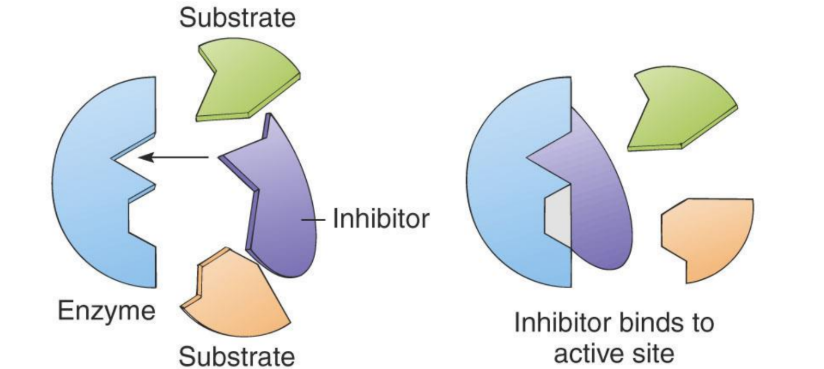
Competitive Inhibition
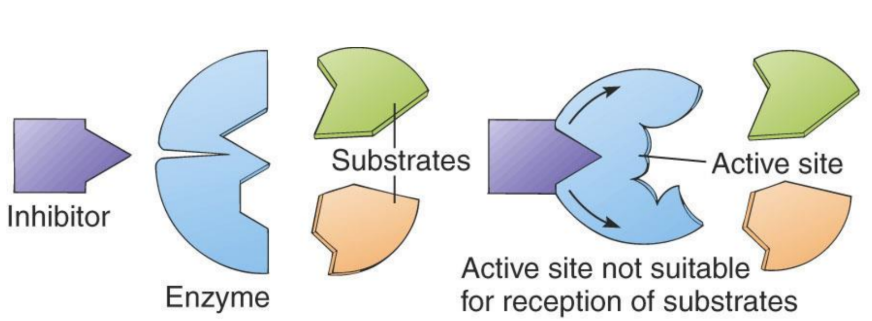
Inhibitor binds to active site.
Noncompetitive Inhibition
Inhibitor binds at a specific (not the active site) site.