Unit 3 Short Answer
 Call Kai
 Learn
 Practice Test
 Spaced Repetition
 Match
 Flashcards
 Knowt Play
1/5

There's no tags or description
Looks like no tags are added yet.
6 Terms

What is this?
Archegonia

What is this?
Antheridia
Green algae show remarkable diversity that mirrors key steps in plant evolution. Discuss the evolutionary trends seen across extant green algae, citing examples of green algae that demonstrate them.
Cells: Going from unicellular algae like Chlamydomonas to colonial like Eudorina and then to multicellular forms like in Volvox.
Gamete: same size gametes (isogamous) like in Chlamydomonas to different sized motile gametes (Anisogamous) in Eudorina to different sized gametes with only the male gamete being motile (Oogamous) like in Volvox.
Embryo: completely unprotected (just put out there) in Volvox to having the egg in a single cell like Oedogonium then to having the egg and embryo protected by a multicellular structure like in Chara.
Green algae and land plants share many features. Explain the key innovations that distinguish land plants from green algae, including structural, reproductive, and physiological adaptations that allowed plants to colonize land.
Land plants had to develop a cuticle to prevent drying out. They needed to be able to anchor themselves to the soils like rhizoids in bryophytes and roots in vascular plants. They needed gametangia to make gametes and sporangia to form spores. They also needed a sterile jacket to surround their eggs to protect their zygotes. In land plants the embryo is retained on the parent which feeds the embryo.
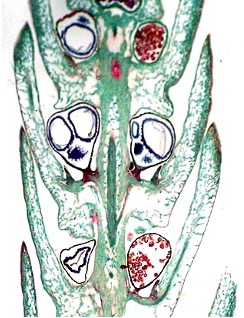
Is this homosporous or heterosporous?
Heterosporous

Is this plant homosporous or heterosporous?
Homosporous