F16-05: Histology of Vessels and Starling's Law of the Capillary
 Call Kai
 Learn
 Practice Test
 Spaced Repetition
 Match
 Flashcards
 Knowt Play
1/11

There's no tags or description
Looks like no tags are added yet.
12 Terms
For this assignment, you will match the types of vessels and their structures on the left to the corresponding terms on the right.
Arteries
These vessels have a thick tunica media of smooth muscle to allow for dilation and constriction for movement of blood
For this assignment, you will match the types of vessels and their structures on the left to the corresponding terms on the right.
Veins
These vessels have a very thick tunica externa and in general do not control their own flow
For this assignment, you will match the types of vessels and their structures on the left to the corresponding terms on the right.
Valves
These are found in veins to regulate flow of blood and prevent backflow
For this assignment, you will match the types of vessels and their structures on the left to the corresponding terms on the right.
Elastic arteries
These are generally larger arteries that must expand and contract as pulse pressure changes; the aorta is an example
For this assignment, you will match the types of vessels and their structures on the left to the corresponding terms on the right.
Muscular Artery
These vessels have larger smooth muscle layers to control blood flow; an example is the brachial artery
For this assignment, you will match the types of vessels and their structures on the left to the corresponding terms on the right.
Capillary
These vessels are microscopic and have very thin walls to allow for gas and nutrient exchange between the bloodstream and tissues

This image is an example of what type of capillary?
Continuous

This image is an example of what type of capillary?
Fenestrated
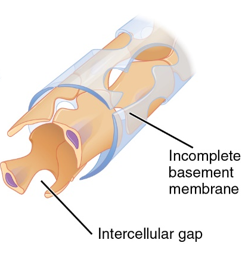
This image is an example of what type of capillary?
Sinusoid

Using this image as a guide, what would the net movement of fluid be if capillary hydrostatic pressure was 40 mm Hg and blood colloidal osmotic pressure was 40 mm Hg?
No net movement

Using this image as a guide, what would the net movement of fluid be if capillary hydrostatic pressure was 35 mm Hg and blood colloidal osmotic pressure was 25 mm Hg?
Fluid would move into the tissues

Using this image as a guide, what would the net movement of fluid be if capillary hydrostatic pressure was 25 mm Hg and blood colloidal osmotic pressure was 32 mm Hg?
Fluid would re-enter the capillary