Cell Biology: Cell Structure and Organelles
 Call Kai
 Learn
 Practice Test
 Spaced Repetition
 Match
 Flashcards
 Knowt Play
1/54

Earn XP
Description and Tags
A comprehensive collection of vocabulary flashcards covering cellular organelles, structural components, cell junctions, and transport mechanisms based on Chapter 4 lecture notes.
55 Terms
Cell (Plasma) Membrane
A dynamic, selectively permeable lipid bilayer containing proteins and cholesterol that surrounds the cell, separates the internal cytoplasm from the external environment, and regulates the movement of oxygen, nutrients, and waste into and out of the cell (present in plant, animal, and prokaryotic cells).
Cell Wall
A rigid layer located outside the plasma membrane composed of cellulose, polysaccharides, and protein; it maintains cell shape, protects against mechanical damage, and permits the passage of water and nutrients (present in plant and prokaryotic cells).
Middle Lamella
The outermost layer of the plant cell wall structure that cements adjacent cell walls together.
Extracellular Matrix (ECM)
A complex three-dimensional network surrounding animal and plant cells composed of glycoproteins such as proteoglycans and fibronectin; it provides structural shape to tissues and binds surface receptor proteins on the plasma membrane.
Interstitial Matrix
A structural component of the extracellular matrix that surrounds connective tissue cells.
Basement Membrane
A specialized sheet-like layer of the extracellular matrix situated directly beneath endothelial cells.
Nucleus
A membrane-bound organelle bounded by a nuclear envelope that serves as the administrative control center of the cell, housing most cellular DNA organized into chromatin and chromosomes, with its shape supported by the nuclear lamina (present in plant and animal cells).
Nuclear Lamina
A supportive network of protein filaments lining the inner surface of the nuclear envelope that mechanically maintains the spherical shape of the nucleus.
Nucleolus
Prominent non-membrane-bound structure within the nucleus
responsible ribosomal RNA (rRNA) synthesis + production, and assembly of ribosome subunits
P, A

Ribosomes
Non-membrane-bound complexes composed of rRNA and proteins that carry out protein synthesis in all living cells by translating mRNA instructions into amino acid polypeptide chains (found free in the cytosol or bound to the endoplasmic reticulum and nuclear envelope).
Rough Endoplasmic Reticulum (RER)
A membrane-bound organelle studded with ribosomes on its outer surface; functions as a cellular membrane factory, distributes transport vesicles, folds and modifies newly synthesized polypeptides, and initiates glycoprotein synthesis for export (present in plant and animal cells).
Smooth Endoplasmic Reticulum (SER)
A membrane-bound network of tubules and vesicles lacking ribosomes that synthesizes lipids, metabolizes carbohydrates, detoxifies drugs and poisons, stores calcium ions, and synthesizes steroid hormones (present in plant and animal cells).
Golgi Apparatus
A cellular organelle consisting of flattened membranous sacs called cisternae that manufactures macromolecules and acts as a distribution center to sort, modify, package, and direct cell products into transport vesicles (present in plant and animal cells).
Cisternae
Flattened membranous sacs held together by proteins that form the structural units of the Golgi apparatus and endoplasmic reticulum.
Mitochondria
Double-membrane-bound organelles containing their own circular DNA and ribosomes where cellular respiration utilizes oxygen to generate ATP; features an inner membrane folded into cristae, regulates apoptosis, and stores calcium ions (present in plant and animal cells).
Cristae
The infoldings of the inner mitochondrial membrane that expand surface area and house the protein machinery for electron transport and ATP synthesis.
Chloroplast
A double-membrane-bound photosynthetic organelle found in plants and algae that contains the green pigment chlorophyll, thylakoids, stroma, ribosomes, and circular DNA molecules to convert light energy into chemical energy stored in sugar.
Thylakoids
Flattened, interconnected photosynthetic membrane discs stacked inside chloroplasts where light-dependent reactions take place.
Stroma
The dense fluid space contained within the inner membrane of the chloroplast surrounding the thylakoid system.
Lysosomes
Small, spherical, membrane-bound organelles containing acidic hydrolytic enzymes that digest macromolecules, clear cellular waste, perform autophagy, assist in plasma membrane repair, and participate in apoptosis (present in plant and animal cells).
Autophagy
A lysosomal self-recycling pathway wherein a cell degrades and recycles its own damaged organelles and macromolecules.
Vacuoles
Large membrane-bound vesicles derived from the endoplasmic reticulum and Golgi apparatus that lack a fixed shape
Storage compartments for water, nutrients, ions, minerals, and pigments, while providing structural support for cell growth.
Part of endomembrane system
Food vacuoles (phagocytosis), contractile vacuoles (freshwater protists, remove excess water), central vacuoles (plant cells)
P, A

Contractile Vacuoles
Specialized vacuoles present in freshwater protists that accumulate and pump excess water out of the cell to maintain osmotic balance.
Peroxisomes
Single-membrane-bound metabolic compartments containing an enzyme matrix that oxidizes fatty acids
detoxifies toxic compounds, and produces hydrogen peroxide (H2O2) before converting it into water (H2O).
P, A

Vesicles
Small, membrane-bound sacs within the cytoplasm that transport, store, or digest cellular products and waste during endocytosis, exocytosis, and internal trafficking
P, A, PK

Cytoskeleton
A dynamic network of protein fibers extending throughout the cytoplasm that organizes structural components, maintains cell shape, and coordinates cellular movement and division.
Microtubules
Hollow, cylindrical rods constructed from tubulin dimers
thickest cytoskeletal fiber
They maintain cell shape, guide organelle traffic, assemble the mitotic spindle to separate chromosomes, and drive cilia and flagella beating
P, A

Tubulin
The globular protein dimer subunit that polymerizes into hollow rods to construct microtubules.
Intermediate Filaments
bigger than microfilaments, smaller than microtubules
Provide mechanical strengths, reinforces overall cell shape, and permanently anchors specific organelles in place
A

Microfilaments (Actin Filaments)
Thinnest fibers of the cytoskeleton
Built from globular actin subunits that resist tension, maintain cell morphology, support cellular projections, and drive muscle contraction
P, A

Plasmodesmata
Microscopic cytoplasmic channels perforating plant cell walls that connect the cytoplasms of adjacent cells
Permits direct passage of water, small solutes, and occasionally proteins and RNA.
P

Tight Junctions
Intercellular connections in animal epithelial sheets where transmembrane proteins (claudins and occludins) interlock to create a watertight seal that prevents fluids, ions, and molecules from leaking between cells.
Claudins and Occludins
The specialized transmembrane proteins that interlock between neighboring plasma membranes to construct watertight tight junctions.
Gap Junctions
Intercellular communication channels between animal cells formed by aligned transmembrane protein complexes called connexons, enabling direct transfer of ions, water, and signaling molecules from cytoplasm to cytoplasm.
Connexons
Barrel-shaped hexameric protein complexes that dock across the intercellular gap to form the open passage of a gap junction.
Desmosomes
Anchoring junctions in animal tissues formed by cadherin adhesion proteins that fasten adjacent cells into strong sheets like spot welds, preventing mechanical tearing during stretching.
Cadherins
Specialized calcium-dependent transmembrane adhesion proteins that bridge the intercellular gap to anchor desmosomes.
Chromatin
The structural complex of genomic DNA wrapped around histone proteins located within the nucleus, which remains sufficiently open for transcription and replication during interphase.
Histones
Specialized, highly conserved proteins around which eukaryotic DNA winds to form nucleosomes and package chromatin.
Chromosomes
Dense, discrete units of genetic material formed by tightly condensed chromatin when a cell prepares for division; composed of identical sister chromatids carrying genes, with human cells containing 46 (23 pairs).
Cytoplasm
The entire interior region of a cell enclosed by the plasma membrane, excluding the nucleus; houses organelles and serves as the medium for biochemical reactions and intracellular transport.
Cytosol
The semifluid, water-based jelly-like solution of the cytoplasm surrounding the organelles, which contributes to cell volume and shape.
Centrosome
Primary microtubule-organizing center located near the nucleus of animal cells
Contains a pair of centrioles
Duplicates to assemble the mitotic spindle during cell division and organizes cilia and flagella assembly
A

Centrioles
A pair of tiny, hollow cylindrical structures located within animal centrosomes, each composed of nine triplets of microtubules arranged in a ring; they orient at right angles, organize the cytoskeleton, and differentiate into basal bodies.
Basal Body
A centriole-derived organelle structure that anchors the base of a cilium or flagellum at the plasma membrane.
Cilia
Short, numerous microtubule-based hair-like projections extending from animal cell surfaces, anchored by a basal body and propelled by dynein motor proteins to move surrounding fluid or detect external stimuli.
Dynein
Motor protein that drives the bending of Cilia and Flagella
Cytoskeletal motor protein that uses ATP hydrolysis to drive the sliding of outer doublet microtubules, generating the rhythmic bending motion of cilia and flagella.
Flagella
Long, specialized cellular appendages typically limited to one or a few per cell
Constructed of clustered microtubules anchored by a basal body and bent by dynein to move cells through liquid environments
basal body anchors the flagellum
P, A, PK
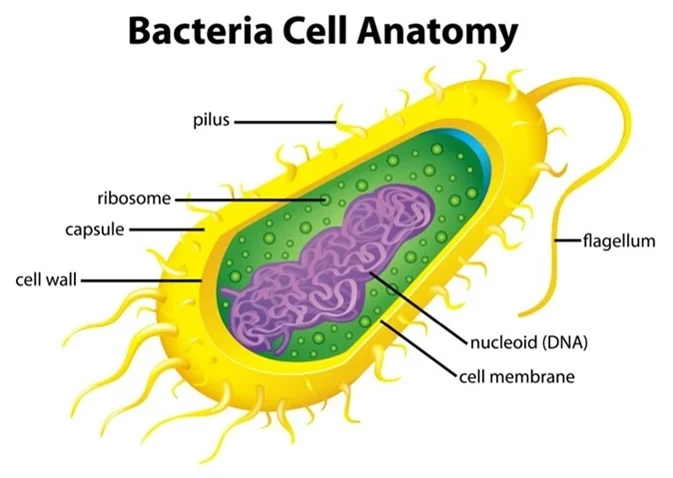
Prokaryotic Cells
pro => NO (membrane-bound) nucleus
No membrane-bound organelles
Unicellular microorganisms, like Bacteria and Archaea
DNA in an unbound region called the nucleoid
Eukaryotic Cells
Complex cells encompassing protists, fungi, plants, and animals characterized by the presence of a membrane-enclosed nucleus containing chromosomal DNA and specialized membrane-bound organelles.
Surface Area-to-Volume Ratio
A fundamental geometric ratio that sets upper physical limits on cell size; as cell volume expands faster than surface area, transport across the membrane becomes less efficient.
Endomembrane System
A functionally unified network of internal membranes that includes the nuclear envelope, endoplasmic reticulum, Golgi apparatus, lysosomes, vacuoles, and plasma membrane.
Phagocytosis
A type of endocytosis where a cell wraps its plasma membrane around another cell or large particle to engulf it, forming an intracellular food vacuole.
Endosymbiont Theory
Evolutionary model proposing that mitochondria and chloroplasts originated as symbiotic prokaryotes engulfed by an ancestral eukaryote
has a double membrane, independent circular DNA, bacterial-like ribosomes, and autonomous replication (grows somewhat independently in cells)
Nucleoid
The non-membrane-enclosed region within a prokaryotic cell where genomic DNA is concentrated.