Ch. 25 – Food and Water diseases
 Call Kai
 Learn
Learn Practice Test
 Spaced Repetition
 Match
Match Flashcards
 Knowt Play
1/222

There's no tags or description
Looks like no tags are added yet.
Name | Mastery | Learn | Test | Matching | Spaced | Call with Kai | Chat |
|---|
No analytics yet
Send a link to your students to track their progress
223 Terms
What are foodborne and waterborne diseases, and what is their distribution?
Infectious diseases (contain pathogens) spread through contaminated food & water.
They have a worldwide distribution.
What route do foodborne/waterborne diseases involve? Give the mode of transmission and portal of entry.
Fecal-oral route (poop → mouth).
Mode of transmission: contaminated food & water.
Portal of entry: oral cavity → mucous membranes of GI tract.

What is the "big picture" sequence of foodborne/waterborne disease?
Pathogens (in fecal matter) → contaminate food & water → pathogens ingested → disease in the host.
What is the difference between a 1° and 2° reservoir?
1° (primary) reservoir: where the pathogen "mainly" lives.
2° (secondary) reservoir: where the pathogen "sometimes" lives.
What are the typical symptoms of foodborne/waterborne diseases?
GI symptoms, such as nausea, vomiting, diarrhea, abdominal cramps, and gas.
How are foodborne/waterborne diseases diagnosed?
Based on GI symptoms.
Identifying the pathogen in food/water or in a stool sample.
Serology: bloodwork to look for the pathogen or antibodies (IgM).
What are the predisposing factors for foodborne/waterborne diseases?
Inadequate cooking, improper food handling (improper temperature), poor personal hygiene, and unsanitary conditions.
What are the best preventive measures for foodborne/waterborne diseases?
Washing hands and well-cooked food.
What are the best treatments for foodborne/waterborne diseases?
Medications.
Antitoxins (antibodies against a toxin).
Supportive therapy, such as oral rehydration.
What is a bacterial infection, and how does it cause disease?
Does NOT involve toxins.
The pathogen (bacteria) is consumed in food/water.
Pathogens invade & multiply in the intestinal lining.
What is a bacterial intoxication, and how does it cause disease?
Involves toxins.
The toxin is consumed in food.
Toxins made by the pathogen (bacteria) → toxemia (toxins spread in blood).
Compare the incubation period and S/Sx of a bacterial infection vs. intoxication.
Infection: long incubation (hours to days)
No S/Sx yet during initial infection…
Then 1st S/Sx appear (prodromal period). S/Sx happen slowly: nausea, vomiting, diarrhea, usually fever.
Intoxication:
short incubation (minutes to hours).
S/Sx happen quickly: nausea, vomiting, diarrhea, usually NO fever.
What type of toxin is usually involved in bacterial intoxication, and what is the exception to "no fever"?
Probably an exotoxin (protein toxin made by gram+ cells).
Exception: a super Ag can cause fever.
What is Staphylococcal Food Intoxication also known as, and what does "intoxication" tell you?
AKA "Food Poisoning."
It will involve a toxin.
What is the causative agent of Staphylococcal Food Intoxication? Give its gram stain, shape, arrangement, and where it's found.
Staphylococcus aureus.
Gram-positive bacteria.
Cocci in clusters.
Present on skin and most surfaces.
What is the reservoir for Staphylococcal Food Intoxication?
Human skin.
What is the virulence factor of Staphylococcal Food Intoxication?
A heat-stable enterotoxin (Type I exotoxin).
Enterotoxin = targets the GI/intestinal tract.
Exotoxin = made by gram+ bacteria.
Type I = super Ag → causes fever.
What are 2 key facts about the Staph enterotoxin?
Toxins are NOT destroyed by boiling.
Toxins are produced when bacteria are allowed to incubate in food (temperature abuse).
What is the mode of transmission for Staphylococcal Food Intoxication?
Dirty hands (skin) with bacteria → food contaminated (remains at room temp) → bacteria make heat-stable enterotoxins (VF).
What are the symptoms of Staphylococcal Food Intoxication, and what is the incubation period?
Short incubation period.
Acute (short duration) symptoms: nausea, vomiting, diarrhea, abdominal cramps, and fever.
Fever is caused by the type I exotoxin (Super Ag).
What are the best preventive measures for Staphylococcal Food Intoxication?
Safe food handling.
Good personal hygiene/washing hands.
Proper food temperature or refrigerating food.
What is the treatment for Staphylococcal Food Intoxication, and why won't antibiotics work?
Supportive care: oral rehydration.
Antibiotics won't work because it's a toxin issue, not a bacterial infection.
Describe the sequence of events in a typical outbreak of Staphylococcal Food Poisoning.

Will reheating food prevent Staphylococcal Food Poisoning? How fast does it occur after eating?
No, reheating eliminates staphylococci but NOT the toxins.
Occurs in 1–6 hours (short incubation period, quick S/Sx).
What is Botulism also known as, and what does "intoxication" tell you?
AKA Clostridium Botulism Intoxication/Foodborne Botulism.
It will involve a toxin.
What is the causative agent of Botulism? Give its gram stain, shape, spore ability, and oxygen requirement.
Clostridium botulinum.
Gram-positive bacteria.
Bacilli.
Endospore-forming (endospores only in genus Bacillus & Clostridium).
Obligate anaerobe (only grows in 0% O₂).
How is Botulism diagnosed?
Slide prep showing bacteria with an endospore at the end of the cell → "drumstick" appearance.
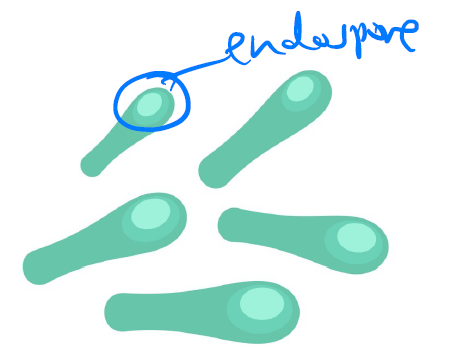
What is Botulism's 1st virulence factor?
A potent, heat-labile neurotoxin (exotoxin).
What does "potent" and "heat-labile" mean for the botulinum neurotoxin?
Potent = low LD₅₀.
Heat-labile = heat can destroy the toxin.
What does the botulinum neurotoxin target, and what is the result?
Targets the nervous system → nerve damage → no muscle stimulation.
The botulinum neurotoxin is an exotoxin. What type of bacteria probably makes it?
Gram+ bacteria.
What is Botulism's 2nd virulence factor, and how does it lead to disease?
Endospores → germinate into active cells → produce the neurotoxin.
What is the reservoir for Botulism?
Contaminated food.
What is the mode of transmission for Botulism?
Canned food with neurotoxins.
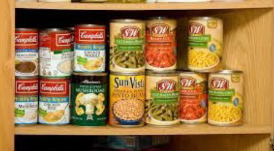
Why is canned food a common source of Botulism?
Canning creates an anaerobic environment → spores can germinate into active cells, or active cells make toxin.

How does Botulism cause symptoms? Describe the path from ingestion to the main effect
Ingesting the botulinum exotoxin → toxemia (toxin spreads throughout body) → targets nerves → affects nervous system → flaccid paralysis.
What usually causes death in Botulism?
Respiratory or cardiac failure.
What are the best preventive measures for Botulism?
Commercial/proper canning methods.
Treating meats with nitrites.
How do nitrites prevent Botulism?
They inhibit spores from germinating into active cells → no neurotoxin.
What is the treatment for Botulism?
Respiratory assistance.
Antitoxins (injecting antibodies against the toxin).
Besides foodborne botulism, what are the 2 other types of Botulism?
Infant Botulism.
Wound Botulism.
How does Infant Botulism develop, and what food is it associated with?
Infant ingests C. botulinum spores → spores germinate into active cells → produce a potent, heat-labile neurotoxin.
Associated with infants eating honey.
What are the symptoms of Infant Botulism?
Weakened muscle tone (floppiness/hypotonia) and trouble feeding.

How does Wound Botulism develop, and who is it common in?
Growth of C. botulinum in deep puncture wounds → creates an anaerobic environment → spore germinates.
Common in IV drug users.
What is Clostridium difficile-Associated Diarrhea also known as?
"C. diff" Colitis.
What is the causative agent of C. diff Diarrhea? Give its gram stain, shape, spore ability, oxygen requirement, and the genus it shares with Botulism.
Clostridium difficile.
Gram-positive bacteria.
Bacilli.
Endospore-forming.
Obligate anaerobe.
Same genus as Clostridium botulinum.
What is the virulence factor of C. diff Diarrhea?
Produces exotoxins.
What are the 1° and 2° reservoirs for C. diff Diarrhea?
1° = humans.
2° = contaminated medical equipment.
What are the modes of transmission for C. diff Diarrhea?
Fecal-contaminated water and contaminated medical equipment.
What are the 2 predisposing factors for C. diff Diarrhea?
Mostly acquired in health-care settings.
Extended use of antibiotics.
Which 6 foodborne/waterborne diseases have toxins as a virulence factor?
Staphylococcal Food Intoxication.
Botulism.
C. diff Diarrhea.
Shigellosis.
Bacterial Gastroenteritis.
Hemorrhagic Colitis.

What are the symptoms of C. diff Diarrhea? Describe how it progresses and the life-threatening form.
Mild diarrhea → colitis.
Life-threatening colitis: ulceration & perforation (hole) of the intestinal wall.
Bacteria or toxin damages blood vessels → sometimes leads to bloody diarrhea.

How is C. diff Diarrhea diagnosed?
PCR, looking for the gene (DNA) in stools that produces toxins.
How is C. diff Diarrhea prevented?
Wearing a gown, gloves, and using disposable equipment in a hospital setting.
What 2 drug groups are used to treat C. diff Diarrhea?
Antiprotozoal drug (Metronidazole).
Antibiotic (Vancomycin).
How many infections did C. difficile cause in the U.S. in a single year (CDC 2015)?
Almost 500,000.
Why does long-term antibiotic use put a patient at risk for C. diff?
It wipes out the normal microbiota (no more N.M.), leaving the patient vulnerable to C. difficile.
Describe how C. diff spreads in the CDC case example (George).
Doctor's office: prescribed long-term antibiotics → no more normal microbiota.
Hospital: exposed to C. diff by staff who didn't wear gloves.
Rehab facility: has S/Sx but not yet treated → staff without gloves spread it to other patients.
Hospital: tests positive, gets treated, staff wear gloves → recovers.

What is Salmonellosis also known as?
Salmonella Gastroenteritis.
What is the causative agent of Salmonellosis? Give its gram stain, shape, oxygen requirement, and motility.
Salmonella enterica serovar Typhimurium:
Gram-negative bacteria.
Bacillus.
Facultative anaerobe.
Motile.
What does "serovar" mean, and how does Salmonellosis's serovar differ from Typhoid Fever's?
Serovar = strain/subspecies.
Salmonellosis = serovar Typhimurium.
Typhoid Fever = serovar Typhi.
What is the virulence factor of Salmonellosis?
Invades intestinal mucosa and multiplies in phagocytes → bacteremia (spreading throughout body).
Which 3 foodborne/waterborne diseases have "multiplies in phagocytes" as a virulence factor?
Salmonellosis.
Typhoid Fever.
Brucellosis.

What are the reservoirs for Salmonellosis?
Contaminated meat/fruits/vegetables, raw eggs, and pet reptiles (Ex: iguanas, turtles).
What is the mode of transmission for Salmonellosis?
Contaminated food.
What is the incubation period for Salmonellosis, and how does it compare to Typhoid Fever?
Incubation = time from infection → 1st appearance of S/Sx.
Salmonellosis: 12 to 36 hours.
Typhoid Fever: weeks.
What are the symptoms of Salmonellosis, and how does its fever compare to Typhoid Fever?
Fever, nausea, vomiting, abdominal cramps, and diarrhea.
Fever is NOT high (vs. high fever in Typhoid Fever).
What is a chronic carrier in Salmonellosis?
A patient who sheds bacteria in feces for up to 6 months, with no S/Sx but still highly infectious.
How is Salmonellosis diagnosed?
PCR to identify the serovar/strain in food (looks for DNA of the pathogen).
What are the best preventive measures for Salmonellosis?
Avoid consumption of raw eggs.
Wash all fruits and vegetables with clean water.
Avoid pet reptiles.
What is the treatment for Salmonellosis?
Oral rehydration and antibiotics.
What is the causative agent of Typhoid Fever? Give its gram stain, shape, oxygen requirement, and motility.
Salmonella enterica serovar Typhi.
Gram-negative bacteria.
Bacillus.
Facultative anaerobe.
Motile.
What is the virulence factor of Typhoid Fever?
Bacteria multiply in phagocytes → bacteremia.
What is the reservoir and mode of transmission for Typhoid Fever?
Reservoir: humans.
Mode of transmission: usually fecal-contaminated water/food.
What is the incubation period for Typhoid Fever?
2–3 weeks (vs. hours for Salmonellosis).
Where in the world is Typhoid Fever incidence highest?
South and Southeast Asia (>100 per 100,000 per year).
- Maybe delete this card based on what he says in lecture

What are the symptoms of Typhoid Fever? Include the type of fever and the skin finding.
Prolonged high fever (104°F) (vs. "regular" fever in Salmonellosis).
Headache, muscle aches, abdominal cramps, diarrhea.
Skin rash on trunk (rose spots).

What happens in severe cases of Typhoid Fever, and what is this called?
Intestinal wall ulceration & perforation → bloody diarrhea (Dysentery).
How is Typhoid Fever diagnosed?
Pathogen in blood (serology) or stool sample.
Based on symptoms, such as presence of rose spots.
Which 4 foodborne/waterborne diseases cause bloody diarrhea/dysentery?
C. diff Diarrhea.
Typhoid Fever.
Shigellosis.
Hemorrhagic Colitis.

What percentage of Typhoid Fever patients become chronic carriers, and what is a famous example?
1–3% become chronic carriers and shed bacteria in feces.
Ex: "Typhoid Mary" (memory trick: "Mary Rose" → rose spots).
Which 2 foodborne/waterborne diseases have chronic carriers?
Salmonellosis.
Typhoid Fever.

What is the prevention and treatment for Typhoid Fever?
Prevention: good personal hygiene (washing hands).
Treatment: antibiotics and oral rehydration; chronic carriers may require weeks of treatment.
How has the prevalence of Salmonellosis and Typhoid Fever changed in the U.S. over time?
Typhoid Fever: dropped sharply from the 1930s and is now near zero.
Salmonellosis: rose from the 1950s, peaked in the late 1980s, and remains common today.

What is Shigellosis also known as, and what does the name mean?
Bacillary Dysentery.
Bacillary = bacillus.
Dysentery = bloody diarrhea.
What is dysentery, and what causes the damage in Shigellosis?
Dysentery = severe damage to the intestinal mucosal lining → ulceration → bloody mucous diarrhea → "Bloody Dysentery."
The damage is done by a toxin (Shiga toxin).
What is the causative agent of Shigellosis? Give its gram stain, shape, attachment structure, and oxygen requirement.
Genus Shigella (several species).
Gram-negative bacteria.
Bacillus.
Fimbriae.
Facultative anaerobe.
What are the 4 species of Shigella, and which is the most virulent?
S. sonnei.
S. boydii.
S. dysenteriae (most virulent).
S. flexneri.
What are the 2 virulence factors of Shigellosis?
Shiga toxin.
Multiplies in epithelial cells of the GI tract.

Which 2 foodborne/waterborne diseases have "multiplies in epithelial cells" as a virulence factor?
Shigellosis.
Hepatitis A.
What are the 1° and 2° reservoirs and the mode of transmission for Shigellosis?
1° = water; 2° = humans.
Mode of transmission: fecal-contaminated water.
What is the incubation period for Shigellosis?
12 hours to 2 weeks.
What are the symptoms of Shigellosis, and what causes them?
Inflammation of intestines (ulceration) & bloody diarrhea (dysentery) due to Shiga toxin.
How is Shigellosis diagnosed?
PCR, looking for the gene (DNA) in stools that produces Shiga toxins.
Based on symptoms.
What is the prevention and treatment for Shigellosis?
Prevention: good personal hygiene (washing hands).
Treatment: often antibiotics and oral rehydration.
What is Bacterial Gastroenteritis also known as, and can it lead to death?
AKA Pathogenic E. coli Gastroenteritis, Travelers Diarrhea.
Will NOT lead to death (vs. Hemorrhagic Colitis).
What strain of E. coli causes Bacterial Gastroenteritis, and what does its name mean?
Enterotoxigenic E. coli (ETEC) strain, a non-O157:H7 strain.
Enterotoxigenic = produces toxin.
What are the characteristics of ETEC? Give its gram stain, shape, oxygen requirement, motility, and bacterial class.
Gram-negative bacteria.
Bacillus.
Facultative anaerobe.
Motile.
Coliform bacteria.
What are coliform bacteria, and what does coliform water pollution indicate?
Coliforms = a broad class of bacteria (E. coli) found in the human & animal GI tract and found in water sources.
Coliform water pollution = indication of fecal contamination of water (b/c poop in H₂O).
What is the virulence factor of Bacterial Gastroenteritis?
Enterotoxin (exotoxin), sometimes secreted by gram− bacteria.