Spanish vocab final exam
 Call Kai
 Learn
 Practice Test
 Spaced Repetition
 Match
 Flashcards
 Knowt Play
1/124

There's no tags or description
Looks like no tags are added yet.
125 Terms
Mitosis produces two identical haploid cells: T or F
F
After meiosis I, there is an interphase before prophase II: T or F
F
associated with growth and asexual reproduction
mitosis
Requires prior duplication of chromosomes
mitosis and meiosis
chromosome number is maintained
mitosis
Crossing over occurs between homologous pairs
meiosis
Daughter cells are not identical to the parent cells
meiosis

prophase

telophase

interphase

metaphase

anaphase
After which stage of cell division is the chromosome number reduced?
After telophase I
When using a micropipette to "draw" a sample, it is important to press the plunger before immersing the tip of the pipette into a solution: T or F
T
When using a micropipette to "draw" a sample, it is important to stop at the second point of resistance, the second stop: T or F
F
When using a micropipette to "dispose" of a sample, it is important to stop at the second point of resistance, the second stop: T or F
T
Students are trying to transfer 80 µL of sample from one microcentrifuge tube to another. Which micropipette should they use?
p200
Students are trying to transfer a 20 µL sample from a microcentrifuge tube to another tube. Which micropipette should they use?
p20
if I need to transfer 12 µL of sample, then I can use a p10 micropipettor and set it to 12 µL: T or F
F
Which of the following is p200 micropipette?
with a pipetting range from 20 µL to 200 µL
There are 3 digits on a 100- 1000 µL (1mL) pipet. What would you set the pipet to if you transfer 640 µL?
___a____ first digit
___b____ second digit
___c____ thrid digit
a: 0
b: 6
c: 4
There are 3 digits on a 100- 1000 µL (1mL) pipet. What would you set the pipet to if you transfer 6.5 µL?
___a____ first digit
___b____ second digit
___c____ thrid digit
a: 0
b: 6
c: 5
250 µL = __________ mL
0.25
0.025 mL = __________ µL
25
Question 12 lab 2
list all possible gametes produced from a parent whose genotype is AaBb
- AB
- Ab
- aB
- ab
list all possible gametes produced from a parent whose genotype is aaBb
- aB
- ab
If T, tall, is dominant to t, short, then what proportion of the progeny will be tall in the following cross Tt x tt
50% or 1/2
if one parent is homozygous and the other parent is heterozygous for the genetically inherited recessive trait, what is the probability that they will have a child who does have this trait in his or her phenotype?
50% or 1/2
probability of an Ab gamete from an AaBb individual
1/4
probability of an ab gamete from an aaBb individual
1/2
Probability of an AaBb zygote from an AaBb x AaBb cross?
1/4
Probability of an AaBB zygote from an AaBb x AaBb cross?
1/8
Probability of an aB phenotype from an AaBb x AaBb cross?
3/16
Probability of an aB phenotype from an AaBb x aabb cross?
1/4
Data analysis lab 3
a spectrophotometer can be used for DNA or RNA quanfication. Which of the following is used directly to quantify nuleic acids
absorbance
Which of the following is true of Beer-Lambert law
DNA concentration is directly correlated with the absorbance of the DNA
Which wavelength of light is absorbed by nucleic acids at maximum
260 nm
You isolated genomic DNA, and diluted 10 µL. You quantified the diluted DNA sample using a spectrophotometer. The reading at A260 nm was 0.06. What is the concentration of your original (non-diluted) DNA sample? Include the correct unit for concentration.
100 ng/µL
Which technique was used to find out that DNA has a helical structure?
X-ray crystallography
Which of the following scientidsts prepared a manuscript for publication of the DNA structure as a trimple helix?
Pauling
Who took photo 51?
Franklin
What did Erwin Chargaff do?
Noted that the number of "A"s was equal to the number of "T"s
Which of the following bases are pyrimidines?
- cytosine
- thymine
- uracil
On which of these carbons does a purine base attach in a nucleotide triphosphate (dNTP)?
1'
One which of these carbonds does a phosphate group attach in a nucleotide triphosphate (dNTP)?
5'
__________ bonds between the two ___________ holds the two complementary DNA together
hydrogen; bases
draw deoxyribose

What is the correct structure of Thymine?

What is the correct structure of adenine?

What is the correct structure of cytosine?

What is the correct structure of guanine?

What is the correct structure of uracil?
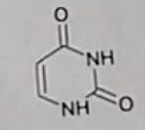
Differences between DNA and RNA structures:
- DNA is double-stranded
- DNA uses Thymine
- DNA lacks a hydroxyl group in column 2
- RNA is single-stranded
- RNA uses uracil
- RNA has a hydroxyl group in column 2
Describe the differences in the events during prophase I vs. prophase II (in meiosis). Don't need to mention anything in common.
- prophase I is where crossing over occurs and is diploid and has synapsis
- Prophase II has the absence of crossing over and is haploid
Describe the differences in the events during anaphase I vs. anaphase II (in meiosis). Don't need to mention anything in common.
- Anaphase I is the separation of homologous chromosomes
- Anaphase II is the separation of sister chromatids
What is the function of the silica matrix in a spin column used in a plasmid DNA extraction lab?
The silica matrix allows the plasmid DNA to bind to the matrix, so when the washing occurs, the wash will not remove the plasmid DNA, but the unnecessary particles can be removed
Why is it necessary to use the washing solution for the spin column?
so the unwanted particles that may still be there will flow through the spin column, resulting in the DNA being purer
What types of DNA are present in the white pellet after mixing the initial three solutions and centrifuging?
The white pellet should include chromosomal DNA

Consider the following results from a gel electrophoresis separated by charge. What is the charge of sample 2?
positive

affected female

unaffected female

unaffected male
Affected Male

This pedigree suggests a pattern of autosomal recessive inheritance: T or F
F

This pedigree suggests a pattern for X-linked recessive inheritance: T or F
T

This pedigree suggests a pattern for autosomal dominant inheritance: T or F
T

this pedigree suggests a pattern for X-linked recessive inheritance: T or F
T
What is the function of bla gene (β-lactamase gene) on pGLO plasmid?
bla gene is an antibiotic resistance enzyme that will kill any antibiotics, destroying the bacteria on the plate, allowing the bacteria to grow
What is "transformation"
When a cell takes in foreign DNA, it will incorporate its traits into its cell

+ pGLO plasmid, LB
- Growth: yes
- Justification: there is no antibiotics to stop the bacteria from growing

+ pGLOW plasmid, LB+Amp
- Growth: yes
- Justification: the bacteria grows becasue +pGLOW means there is the bla gene to kill the amp antibiotics

+ pGLO plasmid, LB+Amp+Arabinose
- Growth:
- Justification:

- pGLO plasmid, LB
- Growth: Yes
- Justification: there is no antibiotics to prevent growth

- pGLOW plasmid, LB+Amp
- Growth: No
- Justification: there is no ara to turn on the pGLO gene so the antibiotic kills the bacteria
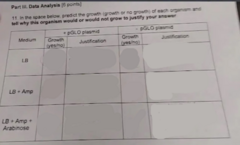
- pGLO plasmid, LB+Amp+Arabinose
- Growth: No
- Justification: Lacks the pGLO plasmid (bla gene), so ampicillin still kills the bacteria despite arabinose being present.

YS phenotype =
3/8
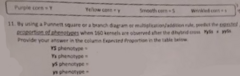
Ys phenotype =
1/8

yS phenotype =
3/8

ys phenotype =
1/8

know how to fill this out and alos to know if this is accepted or not... this is not accepted btw - answer to this is ...
...
PCR reactions use a specific polymerase. What is the name of the polymerase
TAQ polymerase
PCR reactions use a specific polymerase. What is the name of the polymerase?
In the question above, why does no other regular polymerase work for PCR?
DNA pol I denatures in heat so in order to keep DNA pol I in the solution, they would need to reintroduce it after each cycle/heat bath. The TAQ polymerase on the other hand has heat-resistant characteristics which means it does down need to be reintroduced every cycle

what is 1?
94

What is 2?
94

What is 3?
62

What is 4?
72

What is 5?
72
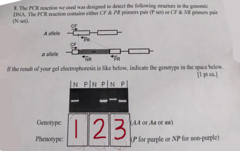
What is 1?
- Genotype: aa
- Phenotype: NP

What is 2:
- Genotype: AA
- Phenotype: P

What is 3:
- Genotype: Aa
- Phenotype: P
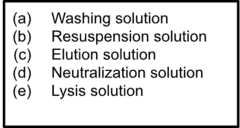
This solution contains SDS (ionic detergent)
e

This solution contains ethanol
a
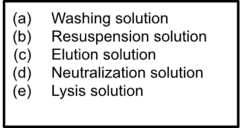
This solution has a very alkaline condition. This is why this method is called the "alkaline lysis method"
e

This solution is acidic
d

After adding this solution, plasmid DNA remains soluble while chromosomal DNA remains denatured
d
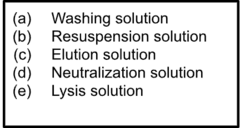
This solution creates a condition in which DNA cannot bind to the silica column anymore, hence dissociating from the column
c

Write the correct order of solutions to isolate plasmid DNA from E. coli cells
b -> e -> d -> a -> c
After adding neutralization solution and centrifugation, where is the plasmid DNA?
in the supernatant