biochem E3L5 pentose phosphate pathway + glycogenesis
 Call Kai
 Learn
 Practice Test
 Spaced Repetition
 Match
 Flashcards
 Knowt Play
1/23

There's no tags or description
Looks like no tags are added yet.
24 Terms
gluconeogenesis:
what is it
why can’t glycolysis just go in reverse
why do we run gluconeogenesis
location
how NADPH kept separate
making glucose from pyruvate
has 3 irreversible committed steps (1, 3, 10)
brain needs glucose
Metabolism roundabouts:
4 things pyruvate can do
pyruvate carboxylase v pyruvate dehydrogenase regulation
2 things glucose-6-phosphate can do
pyruvate:
lactate,
actetyl-CoA,
oxaloacetate,
glyoneogenesis
pyruvate carboxylase v pyruvate dehydrogenase = reversibly regulated
glucose 6-phosphate:
pentose phosphate pathway or Glycogen synthesis

pentose phosphate pathway:
2 purposes
when/why
where does reducing power come from
Purposes
provides 5C ribose sugars
rapidly dividing cells need nucleotides for copying DNA and RNA transcription
provides reducing power
anabolic reactions require reducing power (electrons)
reducing power from electron carrier NADP/NADPH
pentose phosphate pathway:
what happens
2 phases
oxidative
generates what
sugar carbons
non-oxidative
recycles what
when
what happens
2 phases
oxidative
generates NADPH (reducing power)
converts 6C → 5C ribose
non-oxidative
recycles 5C back to glycolytic intermediates/glucose
when 5C not needed (cell not dividing) but still need reducing power
NADPH v. NADH:
soluble?
how many e-?
enzyme?
prefer e- donor or acceptor?
oxidation or reduction reactions?
anabolic or catabolic reactions?
ratio in cytoplasm? why?
NADPH = soluble e- carrier (2 e-)
participates in reducing reactions (anabolic)
NADPH e- donor
enzyme = dehydrogenase
NADH = soluble e- carrier (2e-)
participates in oxidation reactions (catabolic)
NAD+ e- acceptor
also dehydrogenase
High NADPH, high NAD+. both signal high cell E, but NADH in cytoplasm would inhibit glycolysis. need to separate these pools
3 ways cells separate anabolic/catabolic processes
how separate
separate electron carriers = NADPH v NADH
separate pools of electron carriers
cytosol = high NADPH
where reductive processes (anabolic) happen like fatty acid synthesis… except for glycolysis (catabolic)
mitochondrial matrix = high NADH
where oxidative processes (catabolic) happen like CAC or fatty acid oxidation
enzyme specificity for e- carriers = most have strong specificity for NADP+/NADPH or NAD+/NADH
pentose phosphate pathway:
oxidative phase 2 steps,
what is released?
equation
where does C go 6c from 5c
2 steps:
G6P -(G6PDH oxidation)→ -(oxi decarboxylation)→ R5P (ket)
Ribulose5P (ket) -(phosphopentose isomerase)→ Ribose5P (ald)
get 2 NADPH and release 1 CO2 during this
G6P + 2NADP+ + H2O → R5P + CO2 + 2NADPH + 2H+
- 1C decarboxylation

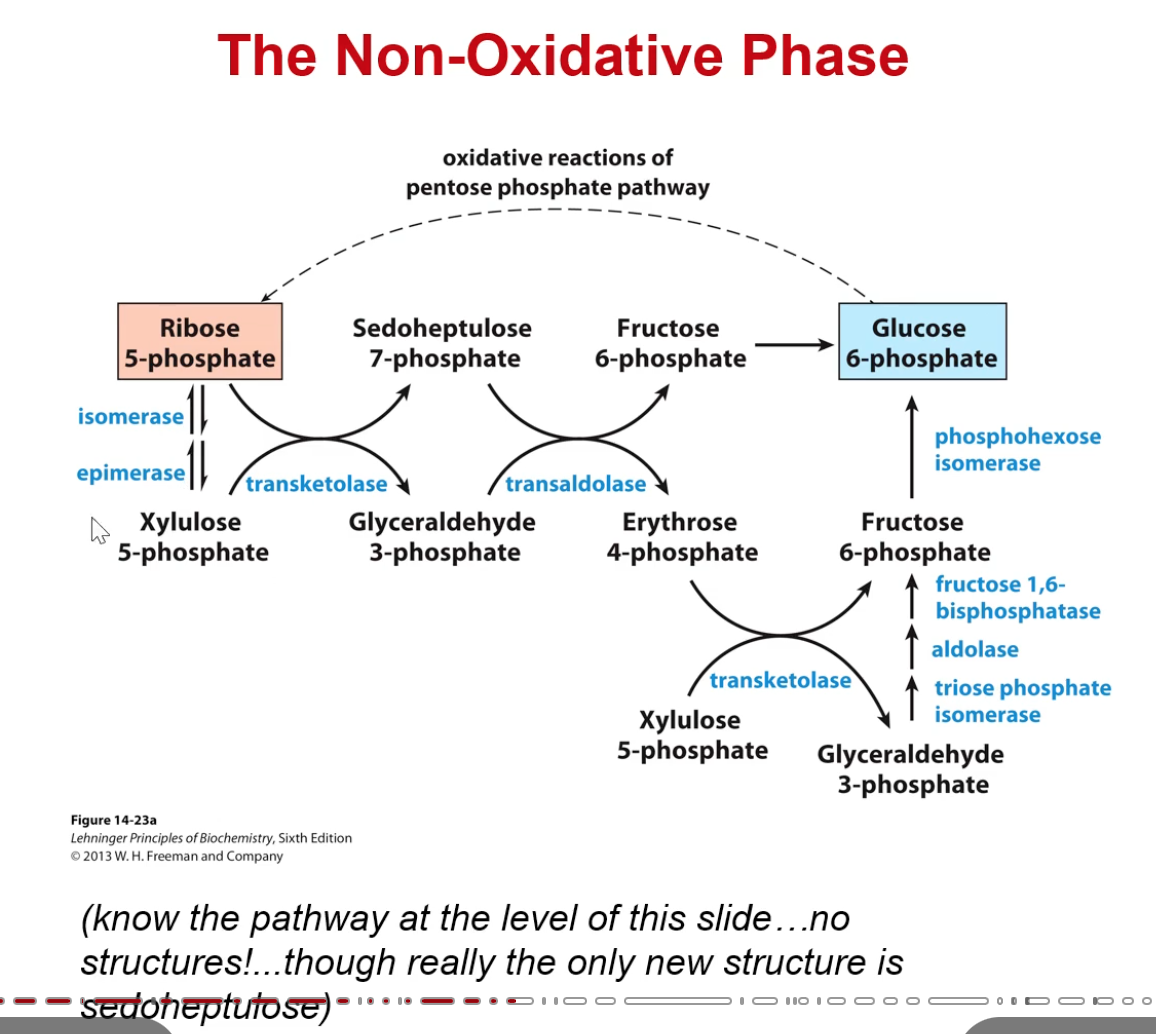
pentose phosphate pathway (PPP):
non oxidative phase purpose
3 non oxidative phase steps
transketolase:
transaldolase:
transketolase:
alternate for GA3P
Answer slide is what to know
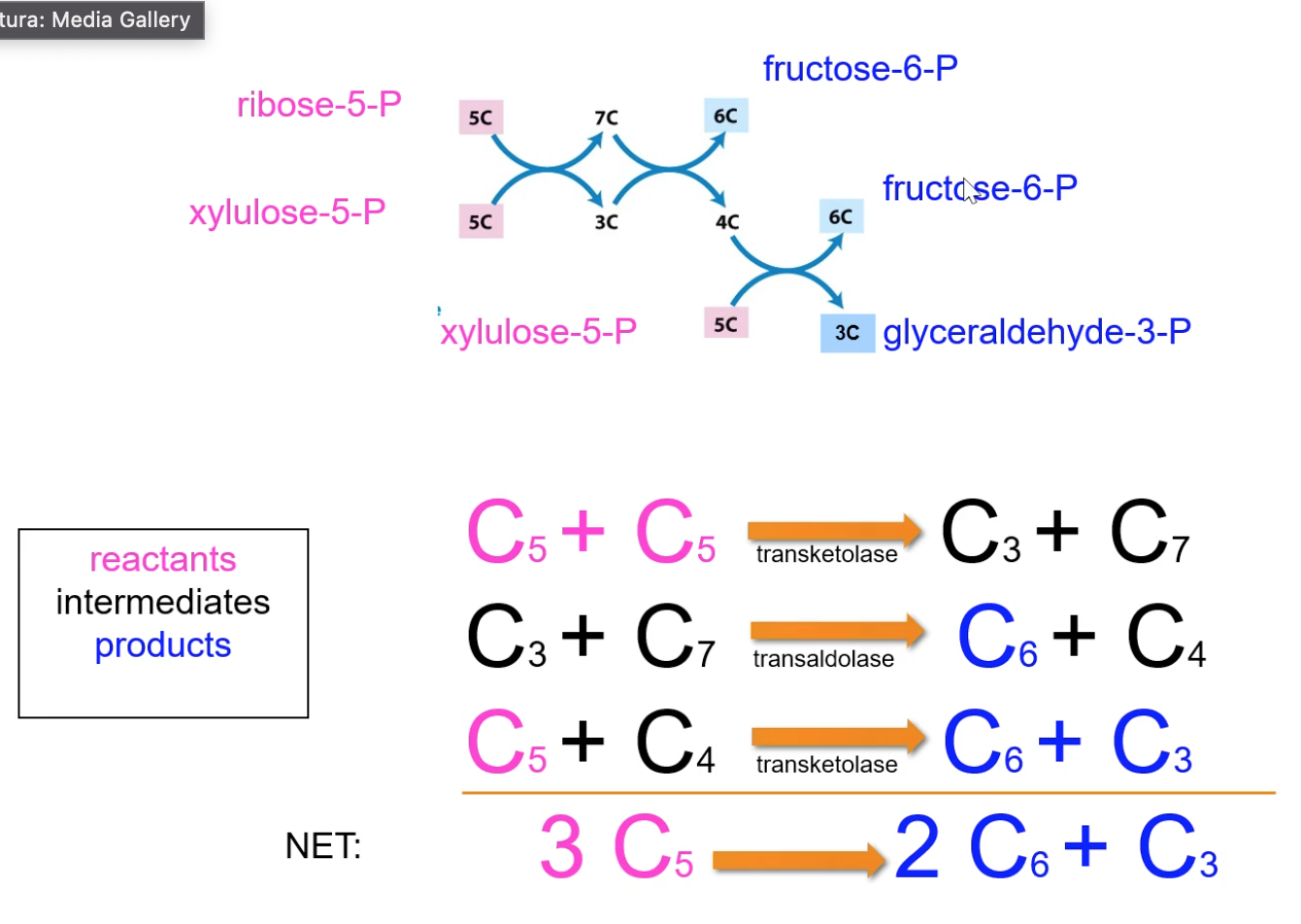
Non oxidative = allows excess 5C sugars (if not needed) → back to 6C sugars
3 non oxidative phase steps
transketolase: 5C + 5C = 3C + 7C
transaldolase: 7C + 3 C = 4C + 6C → F6P
transketolase: 4C + 5C = 3C + 6C → F6P
. 3C → GA3P
d F6P, GAP, all get made back into G6P (gluconeogenesis)
run the pathway twice = 2 GA3P (3C), which can be combined into fructose 3+3=6
how cell know how to run glycolysis or PPP?
regulation of G6PDH
PPP inhibited by high NADPH
PPP activated by high NADP+
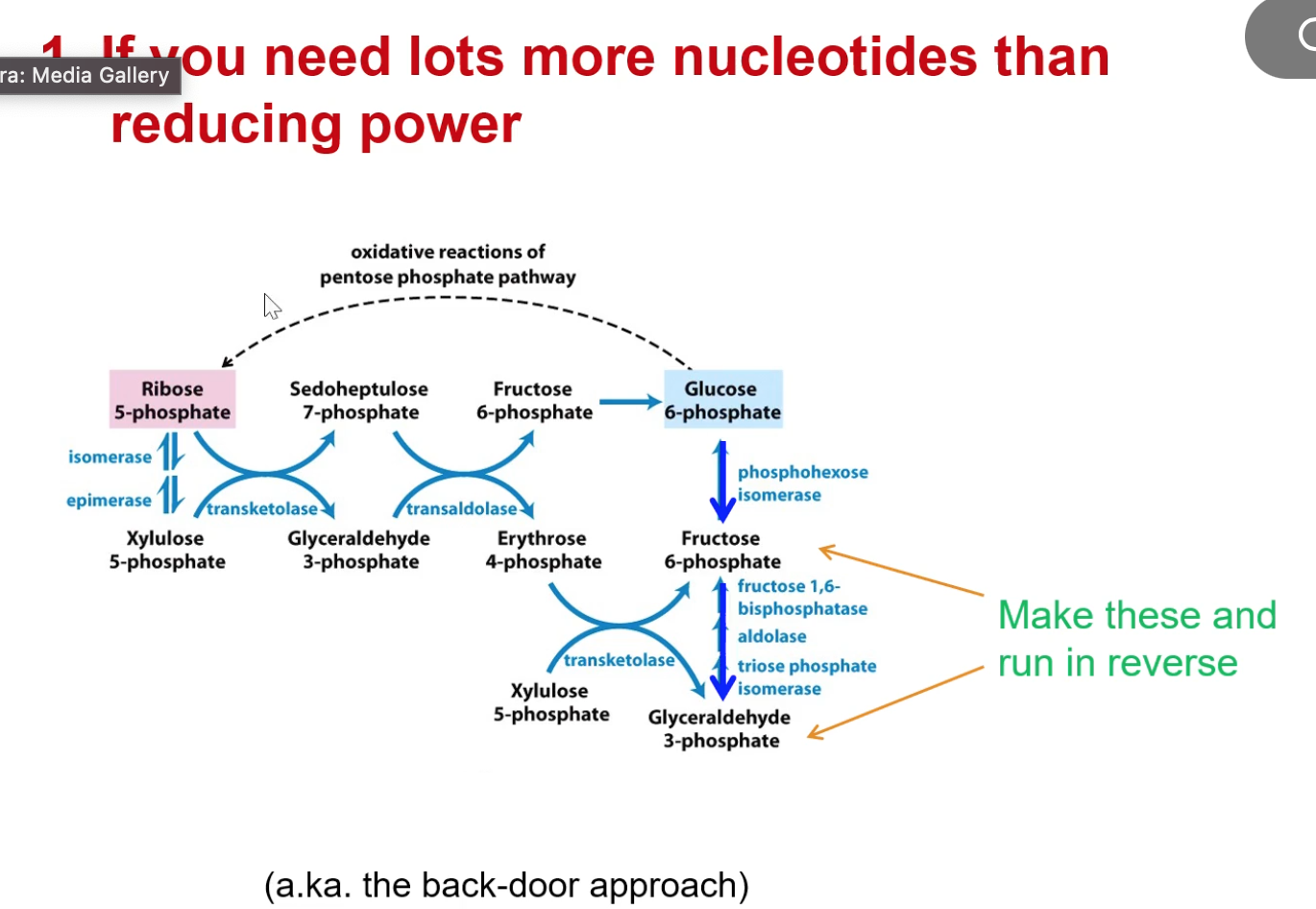
glycolysis, PPP, and gluconeogenesis share enzymatic steps… how does cell know which pathway to run?
what pathway(s) if the cell needs:
lots more nucleotides than reducing power =
why
pathways operate relative to each other based on what the cell needs
nucleotides not reducing power = glycolysis, non-ox PPP
glycolysis generates F6P and GAP
non-ox PPP runs in reverse to generate R5P
(transaldolase, transketolase, isomerase/epimerase rxns are reversible
same amount nucleotides and reducing power =
nucleotides and reducing power =
ox PPP is ON
5C not recycled but instead used to make nucleotides
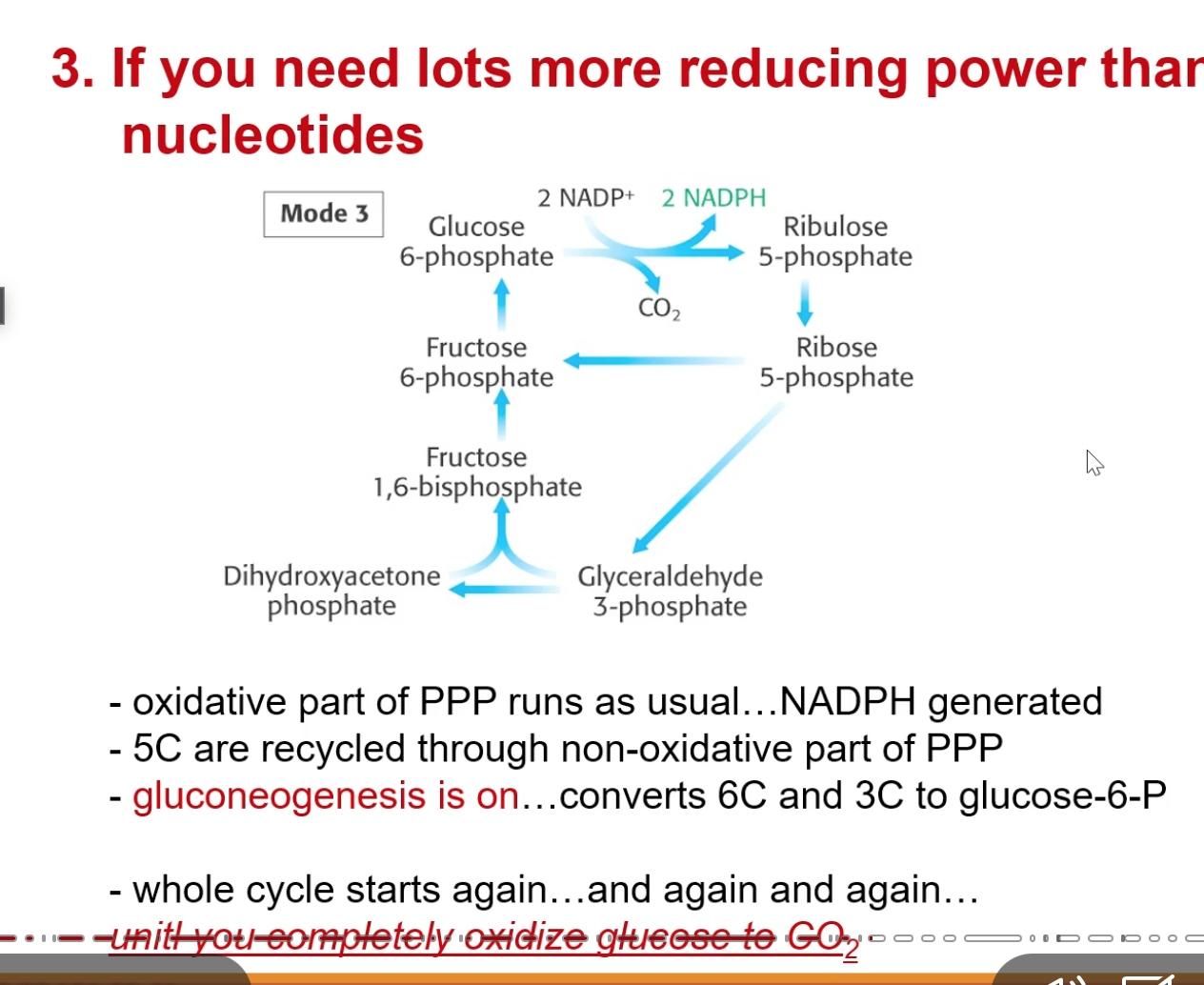
lots more reducing power than nucleotides =
lots more reducing power than nucleotides =
ox PPP is ON
non-ox PPP is ON
gluconeogenesis is ON (converts 6C and 3C to G6P)
cycle repeats until completely oxidize glucose to CO2
need reducing power and ATP =
need reducing power and ATP =
ox PPP is ON
non-ox PPP is OFF
gluconeogenesis is OFF, 3C and 6C complete glycolysis
Glycogen synthesis:
made where, 2 places glycogen stored/why
liver has what enzyme
when does glycogen synthesis occur/ why not do PPP?
2 things has to happen before glycogen synthesis
glycogen synthesis starts with what
what is the glucose donor to glycogen?
made in all tissues, muscles stores for their own use, liver stores to send glucose to brain
liver has glucose 6-phosphtase
high cell E, well fed and cell NOT replicating so you store it
2 things:
glucose 6-phosphate ←(phosphoglucomutase)→ glucose 1-phosphate
convert glucose to UDP-glucose = tag glucose for storage with NTP to ensure it goes to glycogen
starts with glucose 1 phosphate
glucose donor to glycogen = UDP glucose
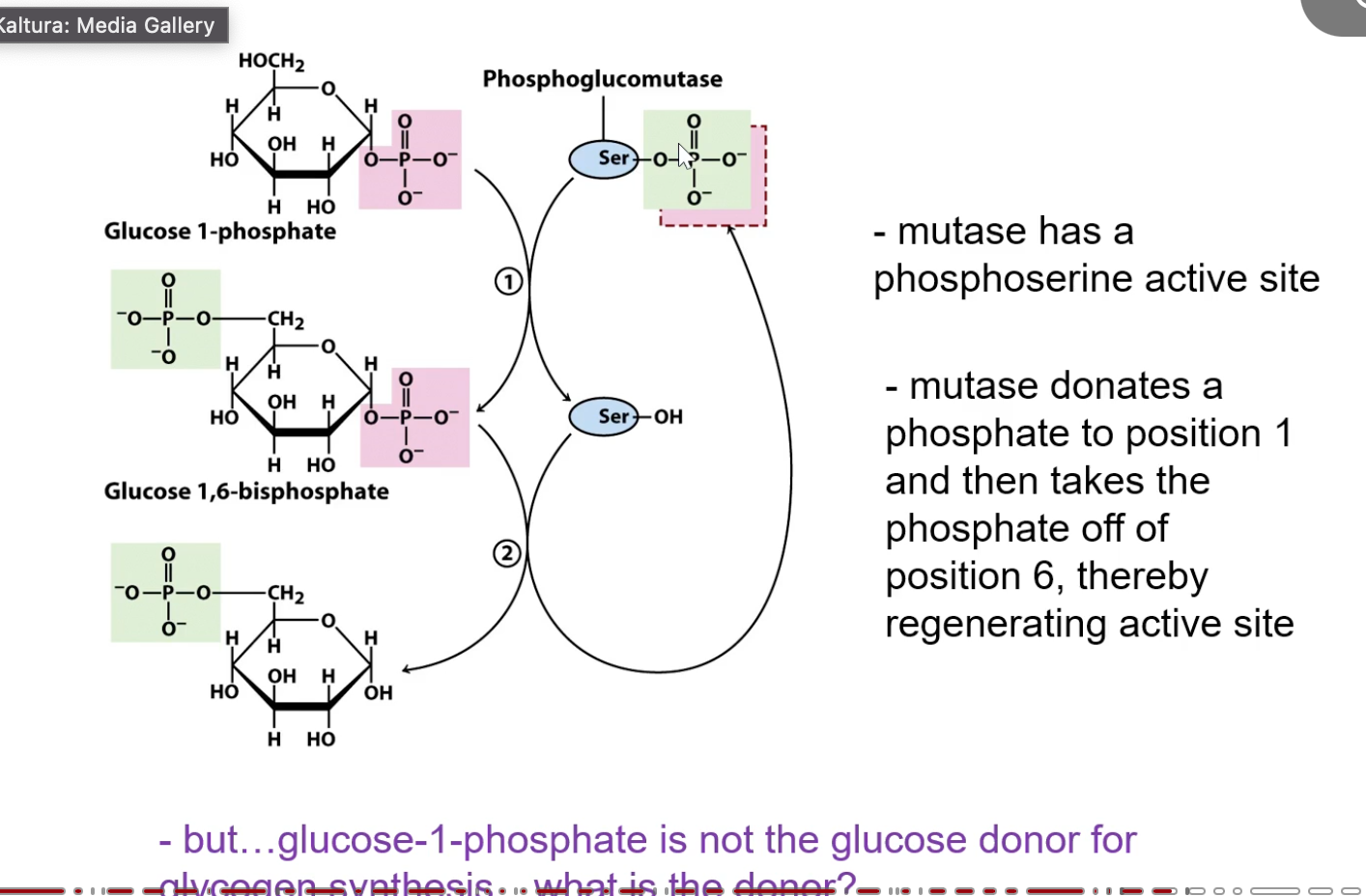
phosphoglucomutase:
reaction
needed for what
active site/how does it work
reaction = G6P ←> G1,6P <→ G1P (regenerates active site)
1st step before glycogen synthesis to create a new pool of glucose (G1P) bc G6P can do glycolysis or PPP
phosphoserine active site donates its phosphate to position 6, then removes it from position 1, regenerating active site
UDP glucose:
what is it
structure =
anomeric carbon =
why?
glucose donor for glycogen synthesis
structure = sugar nucleotide (UDP-sugar)
anomeric carbon is activated (a good leaving group is added onto it) via phosphate ester attachment to a nucleotide

4 advantages of UDP-glucose and other sugar nucleotides (NDP sugars)?
nucleotide moiety
reversible?
moiety = a recurring structure
3 advantages
nucleotide moiety = a “handle” for enzymes (has a lot of groups for enzymes to noncovalently bind)
nucleotide moiety = a great leaving group
tagging sugar separates it from metabolic sugar pool
forming sugar nucleotides is irreversible
(UDP-glucose) sugar nucleotide formation 2 step mechanism
reversible?
how driven
sugar phosphate + NTP -(NDP-sugar pyrophosphorylase)→ pyrophosphate (PPi) + sugar nucleotide (NDP sugar)
PPi -(inorganic pyrophosphase)→ 2Pi
how driven = product removal
irreversible

glycogen synthesis:
glycogen 2 types of ends/how many
3 enzymes
glycogen synthase = how does it work/what linkages
glycogen branching = how does it work/what linkages
glycogenin =
1 reducing end, many non reducing ends
glycogen synthase = extending strand
adds glucose from UDP glucose to non reducing end of glycogen chain via alpha 1→4 linkages
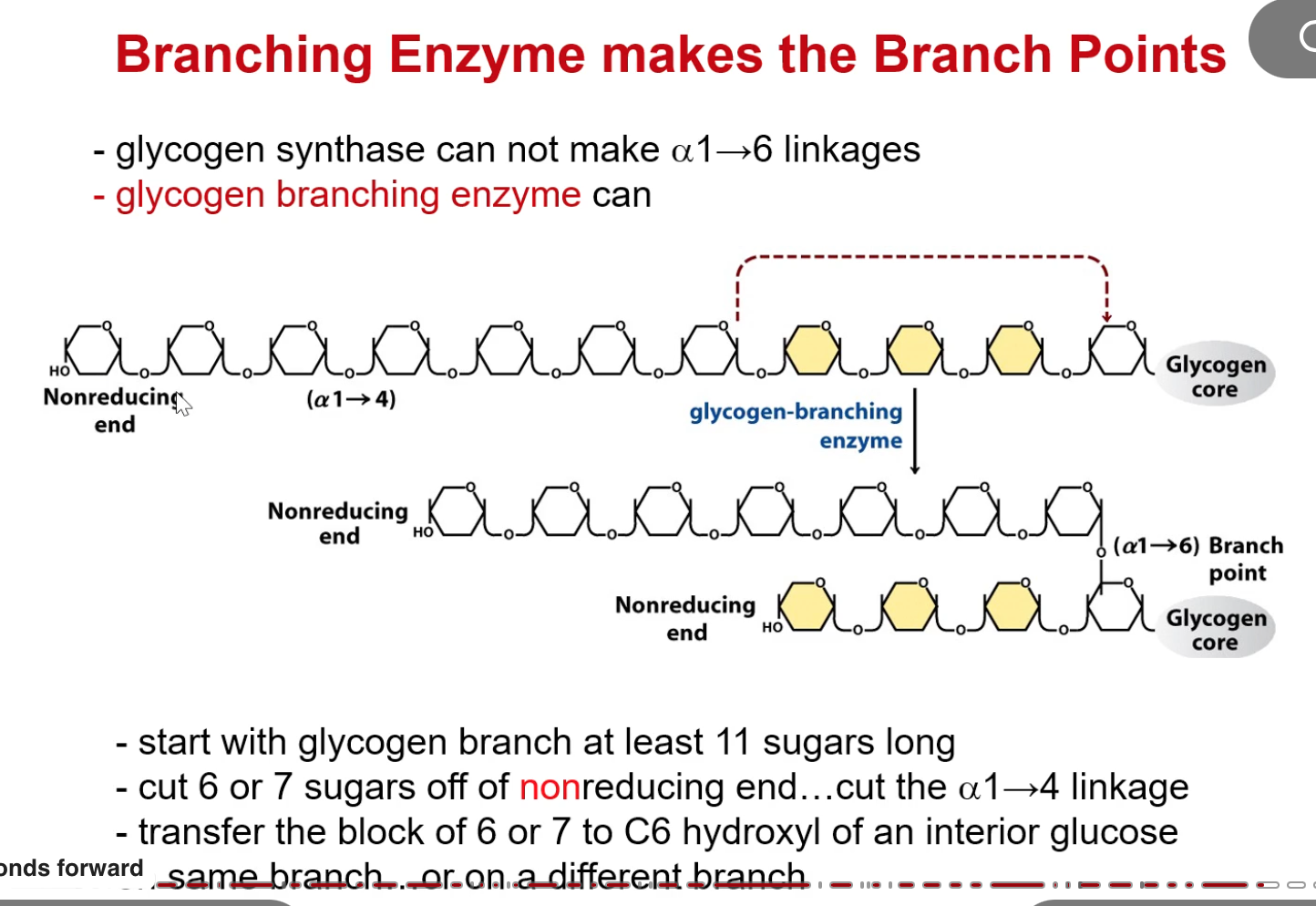
glycogen branching enzyme = making branches
glysynthase has to have made a glycogen brand at least 11 sugars long
gly branching enzyme cleaves 6-7 sugar branch off non reducing end
add branch to hydroxyl of an interior glucose via alpha 1→6 linkages
glycogenin (initiator) = makes primer to start new strand
glycogenin:
structure
2 step mech
after primer?
glyocogenin = has Tyr residue
mech
Tyr residue attacks/takes sugar from UDP-glucose
makes 8 residue primer by extending 7 sugar chain from initial glucose
glycogen synthase takes over once primer is made

glycogen structure:
what is attached at the reducing end
how many tiers
what at innermost/outermost tiers
molecules glucose v glycogen
glucogenin (initiator enzyme) at the one and only reducing end of glycogen
inner tear = 2 alpha 1→ branches, outermost tier = not branched
thousands of glucose mCs in only 1 mC glycogen

synthesis and breakdown from what end
3 enzymes of glycogen synthesis
2 enzymes of glycogen degradation
add onto and remove from non reducing end of sugar
synthesis
glycogenin = primer
glycogen synthase, = a1→4
glycogen branching enzyme, a1→6
breakdown
glycogen phosphorylase, = breaks a1→4
glycogen de-branching enzyme = breaks a1→6
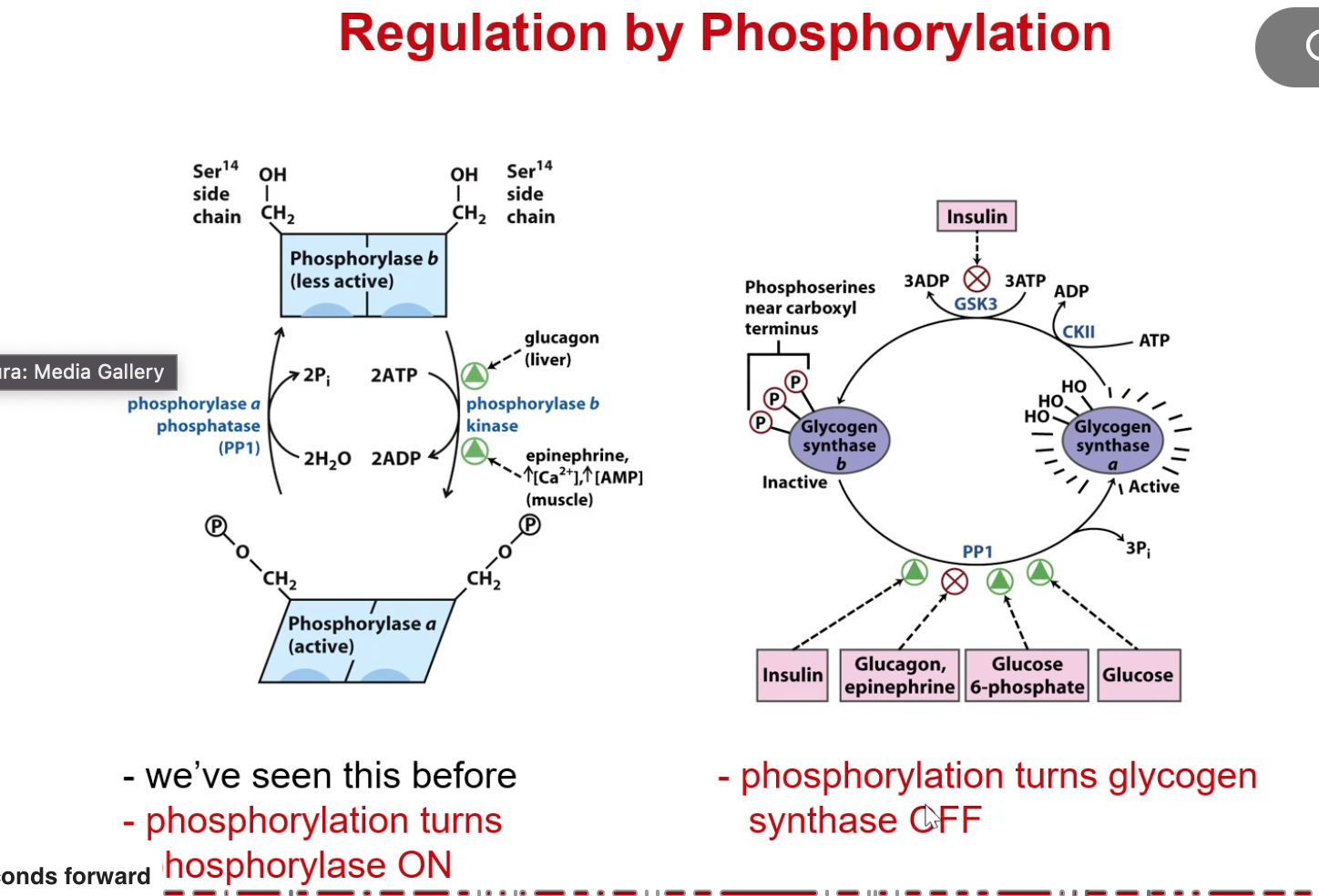
how is glycogen synthesis regulated?
2 forms glycogen synthase
high insulin, glucose , G6Ppresence?
regulated by phosphorylation of glycogen synthase
glycogen synthase A = active, unphosphorylated
phosphotase removes phosphate
glycogen synthase B = inactive, phosphorylated
kinase adds phosphate
high insulin, glucose , G6P = active
Glycogen breakdown:
glycogen phosphorylase =
which end
type of reaction
product
how get back to main pathways
glycogen phosphorylase = cleaving sugar off non-reducing end
phosphorolysis = cleavage by phosphate attack that leaves a phosphate on one of the mCs (as opposed to by water in hydrolysis)
product = glucose 1-phosphate
phosphoglucomutase will convert back to G6P
