Liver, Gallbladder & Pancreas
 Call Kai
 Learn
Learn Practice Test
 Spaced Repetition
 Match
Match Flashcards
 Knowt Play
1/34

There's no tags or description
Looks like no tags are added yet.
Name | Mastery | Learn | Test | Matching | Spaced | Call with Kai | Chat |
|---|
No analytics yet
Send a link to your students to track their progress
35 Terms
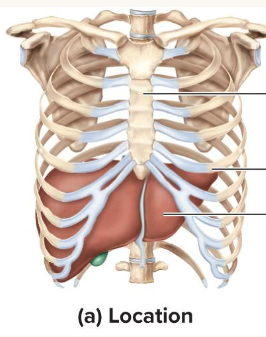
What is the liver and where is it located
The liver is the largest gland in the body and it is located in the Upper Right Quadrant inferior to the diaphragm
What is the main digestive function of the liver
to secrete bile
What are the 4 lobes of the liver
Right, left, caudate and quadrate

Right lobe of liver

Liver left lobe

Liver caudate lobe

Liver quadrate lobe
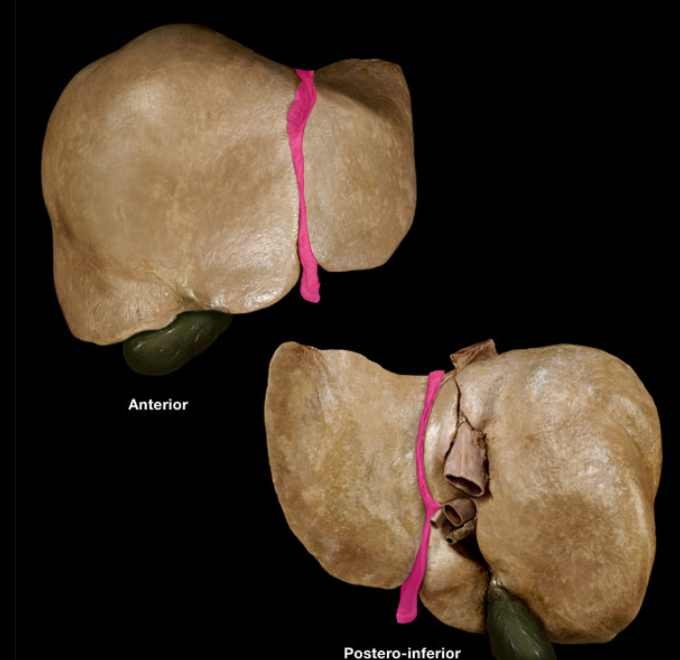
Falciform ligament of liver
Bile
Yellow green fluid secreted by the liver that facilitates fat and cholesterol absorption
What does bile contain
Bile acid/salt and pigments
Bile acid/ salt
a component of bile - cholesterol derivative that helps with fat emulsification (basically breaking down fat into smaller pieces so there is more surface area for digestive enzymes to work with)
Bile pigment
the primary bile pigment is bilirubin which is recycled from hemoglobin

Liver
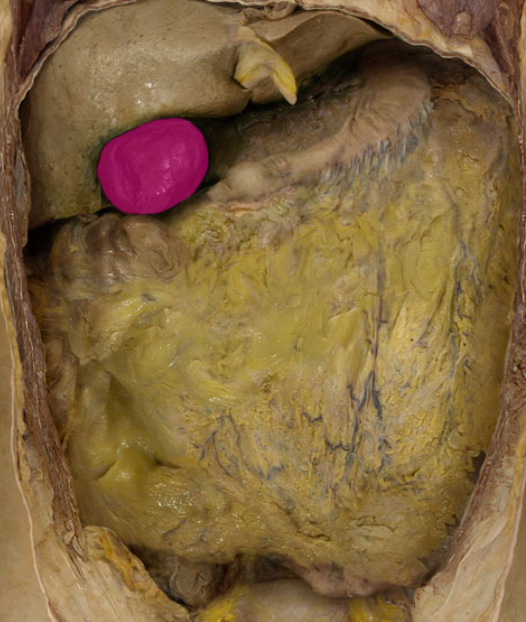
Gallbladder
What is the gallbladder and where is it located
thin walled pear shaped sac that is located posterior of the liver (URQ)
What is the 3 main function of galllbladder
store bile, concentrate the bile, and release bile
Pathway that the bile leaves the gallbladder
It leaves via the cystic duct and enters the common bile duct
Cholelithiasis
presence of gallstones (hardened deposits of bile) which can block the ducts
Where is the pancreas
it is retroperitoneal and it is located posterior to the greater curvature of the stomach
and the head is encircled by the duodenum
retroperitoneal vs intrapertioneal
retroperitoneal means behind the peritoneal
intraperitoneal means covered by the peritoneal (surrounded) → touching the visceral part
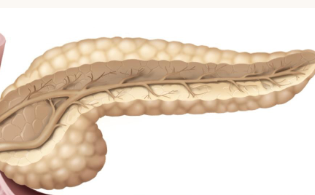
4 parts of the pancreas
head, neck, body, and tail

Pancreatic duct
What type of gland is the pancreas
endocrine and exocrine gland
Endocrine gland (what is it) and what does it release for the pancreas
release hormones into the blood → insulin and glucagon
Exocrine gland - what is it and what does the exocrine pancreas secrete
secretions into a duct to somewhere else
pancrease secretes pancreatic juice
Pancreatic juice
exocrine secretion by pancreas that contains digestive enzymes and bicarbonate ions
Pancreatic juice is a _____ solution with a pH of ___
and is a mixture of what
alkaline pH 8 → to neutralize acidic chyme
water, electrolytes (HCO3-) and enzymes/zymogens (inactive digestive enzymes)
Pancreatic juice digestive enzymes / zymogens
protease → protein
amylase → starch
lipase → fat
nuclease → nucleic acid
Zymogens
inactive digestive enzymes precursor
What are the three regulations of secretion of bile and pancreatic juic
ACh (acetylecholine), cck(cholecytokinin) , secretin
Ach (acetylcholine) -from what and during when
does what
from vagus nerve and enteric nerve during cephalic and gastric phase
initiates enzyme production → weak gallbladder contraction → release some bile from gallbladder to duodenum
Cck - cholecystokinin - what releases it and when
released by mucosa of duodenum as a reaction of chyme enters the small intestines (arrival of FAT!!!)
Function of cck cholecystokinin
stimulates gallbladder contractions (more than ACh) → causes bile to be released into the duodenum → emulsifying chyme (specifically the fat) (making it into smaller bits)
it also causes secretio of pancreatic juice which has enzymes → break down the chyme (fat)
Secretin - what releases it and when
also released by duodenum as a reaction to acidic chyme coming from the stomach
ACID!!!
Secretin function
stimulates liver and pancrease to secrete more sodium bicarbonate to increase the pH (counteracts the acidic chyme coming from stomach) so that digestive enyymes from the pancreas and intestine can work