L06 speech perception I
 Call Kai
 Learn
 Practice Test
 Spaced Repetition
 Match
 Flashcards
 Knowt Play
1/23

There's no tags or description
Looks like no tags are added yet.
24 Terms
speech perception
mental processes that convert sounds into ideas (comprehension)
articulation
a physical event - configure our vocal tract where sounds produced are filtered
perturbs air flow to create diff patterns of sound wave
consonants: air flow cut off when sound is produced
vowels: air flow unobstructed
articulatory phonology theory:
80s goldstein & browman
Theory that speech is organised into articulatory gestures
Gestures = movements of speech articulators
Speech perception involves perceiving gestures underlying the acoustic signal
gestural score
Representation of articulatory gestures involved in producing speech
Shows which articulators move and when:
which articulators
toward location in vocal tract where constriction occurs
w specific degree of constriction
occurring in a characteristic dynamic manner
contrastive gestures
Articulatory movements that distinguish speech sounds
Create differences in the acoustic speech signal
articulators
lips, tongue tip, tongue body, velum, glottis
semi independent:
Different articulators can perform overlapping movements
But their movements are physically and functionally coordinated
phonemes + classification/characteristics
produced by articulator movements 1/100ms
classified according to :
place of articulation
t/d dental
p/b lips together
manner of articulation
air flowing freely, vowels
max.blockage, stop consonant t/d/p/b
voicing
voicing
Whether vocal folds vibrate during production of a speech sound
Voiced: vocal folds vibrate (e.g., /b/, /d/, /g/, /z/)
Voiceless: vocal folds do not vibrate (e.g., /p/, /t/, /k/, /s/)
Distinguishes sounds that may share the same place and manner of articulation (e.g., /s/ vs /z/)
co-articulation
transitioning from 1 phoneme to another
gestures for adjacent phonemes overlap in time
gestures influenced by preceding & following phonemes
“pool” vs “pan”
compression & rarefaction
Compression = air particles closer together
Rarefaction = air particles further apart
Alternating compression and rarefaction creates a sound wave
what is frequency vs amplitude
frequency
Number of sound wave cycles per second
Measured in Hz
Higher frequency → higher perceived pitch
amplitude
Size of pressure variation in a sound wave
Greater amplitude generally → greater intensity → louder perceived sound
Why is speech a complex sound wave?
Speech contains multiple frequency components simultaneously
Each component has its own frequency and amplitude
Their combination creates the complex acoustic signal that we perceive as speech
sound spectrogram
Visual representation of acoustic energy in speech over time
X-axis = time
Y-axis = frequency
Darker/intense regions = greater acoustic energy
formants
Resonant frequency regions of the vocal tract
Vocal tract shape and size determine which frequencies are amplified
Formant patterns help distinguish speech sounds, especially vowels
steady-state formants?
Relatively stable formant frequency patterns
Occur when vocal tract configuration remains relatively stable
Particularly characteristic of sustained vowels
formant transition
Rapid changes in formant frequencies over time
Caused by articulatory movements changing the shape of the vocal tract
Useful for identifying consonants, especially transitions into vowels
coarticulation x spectrogram?
=> no unique spectrogram for each sound bc of coarticulation
perceptual constancy
Perceiving the same phoneme despite large differences in its acoustic signal across contexts
Example: /d/ in /di/ vs /du/
example , /di/ vs /du/
Co-articulation changes the acoustic properties of /d/
Formant transitions differ depending on the following vowel
Despite acoustic differences, both are perceived as /d/
Formant – horizontal bars
Transition – slanting bars
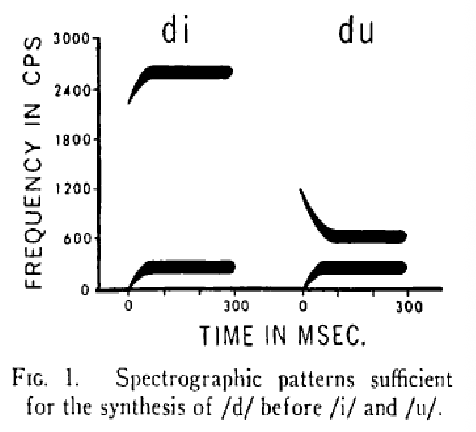
isolated formant transitions sound…
like chirps / whisles
They contain changing frequency information but lack the full speech signal
Listeners can still detect differences between them
In speech context, they contribute to perception of the same consonant in different vowel contexts
coarticulation → redundancy
Articulatory movements overlap, smearing information about phonemes across neighbouring segments
Each segment can provide clues about preceding and following segments
Multiple acoustic cues help identify phonemes => removing them makes perception harder
examples: silent center vowels & Franken-words
silent center vowels:
listeners can identify a word despite a missing vowel (e.g. "b_g" → "bag")
Remaining acoustic/co-articulatory cues help constrain the identity of the missing segment
franked-words = cross-spliced stimuli
Acoustic information in one segment can provide clues about neighbouring segments, even before they are heard
E.g. "jo" taken from "jog" contains information about the upcoming /g/
onset & code / burst & end
Onset = beginning consonant(s); coda = ending consonant(s)
Earlier-arriving information generally has a greater influence on perception
challenges for speech perception mechanism
No clean breaks between phonemes in continuous speech
Co-articulation: overlapping gestures cause acoustic properties of phonemes to vary with context
No fixed acoustic signature / 1:1 correspondence between acoustic signal and phoneme
Variability:
Between speakers (voice, vocal tract size, accent)
Within speakers (speaking rate, loudness, context)