Organ Systems (science bio) Galema
 Call Kai
 Learn
 Practice Test
 Spaced Repetition
 Match
 Flashcards
 Knowt Play
1/31

There's no tags or description
Looks like no tags are added yet.
32 Terms
Steps of Digestive System
Ingestion
Digestion
Absorption
Elimination
Protease
Digestive enzyme that break down proteins into amino acids
Lactase
Digestive enzyme that breaks down lactose into sugar (glucose)
Lipase
Breaks down fats
Amylase
Breaks down carbohydrates
Sucrase
Breaks down table sugars
Mechanical digestion
When we chew food with our teeth, which then creates a bolus, and then goes down the esophagus (peristalsis)
Chemical digestion
Saliva in our mouth (which has amylase in it) or our stomach acid
Detailed Explanation of Digestion Process
Ingestion - Food gets chewed (mechanical digestion) and it gets broken by saliva, teeth and tongue (chemical digestion).
Food becomes bolus and goes down esophagus by the process of peristalsis.
Digestion - Goes to stomach, wear foods gets pushed around by stomach muscles and broken down by hydrochloric acid “stomach acid”.
Absorption - Reaches the small intestine, villa lines the organ to increase nutrients. Where nutrients get absorbed in the blood
Anything undigested goes to the large intestine.
Then goes to rectum, and is realsed through the anus
Liver
Produces bile
Bile
A digestive fluid that helps dissovles fats when in the small intestine
Pancreas
Produces and supplies digestive enzymes to the small intestine
Gallbladder
Stores bile

A
Mouth

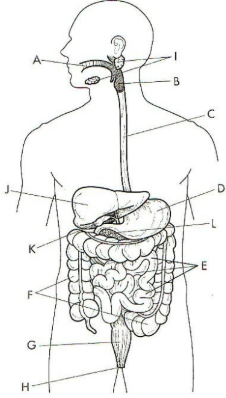
I
Salivary Glands


C
Esophagus
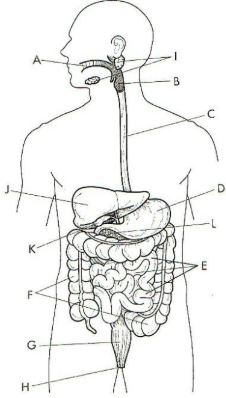
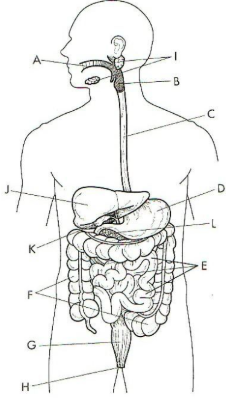
D
Stomach

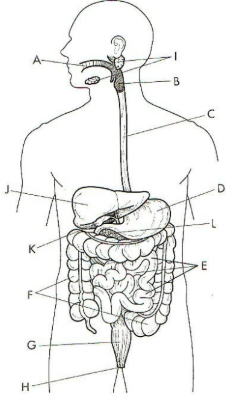
L
Pancreas

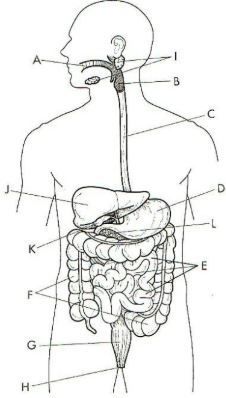
E
Small Intestine


J
Liver


K
Gall Bladder
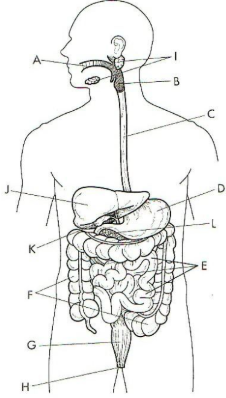

F
Large Intestine


G
Rectum


H
Anus

Ingestion
Bring food in body
Elimination
Excreting waste we dont need
Digestion
Breaking down food to nutrients
Absorption
Getting nutrients in bloodstream
Carbohyrdates
Used as fuel to help our body function
Protien
Used as a building material for muscles and tissues
Fats
Used to insulate but is the secondary source of energy (when no carbohydrates)
Why do we digest food?
Break down food to smaller pieces
Provide energy + nutrients
Repair/build the body