Phys 2213 Exam 3
 Call Kai
 Learn
 Practice Test
 Spaced Repetition
 Match
 Flashcards
 Knowt Play
1/18

There's no tags or description
Looks like no tags are added yet.
19 Terms



a). the definition of the question states that 2πr=nλ (n=1,2,3,…). Since the orbit is a closed loop, the wave meets itself after 2πr distance and since n is only whole numbers, crests align with crests and troughts align with troughts. This creates a stable standing wave around the circumference
b). 2πr=nλ=n(h/(mv))
mvr=n(h/(2π))
mvr=nℏ

Use the wavelength to figure out ΔE and figure out what n_final is. Then use rydbergs formula to figure out what n_initial is. Lyman is transtition to n=1, Balmer is transition to n=2, Paschen is transition to n=3


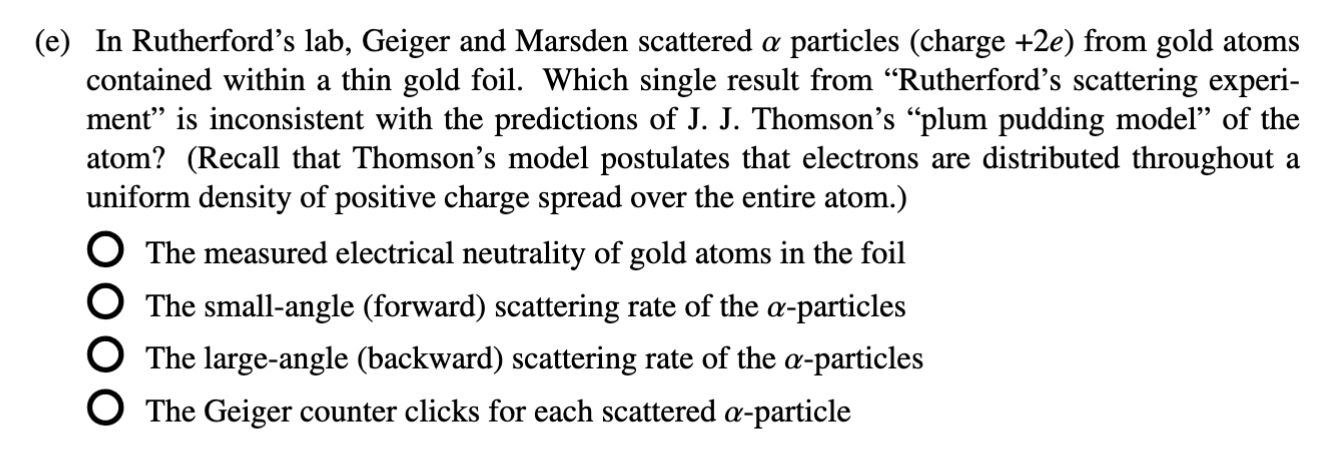
Large angle scattering was incorrect by Thomsons model

approximate diameter of an atom is 10-10
approximate diameter of an atomic nucleus is 10-15
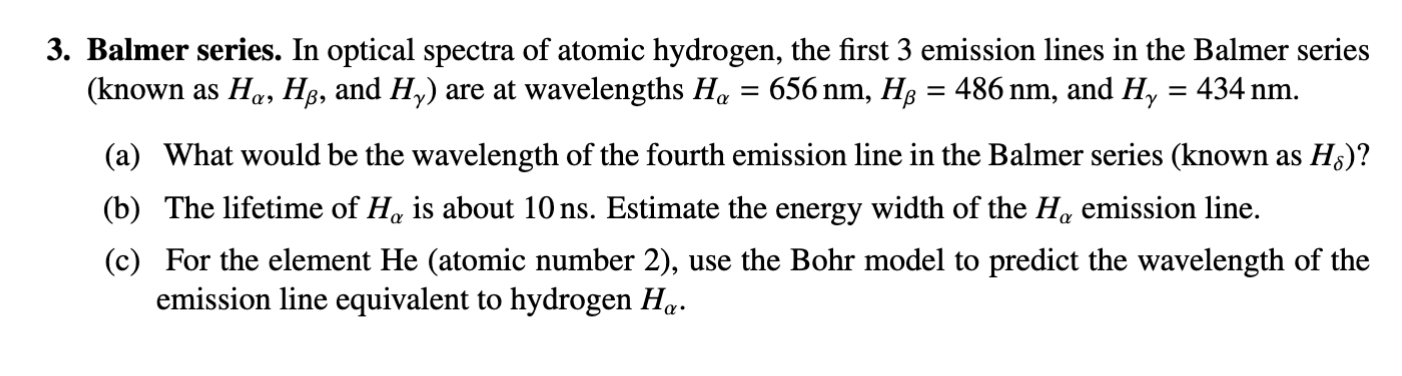
a). Find E2 and E6. Find ΔE and use λ=1240/ΔE.
b). Use heisenberg’s uncertainty. ΔEΔt >=ℏ/2 and solve for ΔE
c). This would be the transition from n=3 to n=2 and for He, Z=2. Use rydbergs formula with this to find lambda.

Constant:
total energy
magnitude of L
Not Constant:
position & momentum
direction of L
K & U separately
All of these are constant in the Bohr Model

The total energy is constant but U is not constant because it depends on r which is not constant. Thus, K is also not constant.

ψ depends on Φ so |ψ|2 depends on Φ2. Φ contains a factor of e+-imϕ and that squared simply equals 1. Thus Φ2 is a constant and |ψ|2 doesnt depend on Φ. Since Φ measures the rotation around the z-axis, the probability of finding the electron is identical everywhere along the ring around the z-axis.

No bcs in ground state, n=1 so l=0. Based on transition rules, Δl=+-1 and since 3d means l=2, this is not possible.

a). |L|=sqrt((l(l+1))
b). Lz=m1ℏ