Week 3 - Reflexes
 Call Kai
 Learn
 Practice Test
 Spaced Repetition
 Match
 Flashcards
 Knowt Play
1/34

There's no tags or description
Looks like no tags are added yet.
Name | Mastery | Learn | Test | Matching | Spaced | Call with Kai | Chat |
|---|
No analytics yet
Send a link to your students to track their progress
35 Terms
Primitive & Equilibrium Reflexes
___ motor response
Originate in the ___
Present in utero until ____
Necessary for newborn survival
Involuntary motor response
Originate in the brainstem
Present in utero until earlychildhood
Necessary for newborn survival
Studies show
__ or more abnormal reflexes are significantly morelikely to have Cerebral Palsy or Developmental Delay
Retained primitive reflexes are closely related to __
Correlated to __ difficulties
Persistent ______R - learning difficulties
and decreased motor skills
5 or more abnormal reflexes are significantly morelikely to have Cerebral Palsy or Developmental Delay
Retained primitive reflexes are closely related to ASD
Correlated to clock reading difficulties
Persistent ATNR, STNR, and TLR learning difficulties and decreased motor skills
Reflexes - ____ - ____
Reflexes - Motor Control and Development - Cognitive Learning
Primitive Walking/Stepping
Appears:
Integrates:
Stimulus:
Result:
If this didn’t integrate, what would it interfere with?
Primitive Walking/Stepping | 37 weeks gestation | 2 months | Hold infant upright, tilt forward, feet touching surface | Automatic stepping movements | High stepping Trouble w/ walking, balance, leg coordination |
Primitive Walking/Stepping
Primitive Walking/Stepping | 37 weeks gestation | 2 months | Hold infant upright, tilt forward, feet touching surface | Automatic stepping movements | High stepping Trouble w/ walking, balance, leg coordination |
Galant
Appears:
Integrates:
Stimulus:
Result:
If this didn’t integrate, what would it interfere with?
Galant | 30 weeks gestation | 2 months | Stroke skin along spine: shoulder→ hip | Lateral trunk flexion toward stimulus | Issues SB w/ crawling Fidgeting, can't sit still Poor posture |
Palmar grasp
Appears:
Integrates:
Stimulus:
Result:
If this didn’t integrate, what would it interfere with?
Palmar Grasp | 28 weeks gestation | 4 months | Pressure to ulnar side of hand | Finger flexion/grasp | Grip - won't let go Poor handwriting, weak pencil grip Difficulty w/ fine motor skills |
Plantar grasp
Appears:
Integrates:
Stimulus:
Result:
If this didn’t integrate, what would it interfere with?
Plantar Grasp | 28 weeks gestation | 9 months | Pressure to sole just proximal to metatarsal heads | Toe flexion/grasp | Balance problems Toe walking |
Moro/Startle grasp
Appears:
Integrates:
Stimulus:
Result:
If this didn’t integrate, what would it interfere with?
Moro/Startle | 28 weeks gestation | 5 months | Sudden noise or dropping sensation | Arm abduction/extension followed by adduction; crying | Emotional dysregulation
|
Rooting grasp
Appears:
Integrates:
Stimulus:
Result:
If this didn’t integrate, what would it interfere with?
Rooting | 28 weeks gestation | 3-8 months | Stroke cheek/side of mouth | Head & mouth turns toward stimulus | Feeding problems Drooling Speech difficulties |
Sucking/Swallow grasp
Appears:
Integrates:
Stimulus:
Result:
If this didn’t integrate, what would it interfere with?
Sucking/Swallow | 28 weeks gestation | 5 months | Touch lips or inside mouth | Rhythmic jaw excursion Tongue movement up/down→ swallow | Feeding problems Drooling Speech difficulties |
Asymmetrical Tonic Neck Reflex (ATNR) grasp
Appears:
Integrates:
Stimulus:
Result:
If this didn’t integrate, what would it interfere with?
ATNR (Asymmetrical Tonic Neck Reflex) | 20 weeks gestation | 6 months | Turn head to one side | Face side: arm/leg extend Skull side: arm/leg flex | Difficulty crossing midline Handwriting issues Poor coordination |
Symmetric Tonic Neck Reflex (STNR)
Appears:
Integrates:
Stimulus:
Result:
If this didn’t integrate, what would it interfere with?
STNR (Symmetrical Tonic Neck Reflex) | 1 month | 4-6 months | Neck flexion or extension | Flexion: arms flex, hips extend Extension: arms extend, hips flex | Poor posture Difficulty sitting still Poor hand-eye coordination |
Tonic Labyrinthian Reflex (TLR)
Appears:
Integrates:
Stimulus:
Result:
If this didn’t integrate, what would it interfere with?
TLR (Tonic Labyrinthine Reflex) | Birth | 4-6 months | Head position in prone or supine | Prone: increased flexor tone Supine: increased extensor tone | Poor balance, posture, coordination, body awareness |
Landau
Appears:
Integrates:
Stimulus:
Result:
If this didn’t integrate, what would it interfere with?
Landau | 4-6 months | 2-3 years | Held horizontally in prone | Extension of head, trunk, and legs | Weak posture Poor trunk strength Delayed postural control |
Amphibian
Appears:
Integrates:
Stimulus:
Result:
If this didn’t integrate, what would it interfere with?
Amphibian | 6 months (after ATNR integration) | Not listed | In prone, lift pelvis on one side | Same-side hip, knee, and arm flexion | Trouble rolling & rotating Poor coordination of head & body movements |
Neck Righting on Body
Appears:
Integrates:
Stimulus:
Result:
If this didn’t integrate, what would it interfere with?
Neck Righting on Body | 4-6 months | 5 years | Turn head in supine | Log rolls to that side | Difficulty crawling, rotation, coordination body movements |
Protective Extension
Appears:
Integrates:
Stimulus:
Result:
If this didn’t integrate, what would it interfere with?
Protective Extension | Downward: 4 mo Forward/Lateral: 6-9 mo Backward: 9 mo | Life | Pushed in a direction Or head held down | Arm extension to prevent fall | Increased fall risk Decreased confidence w/ movement |
Five Most Common Retained Reflexes
Moro Reflex/Startle Reflex
ATNR (Asymmetrical Tonic Neck Reflex)
STNR (Symmetrical Tonic Neck Reflex)
Palmar Grasp Reflex
TLR (Tonic Labyrinthine Reflex)
Retained Moro Reflex
What should happen
Arms extend to catch self
What is a retained Moro generally associated with?
Exaggerated startle response
Coordination and balance - Poor eye tracking
Sensory sensitivities
Emotional Dysregulation - difficulty focusing, poor impulse control, anxiety
Activities to help a retained Moro

What is popcorn on floor

Retained ATNR - what should happen
Able to rotate head without arm movement
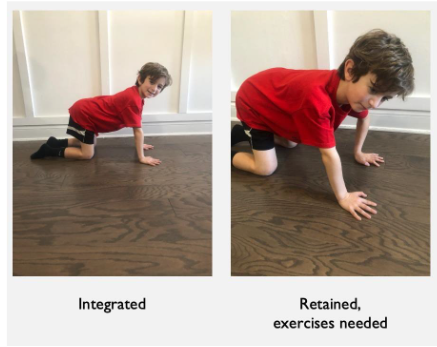
What is a retained ATNR generally associated with?
Difficulty crossing midline
Bilateral tasks
Visual Tracking - Hand-eye coordination - Handwriting
Sensory Processing
Activities to Help - Retained ATNR
Seated Switch up
Lizard
Cross Crawl
Standing
Sitting
Hands and knees
Wall pushes with head turns
Retained STNR - what should happen?
Should be able to flex head and extend arms
What is a retained STNR generally associated with?
Poor sitting posture - slouching
“W” Sitting
Difficulty crawling
Poor upper and lower body coordination
Clumsiness and poor ball skills
Visual Tracking - Reading and Writing challenges
Decreased attention and focus & fine motor
Activities to Help - Retained STNR
Cat Cow
Rocking Horse/Child Pose
Head – Ball push course
Superman
Bird Dog
Retained Palmar Grasp - What should happen?
Independent finger movements, easily release objects
What is a retained Palmar Grasp generally associated with?
Decreased fine motor skills (writing, drawing, using fork/spoon
Mouth movements, tongue sticking out during activity
Speech issues
Early fatigue with fine motor tasks
Activities to Help - Retained palmar grasp
Songs with finger pinching
One hand then two, looking at hands then looking away
Playdough or putty
Paper crumpling
Beading/blocks/legos
Sensory stimulation to hands
Animal walks
Hands in different postures
Retained TLR - What should happen
Arms and legs should move independently of head position
Should be able to hold “superman”
What is a retained TLR generally associated with?
Poor Posture
Low Muscle Tone (Floppy)
Balance/Coordination
Toe Walking
Spatial Perception Issues
Sequencing Issues
Activities to Help - Retained TLR
Yeah-Woah’s!
Superman/Superwoman