chem 2 exam
 Call Kai
 Learn
Learn Practice Test
 Spaced Repetition
 Match
Match Flashcards
 Knowt Play
1/120

There's no tags or description
Looks like no tags are added yet.
Name | Mastery | Learn | Test | Matching | Spaced | Call with Kai | Chat |
|---|
No analytics yet
Send a link to your students to track their progress
121 Terms
Solution
homogenous mixtures where a solute is dispersed throughout a solvent
more moles
lower molar mass
when you see % by mass choose
100 g of solution and use mass percent to get mass of solute
how to calc molar mass
divide g by moles
solute
dissolves
if nonelectrolyte, i equals
1
solvent
does the dissolving
How do we express concentrations in solutions qualitatively
dilute, concentrated
How do we express concentrations in solutions quantitatively
mass percentage/ppm/ppb
mole fraction
molarity and molality compare
solute to the whole using different units
mass percent ex
5% nacl
if we had 100 g of solution, 5g would be NaCl and 95 g would be water
Mass percent equation
(mass of solute/total mass of solution) x 100
unitless
density of water at room temp
1g/mL
ppm and ppb equations
ppm= (mass of solute/total mass of solution)x 10^6
ppb= (mass of solute/total mass of solution)x 10^9
Mole fraction
x= moles of solute/total moles of solution
max is 1→ pure substance
molarity
depends on temp bc volume changes with temp
M=moles of solute/L of solution
molality
does not depend on temp bc the mass of the solution will no change with temp
m=moles of solute/kg of solvent
1 kg
1×10³
Colligative Properties
physical properties of solutions that depend on the quantity of solute particles present
they do NOT depend on the identity of the particles
what are the four Colligative Properties
osmotic pressure
vapor pressure lowering
boiling pt elevation
freezing pt depression
osmosis
net movement of a solvent from an area of low solute concentration to an area of high solute concentration
solvent moves through a semipermeable membrane
solute cannot pass through membrane
semipermeable
solvent can cross the membrane but solute cannot
osmosis is from
low to high concentration
osmotic pressure (pi)
the pressure needed to stop the movement of solvent throught the membrane
force generated from osmosis
osmotic pressure equation
v= volume (L)
n= moles
R= ideal gas constant→ 0.0821
T=temp (K)
M=molarity

ex of osmotic pressure
salt concentration of blood cells
when the solution concentrations on both sides of the membrane are equal they are
isotonic
when the concentrations are unequal, the more concentrated solution is ___ and the less concentrated solution is ___
hypertonic
hypotonic
reverse osmosis
used to remove contaminants from solutions
similar to filtration
applied pressure forces the solution through a membrane permeable to water, but not permeable to dissolved components
van’t Hoff Factor
i=moles of particles in solution/moles of fu dissolved
osmotic pressure equation using van’t hoff factor
pi=iMRT
vapor pressure
pressure exerted by vapor above a liquid in a closed container

explain this
from left-right: stronger IMGS
boil at lower temp if pressure is lower
equation:

The vapor pressure of a solution containing a nonvolatile solute is ___ than the vapor pressure of the pure solvent
lower
the solute-solvent interaction make is difficult for the
solvent particles to escape into the vapor
raoult’s law

phase diagram for a solution
The graph shows how adding a nonvolatile solute changes the phase behavior of a solvent.
The solute lowers vapor pressure, which causes the solution to have a lower freezing point and a higher boiling point than the pure solvent.
These effects are called colligative properties because they depend on the number of dissolved particle

the boiling pt of a solution is
higher than that of a pure liquid
boiling pt eleavation formula
m=molality

the freezing point of a solution is
lower than that of the pure liquid
freezing pt depression equation

Solubility of gases generally
decreases as the temp increases
solubility depends on
IMFs and thermodynamic properties of the solvation process
Henrys Law
C= solubility
K is henrys law constant
P is the partial pressure

solubility is directly proportional to
the pressure of a gas over the solution
strong electrolytes
soluble ionic compounds, strong acids, strong bases
weak electrolytes
weak acids, weak bases, slightly soluble ionics and very few covalents
nonelectrolytes
organic compounds and most covalents
strong acids
HCl, HBr, HI, HClO4, H2SO4, HNO3
strong bases
group 1 hydroxides, Ca(OH)2, Ba(OH)2, Strontium hydroxide
weak acids
HC2H3O2, HF, HClO, HNO2, H2CO3, H3PO4, H2S
Photochemical smog
a mixture of gases formed when sunlight interacts with compounds produced in internal combustion engines
the speed and timescale of reactions can be studied by
chemical kinetics
kinetics
the rate at which chemical reactions occur
we can use kinetics to understand
the rate at which reactions occur
the factors that influence reaction rate
the reaction mechanism, or exactly how the reaction occurs
Rate of reaction
proportional to the rate of reactant collisions: rate collisions/time
collision theory
the reacting species must collide in an orientation that allows contact between the atoms that will become bonded together in the product (steric factor)
the collision must occur with adequate energy so that atoms can rearrange and form new bonds (and new chemical species)
Collision theory conditions
molecules must collide
molecules must collide in the proper orientation
molecules must collide with sufficient energy
reaction rate
how rapidly a reaction occurs, usually expressed as concentration/time (M/s)
Factors affecting reaction rates
physical states of the reactants → # collisions, energy
concentration of reactants → # collisions (more stuff, more likely things are to collide)
temperature → # collisions, energy (more temp, more energy)
surface area→ # collisions, orientation (bigger the molecule, the morelikely it is to running into something)
catalysts → orientation, energy
rates of reactions can be determined by
monitoring the change in concentration of either reactants or products as a function of time
rate=
change in concentration/change in time
rate of disappearance
reactants
negative
rate of appearance
products
positive
in general for a reaction:

three types of reaction rates
average rate
instantaneous rate
initial rate
average rate
calculated by subtracting an initial concentration and time from any subsequent concentration and time
instantaneous rate
the rate at any given pt in time
corresponds to the slope a line tangent to the concentration v. time
would have to draw the tangent line and calculate the slope
initial rate
the instantaneous rate at t=0
a general rate law can be written
k[A]m[B]n
describes the rate of reaction as a function of concentration of teh reactants
k
rate constant
m and n
the reaction order
the overall order is the
sum of the exponents
when the concentration doubles
the initial rate doubles
we can gain information about the rate of reaction by
seeing how the rate changes in inital concetrations of reactants
integrated rated laws
provide a way to determine concentration as a function of time
zero order equation

first order equation

second order equation
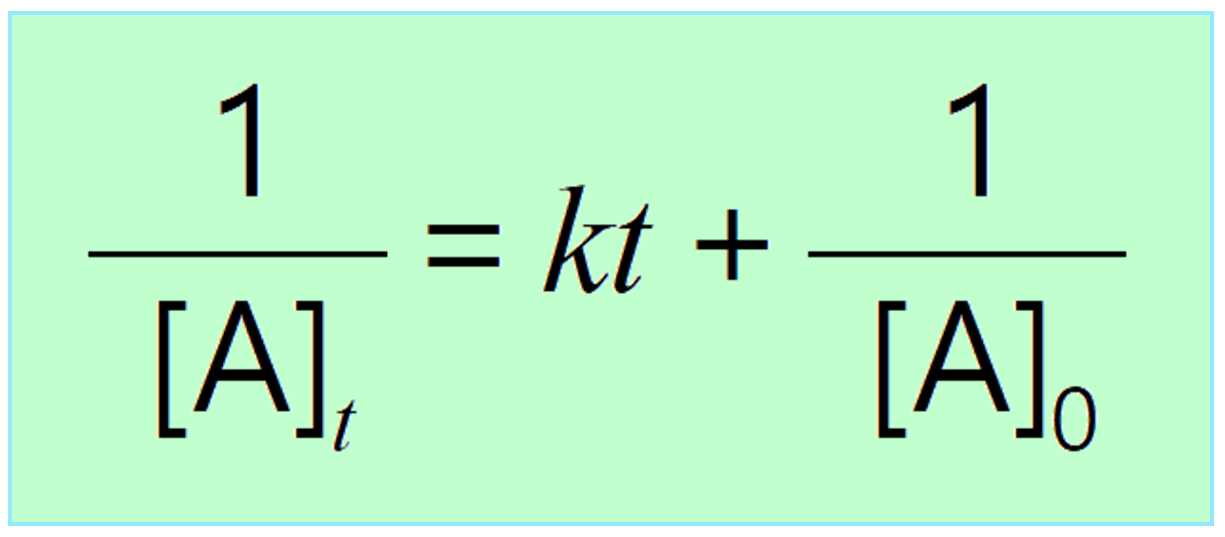
when calculating exponents for a rate
choose the reactions where one of the rates cancels
always put the bigger rate on top
to calculate total mols/mass of solution
add the mols/g of solute and solvent together
for first order reactions, no matter what the astarting concentration is
it will take the same amount of time to reach the desired concentration
Half life
the time required for one-half of a reactant to react
Half life zero order

half life first order
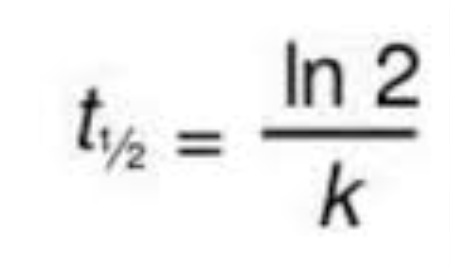
half life second order

slope=
y2-y1/x2-x1= -k
transition state
a proposed high-energy transient state between products and reactants
acitvated complex
specific chemical species in the transition state
what is always soluble
acids, ammonia, Na, K, NH4, nitrates, and acetates
all chlorides are soluble except
AgCl, HgCl2 and PbCl2
all bromides are soluble except
AgBr, PbBr2, HgBr2
all iodides are soluble except
AgI, PbI2, HgI2
All sulfates are soluble except
PbSO4, HgSO4, SrSO4, BaSO4, Ag2SO4, CaSO4
all sulfides are insoluble except for
Group 1, 2 and ammonium
all hydroxides are insoluble except
group 1, ammonium, ba, sr, and ca
all carbonates, phosphates, and sulfites are insoluble except
group 1 and ammonium
reaction profile
allows use to visualize the energetics and progress of a reaction

exothermic reaction profile
Ea→ activation energy
delta H: difference in energy between products and reactants; negative

endothermic reaction profile
