Social Psychology Exam 1
 Call Kai
 Learn
 Practice Test
 Spaced Repetition
 Match
 Flashcards
 Knowt Play
1/89

There's no tags or description
Looks like no tags are added yet.
90 Terms
Social Psychology and Social Problems
Social psychology can help us study social problems and find ways to solve them.
Social psychological theories about human behavior have been applied to a range of contemporary problems, including:
Prejudice
Energy shortages
AIDS
Unhealthy habits
Violence in schools
Social Perception
The study of how we form impressions of and make inferences about other people.
Impression Management
The attempt by people to get others to see them as they want to be seen.
Impression Formation
The process of integrating various sources of information about a person into an overall judgment (forming of the first knowledge a person has about another person)
The first step in Impression Formation is categorizing people into groups
Social Perception and Stereotypes
Categorizing people into groups can lead to stereotyping, in-group, and out-group
Stereotypes
Fixed sets of beliefs (thinking) about people that put them into categories and does not allow for individual variation
In-group
A group to which we belong and that forms a part of our social identity
Out-group
Any group with which we do not share membership
Stereotyping Consequences
Stereotyping can lead to Prejudice and Discrimination
Prejudice
cognitive negative attitude
Discrimination
harmful behavior toward member of out-group
IAT and Stereotypes
IAT developed to identify implicit bias and hopefully not let it lead to overt actions or conscious bias
Physical Attractiveness Stereotype
The belief that physically attractive individuals possess socially desirable personality traits and lead happier, more fulfilling lives than less attractive persons
Also called “what is beautiful is good” belief
Out-Group Homogeneity
The belief that “they” are all alike.
In-group members tend to perceive out-group members as being more similar (homogeneous) than they really are.
If you know something about one out-group member, you are more likely to feel you know something about all of them.
Social Categorization: Jane Elliot Study
In Jane Elliot’s third-grade classroom, children grouped according to eye color began to act differently based on that social categorization.
Blue-eyed children, the superior group, stuck together and actively promoted and used their higher status and power in the classroom.
They formed an in-group, defined as the group with which an individual identifies.
The blue-eyed kids saw the brown-eyed ones as outsiders—different and inferior.
To the blue-eyed children, the brown-eyed kids were the out-group, the group with which the individual does not identify.
Jigsaw Classroom
Classroom setting designed to reduce prejudice, promote integration, and raise the self-esteem of children
Placing children in small, desegregated groups
Make each child dependent on the other children in the group to learn the course material and do well in the class
Why does the Jigsaw Classroom work?
One of the most effective ways of improving race relations, improving empathy, and improving instruction
Breaks down perception of in-group and out-group, creates feeling of “one-ness”
People must do each other “favors” by sharing information
It is in each child’s self-interest to cooperate with others
Develop empathy for others
Social Cognition
How people think about themselves and the social world; how people select, interpret, remember, and use social information to make judgments and decisions.
Social Cognition Perspective
views people as “amateur sleuths” doing their best to understand and predict their social world
Power of Social Influence
Aspects of the social situation that may seem minor can have powerful effects and can overwhelm personality differences
Community Game vs. Wall Street Game
Randomly assigned to one of two groups:
One group told the game was called “The Wall Street Game”
Other group told the game was called “The Community Game”
In this experiment, when the name of the game was the “Community Game,” players were far more likely to behave cooperatively than when it was called the “Wall Street Game”—regardless of their own cooperative or competitive personality traits. The game’s title conveyed social norms that trumped personality and shaped the players’ behavior.
Gestalt Psychology
A school of psychology stressing the importance of studying the subjective way in which an object appears in people’s minds (the gestalt or “whole”) rather than the objective, physical attributes of the object.
Construal
the way people interpret the social situation; has its roots in Gestalt psychology
Two Motives for Construal
Construals shaped by two basic human motives:
The need to be accurate
The need to feel good about ourselves
Motives may tug in opposite directions
Two Kinds of Social Cognition
Automatic Thinking and Controlled Thinking
Automatic Thinking
Thinking that is quick, nonconscious, unintentional, involuntary, and effortless.
No conscious deliberation of thoughts, perceptions, assumptions
We engage in an automatic analysis of our environments based on past experiences and knowledge of the world.
Controlled Thinking
Effortful and deliberate
Thinking about self and environment
Carefully selecting the right course of action
Schemas
Component of automatic thinking
Schemas are the mental structures people use to organize their knowledge about the social world around themes or subjects.
Schemas therefore influence the information people notice, think about, and remember.
Two Types of Mindsets
Dweck: Fixed Mindset and Growth Mindset
Fixed Mindset
Idea that we have a set amount of an ability that cannot change
Growth Mindset
Idea that our abilities are malleable qualities that we can cultivate and grow
Two Types of Views of the Self
Independent View of Self and Interdependent View of Self
Independent View of Self
Defines self through own internal thoughts, feelings, and actions and not other people’s
Independence and uniqueness valued
Held in many Western cultures
Interdependent View of Self
Defines self through relationships to others
Recognizes that others’ thoughts, feelings, and actions affect one’s behavior
Connectedness, interdependence valued
Uniqueness frowned upon
Held in many Asian and non-Western cultures
Social Norms
The implicit or explicit rules a group has for the acceptable behaviors, values, and beliefs of its members.
Social Influence
the process through which the real or implied presence of others can directly or indirectly influence the thoughts, feelings, and behavior of an individual
Conformity
changing one’s own behavior to match that of other people
Asch’s Study
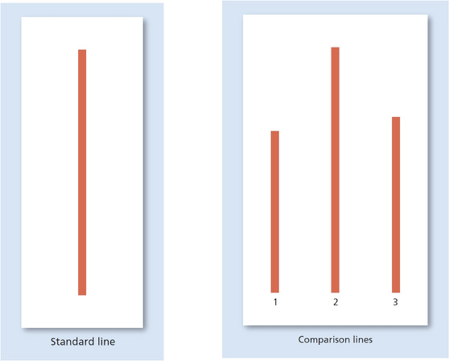
Participants in Asch’s famous study on conformity were first shown the standard line. They were then shown the three comparison lines and asked to determine to which of the three was the standard line most similar.
In a series of studies of normative social influence, participants judged which of the three comparison lines on the right was closest in length to the standard line on the left. The correct answer was always obvious (as it is here). However, members of the group (actually confederates) gave the wrong answer out loud. Now the participant faced a dilemma: Give the right answer and go against the whole group, or conform to their behavior and give an obviously wrong answer?
Prosocial Behavior
actions that someone performs in order to benefit others—generally valued by society
Helping Behavior
acts where people voluntarily and intentionally behave in a way they believe will benefit others—a specific type of prosocial behavior
Altruism
an act which benefits others but is not expected to have any personal benefits
Theorists on Altruism
Theorists debate is any true altruism?
They point out benefits of helping others to the self
Social Learning Theory
Bandura, 1977
Modelling shows us how to behave
Can model positive behaviors such as helping others
And negative behaviors such as aggression
Students focused on this as a way to reduce aggression in their presentation
Situation Determinants of Helping
Although people often see people in need of help, they sometimes don’t go and offer it themselves
Case of Kitty Genovese (1964) lead to research to understand why people help in some situations and not in others
Latané and Darely
Bystander encounters emergency
Goes through 4 stages
A decision made at each stage
Only if reach stage 4 will help be given…
Latané and Darely’s Cognitive Model (Four Stages)
Situation: Victim in an emergency
Attending to the incident
Define the incident
Accept personal responsibility
Decide what to do
Final Decision
Empathy-Altruism
Batson (1991) explains why we sometimes help for egoistical reasons and sometimes for altruistic reasons
Personal distress vs. empathic concern
Personal Distress vs. Empathic Concern
Personal distress – self-focused
Empathic concern – victim-focused
Three Social Norms of Helping Behavior
Three social norms are responsible for helping behaviour:
Reciprocity
Social Responsibility
Social Justice
Reciprocity
Returning a favor for a favor
Social Responsibility
We should help others when they are dependent on us
Social Justice
We should help others who deserve help (i.e., ‘good’ people in trouble)
Gender Differences in Helping Behavior
Eagly and Crowley (1986)
No differences in amount of help
But differences in type of help
Who is helped
What sort of help is offered
Men are more likely to help strangers than women
Women, on the other hand, are more likely to help in everyday situations than men
Recipient-Centered Determinants of Helping
Similarity
Group Membership
Attractiveness
Responsibility for Misfortune
Similarity
We are more likely to help those who we believe are similar to us
Similarity = attraction = helping
Emswiller et al. (1971)
Confederates dressed conventionally or as a hippy asked passers-by for money
Appears that assumptions had been made based on the appearance of the confederate about their similarity to the participant in other areas
Attractiveness
We are more likely to help attractive people
Benson et al. (1976)
Completed university application left in airport phone booth
Attractive vs. unattractive photo
People were more likely to send off the materials of the attractive applicant than the unattractive applicant
Responsibility for Misfortune
We are more likely to help people who are in need through no fault of their own
Barnes et al. (1979)
Confederates called participants pretending to be a student asking to borrow their notes
Claimed they needed them because they weren’t good at taking notes, or because they couldn't be bothered to go to class
Participants were much more likely to help the confederate if they were perceived to be less responsible for their need of help
The Bystander Effect
The greater the number of bystanders who observe an emergency, the less likely any one is to help.
The greater the number of bystanders who witness an emergency, the less likely any one of them is to help the victim.
Kitty Genovese
Kitty Genovese's prolonged murder
38 witnesses failed to call police.
Bibb Latané and John Darley (1970) considered why no one helped.
Latané and Darley (1970) found that in terms of receiving help, there is no safety in numbers.
Diffusion of Responsibility
The phenomenon whereby each bystander’s sense of responsibility to help decreases as the number of witnesses increases.
Social Roles
Shared expectations in a group about how particular people are supposed to behave in that group.
Social Norms and Social Roles
Potential costs to social roles
If enmeshed in a role, individual identities and personalities can get lost.
Stanford Prison Study
Zimbardo and colleagues randomly assigned male volunteers to play roles for two weeks as:
Prisoners
Guards
Students quickly assumed these roles.
Researchers had to end the experiment after only six days.
Guards in the Stanford Prison Study
Abusive
Verbally harassed, humiliated prisoners
Prisoners in the Stanford Prison Study
Passive
Helpless
Withdrawn
Heider
“Father” of attribution theory
“Naïve” or “commonsense” psychology
Viewed people as amateur scientists
Piece together information to figure out cause
Attribution
the process of explaining one’s own behavior and the behavior of others
Attribution Theory
Addresses how we infer the causes of our own or other people’s behavior
The theory of how people make attributions
Two Types of Attributions
Situational Causes and Dispositional Causes
Situational Cause
Infer a person is behaving a certain way because of something about the situation.
Assume most people would respond the same way in that situation.
cause of behavior attributed to external factors:
delays
the action of others
some other aspect of the situation
Dispositional Cause
Infer a person is behaving in a certain way because of something about the person (e.g., attitude, character, personality).
cause of behavior attributed to internal factors:
attitude
personality
character
Nature of the Attribution Process
When deciding about causes of behavior, we can make one of two attributions
Internal, dispositional attribution
External, situational attribution
Fundamental Attribution Error
(actor-observer bias) the tendency to overestimate the influence of internal factors in determining behavior while underestimating situational factors
Why does it occur?
Tend to focus attention on person, not the surrounding situation
The person is “perceptually salient”
Use the focus of attention as a starting point
Perceptual Salience
The seeming importance of information that is the focus of people’s attention
Self-Serving Attributions
Explanations for one’s successes that credit internal, dispositional factors and explanations for one’s failures that blame external, situational factors.
Why do we make self-serving attributions?
We want to maintain self-esteem.
We want other people to think well of us and to admire us.
We know more about the situational factors that affect our own behavior than we do about other people’s.
Attitudes
Evaluations of people, objects, and ideas
The Nature and Origin of Attitudes
People are not neutral observers of the world.
They evaluate what they encounter.
They form attitudes.
Components of Attitudes
Affective, Behavioral, Cognitive
Affectively-Based Attitudes
Emotional reaction
An attitude based more on people’s feelings and values than on their beliefs about the nature of an attitude object.
Affectively based attitudes don’t come from examining facts
They come from…
Values
Example—religious, moral beliefs
Sensory reaction
Example—liking the taste of something
Aesthetic reaction
Example—admiring lines and color of a car
Affectively-based attitudes are similar for several reasons.
They are…
Not a result of rational examination
Not governed by logic
Often linked to values
Example of Affectively-Based Attitudes
In fact, it has been estimated that one-third of the electorate knows virtually nothing about specific politicians but nonetheless has strong feelings about them (Redlawsk, 2002; Wattenberg, 1987).
Behavioral-Based Attitudes
Actions or observable behavior
Congnitively-Based Attitudes
Thoughts and beliefs
An attitude based primarily on people’s beliefs about the properties of an attitude object.
Sometimes our attitudes are based primarily on the relevant facts.
Example—a car
How many miles to the gallon does it get?
Does it have side-impact air bags?
Where Do Attitudes Come From?
Social experiences
Not all attitudes are created equally.
Though all attitudes have affective, cognitive, and behavioral components, any given attitude can be based more on one type of experience than another.
Types of Attitudes
Explicit Attitudes and Implicit Attitudes
We have explicit and implicit attitudes about many things.
Not just different races!
Example:
Students can believe explicitly that they hate math
At an implicit level, can have a more positive attitude
Measurement
Implicit Association Test (IAT)
Explicit Attitudes
Attitudes that we consciously endorse and can easily report.
Implicit Attitudes
Attitudes that are involuntary, uncontrollable, and at times unconscious.
Implicit Association Test
Developed so that individuals could become more aware of possible implicit (unconscious) attitudes toward other groups of people
Implicit attitudes or associations don’t necessarily translate into explicit (conscious) views or actual behavior
Amy Cuddy
Amy Cuddy stated that we know how our minds can influence our bodies. She pointed out differences in gestures that indicated feelings of power and confidence as compared to gestures that indicated feelings of powerlessness and low confidence in both humans and other species. Likewise, she cited research that demonstrated how cortisol and testosterone levels vary according to these states. She hypothesized that if our minds can influence our bodies, then perhaps our bodies can influence and change our minds.
She described research that demonstrated how what she called “power poses” could promote confidence, lower cortisol and enable people in evaluative situations, such as in her MBA classroom or in a job interview, to act in ways that showed “their best self” in those situations. She explained her research was prompted by the concern that her minority and female students were hesitant to speak in class even though they were as qualified as the majority male students who dominated discussions
One reason Amy Cuddy empathized with her Harvard MBA students who were reluctant to make comments in class and told her that, despite their abilities and academic achievements, they felt like they didn’t belong there, was because after her car accident, she struggled to regain her high intelligence level and when expected to give a 20 minute talk as a Princeton student she lamented to her mentor that she didn’t belong there.
Milgram Study
Stanley Milgram conducted a series of studies on obedience. The basic study was that there was a person in a white coat (the experimenter) and a person strapped in a chair with his hand attached to an electrode. The subject was told that it was a learning experiment to see whether punishment could help people learn. They were told that every time the person made a mistake they were to shock him. And then the shock would get stronger for every mistake. The question was how many would give a shock labeled dangerous. It turned out to be more than 2/3. They could have refused but did not. They even shocked someone who said he had a heart condition and screamed and begged to be let go. More shocked when the person was not visible; fewer when they had to place his hand on the electrode.
We follow authority (people will listen to you)
This study shows the power of authority and helps explain why people do horrific things because they are told to by their government.
Human Zoo
This documentary is often humorous in its otherwise clinical approach to how people judge others, find ways to get along, or become managers and followers. Dr. Mark McDermott and Dr. Phil Zimbardo launched a three-day experiment called "The Human Zoo" and used hidden cameras to observe and explain how a group of strangers interacted during what the subjects know is a psychological experiment, although they do not know what the purpose of it is, nor that they are being surveyed almost constantly. Immediate friendships and hostilities are watched by the professors; these scenes are inter-cut with other researchers exploring similar psychological dynamics.