Ground School Day 3 & 4
 Call Kai
 Learn
 Practice Test
 Spaced Repetition
 Match
 Flashcards
 Knowt Play
1/83

There's no tags or description
Looks like no tags are added yet.
84 Terms
VHF NAV …… is the source for CDI on ND1
VHF NAV 1
VHF NAV …… is the source for CDI on ND2
VHF NAV 2
Setup for the SID, when FO is PF
1st Radial = On VHF NAV 2
1st DME = On VHF NAV 1
How does the intercept procedure work?
Tune - Identify - Display (TID)
Current Position
Determine Sector
Communicate plan with PM
FLY
The VOR/LOC button intercepts the LOC or VOR on the selected course of
the MASTER FD
FMC entries on ground are made by …… and checked by …….
PM ………… PF
In flight entries on the FMC are made by
PM
+ EXEC is crosschecked before executed
In flight, with AP ON ONLY, the PF may make ……… FMC entries
Only entry of direct routing (DCT TO)
How does the holding procedure work at EPST?
Tune - Identify - Display (TID)
Current Position
Determine Entry
Reduce Speed to Holding Speed
Request Descend to holding altitude
Calculate holding endurance
(2400kg/hr)
Holding Speed
FUMS + 10 kts
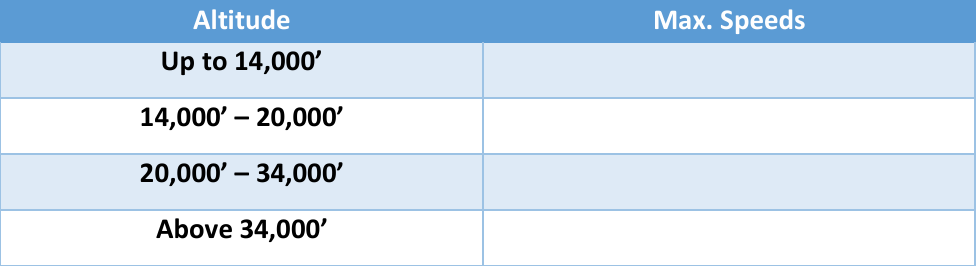

What does the VOR/LOC Button do?
Intercepts LOC or VOR, on the SELECTED COURSE OF THE MASTER FLIGHT DIRECTOR!
Depending on VOR or LOC tuned on the respective radio
What does the APP button do and when is it pressed?
Intercepts LOC / G/S
Make sure you intercept the LOC before the GS
Can only be pressed if (cleared for the APCH)
LOC / ILS tuned and identified (upper left PFD)
LOC / G/S pointers are shown
What are characteristics of a good briefing?
Threat Focused
Interactive
Scalable
Cognitive
What is the definition/characteristics of ‘‘Threat Focused’’ in a briefing
Threats are mentioned first, especially the most important ones → Law of primacy, what you hear first is the thing that is best retained
It creates shared situational awareness
Our leg mentality
What is the definition/characteristics of ‘‘Interactive’’ in a briefing
The PF should involve the PM during the briefing (e.g. asking questions, keeping iPad in the middle instead of in the holder)
It avoids distracted collegues
It creates more and a shared ownership and involvement → Our leg mentality
It can be done by
Asking questions
Pointing out items
Dividing checking tasks
What is the definition/characteristics of ‘‘Scalable’’ in a briefing
Scalable means that the things that require more attention are discussed more extensively than things that are less important for the flight. Mention what needs to be mentioned, but also don't make too long of a briefing.
''Kort maar krachtig, en lang als het moet''
Separate important from not important items. Discuss relevant items
Briefing length depends on familiarity / repetition
What is the definition/characteristics of ‘‘Cognitive’’ in a briefing
Cognitive more or less describes how well the briefing can be ''stored'' and understood.
During longer briefings, make a RECAP at the end
Include PM specific actions to evoke ownership
This helps, because
Principle of Recency → Last presented information sticks
Primes PM actions for faster response and recollection during abnormal situations
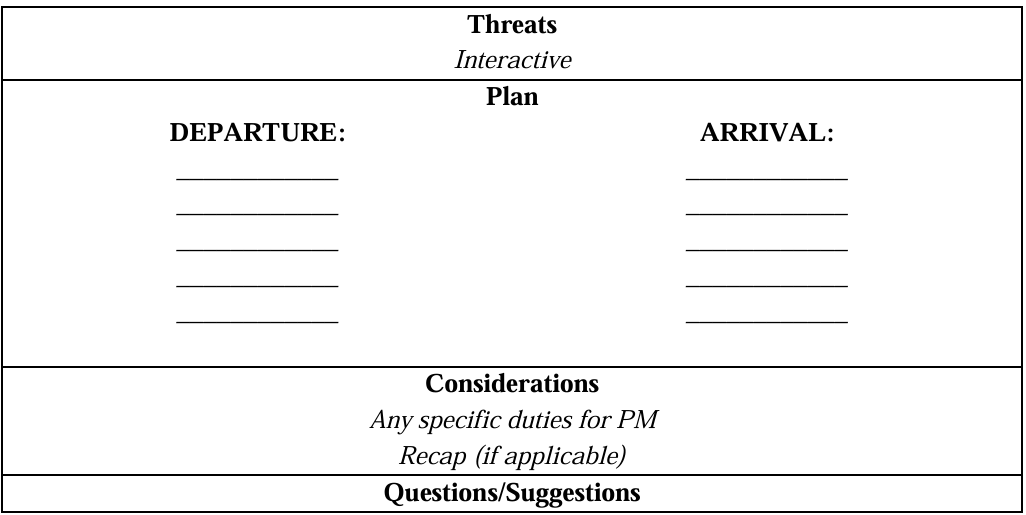
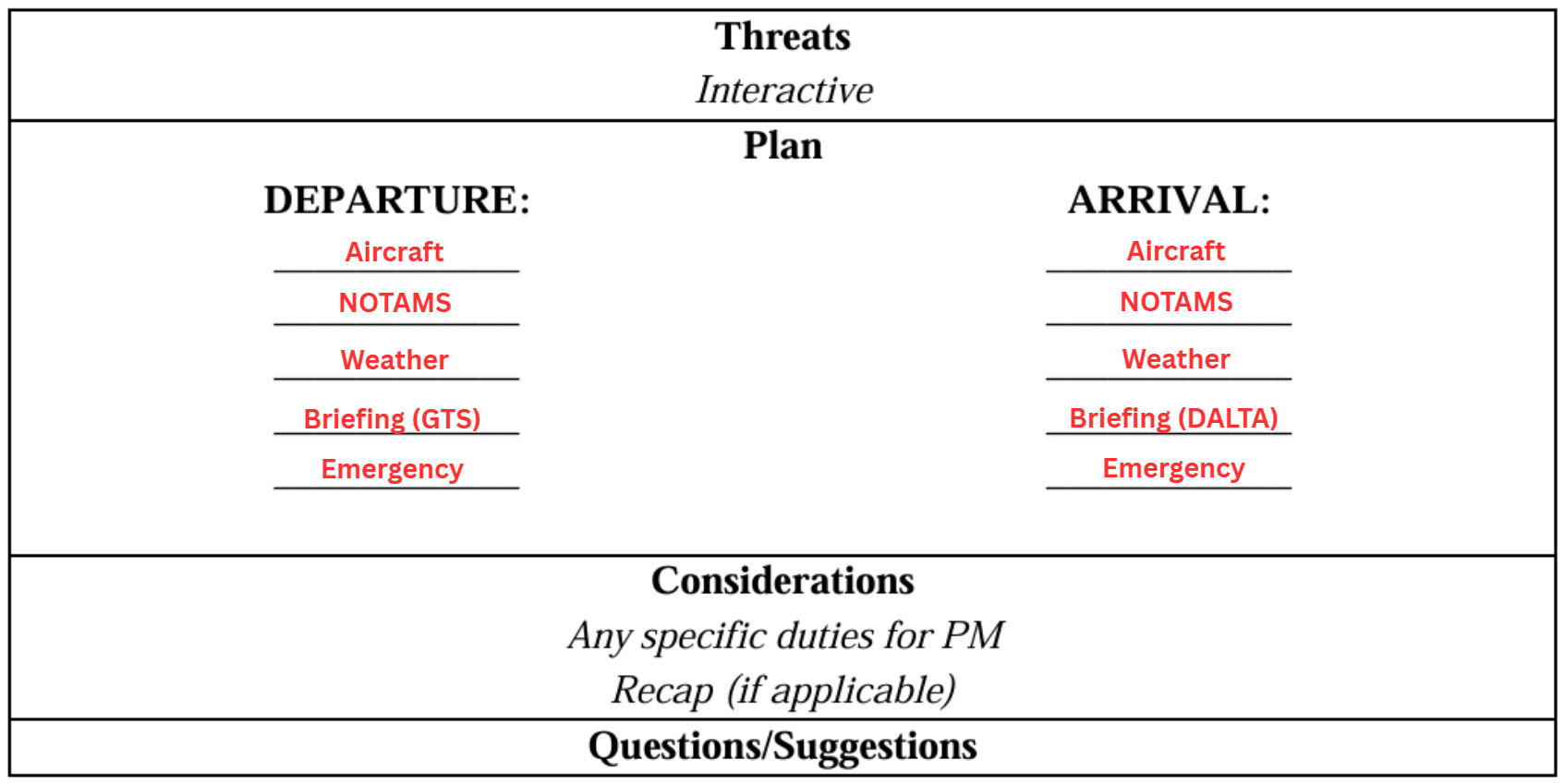
What are other things we should take into account for a briefing? (apart from the 4 characteristics)
Make sure that the briefing does not become ''a tick off'', but actually a briefing adapted to the actual situation
Briefings should be accomplished as early as practical (at gate before start / before TOD)
Use of normal SOPs is always expected, hence why it is not necessary to brief normal procedures.
It does not exclude it, as it might be necessary as a mitigation
What does the G stand for in GTS and what does it include?
Ground:
→ Parking position, pushback, taxi route, takeoff runway
What does the T stand for in GTS and what does it include?
Take Off Performance
→ Anti-Ice, Flap Setting, Thrust setting, thrust reduction / Accel HT, NADP
What does the S stand for in GTS and what does it include?
SID
→ (Vertical) Routing, NAV setup, transition altitude, initial frequency, MSA/MORA
What should the EMERGENCY part of a departure briefing always include?
Engine failure contingency plan relative to SID deviation point
Initial Routing altitude and acceleration strategy
Engine Out ACCEL HT (both situations)
Key considerations (terrain, weather, fuel, overweight landing, return/diversion strategy)
What does the D stand for in DALTA and what does it include?
Descent
→ STAR, Constraints and vertical profile, fuel status and diversion plan
What does the first A stand for in DALTA and what does it include?
Approach
→ Expected approach, approach type and modes used, MAP / Missed Approach Routing and Routing
What does the L stand for in DALTA and what does it include?
Landing
→ Runway Condition (possible braking action), Anti-Ice, Flap Setting (Autobrake?)
What does the T stand for in DALTA and what does it include?
Taxi-In
→ Expected exit and first turn
What does the second A stand for in DALTA and what does it include?
Apron
→ Taxi to stand
What does the NITS briefing stand for, and what must be make sure?
Make sure that the crew member is ready to copy and that he/she is able to read it back afterwards.
NATURE
→ ''We have an engine fire''
Intentions
→ ''We will return to Amsterdam''
Time
→ ''Expected landing is 10 minutes from now on''
Specials
→ We stop on RWY, fire brigade, evacuation, etc.


What are the influences of human performance?
Personal
Organizational → Beyond control of flight crew, in control of organization
Informational → How much information is available to the crew
Environmental → Beyond control of both the flight crew and organization
Name an example of an organizational influence
Commercial Pressure
Company Communications
Ground Handling/Service
Maintenance
Training
Name an example of an informational influence
The content and form of the operational information available to a crew
Checklists / Manuals / Navigational Charts
SOPs
Software
Name an example of an environmental influence
Airport Facilities
ATC Communications
ATC Services
Weather Conditions
Other Aircraft
How can RNAV procedures be accomplished
RNAV Overlay
RNAV Only
What are the specific performance requirements RNAV wise? (Long Range Navigation/Oceanic, Enroute and STAR segments, SIDS and STARs, Approach transitions to Final Approach
RNAV 10 → Oceanic / Long Range
RNAV 5 → Enroute and initial STAR
RNAV 2 → SID and STAR
RNAV 1 → Approach transitions to final approach
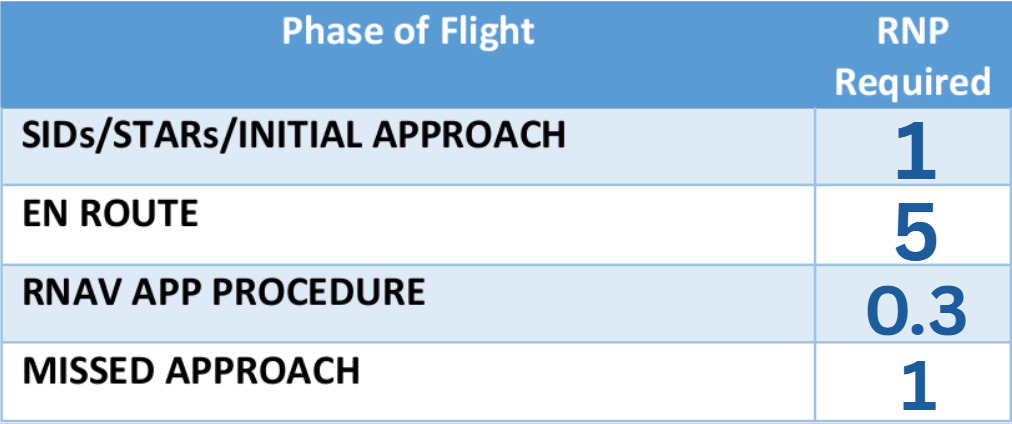
What are the RNP Specifications? (High Density Oceanic/remote, Oceanic Low Density, SID STAR APCHs MAP, Final APCH, Demanding APCHs with curves?
RNP 4 → High Density Oceanic / Remote
RNP 2 → Oceanic / Remote Low Density
RNP 1 → SID STAR, Initial / Intermediate / Missed Approach Segments
RNP APCH → Final APCH segment
RNP AR APCH → Used for demanding approaches in mountainous terrain or noise sensitive areas. Requires additional levels of controls and Authorization Required!
How are the RNP / RNAV specifictions requirements defined?
Accuracy
Integrity
Continuity
Functionality

What happens with the white bars whenever the ANP becomes greater?
They become bigger, and the corridor you can fly through becomes smaller (ANP nears RNP or there is excessive deviation from desired track)

The white bars become amber after 10 seconds!

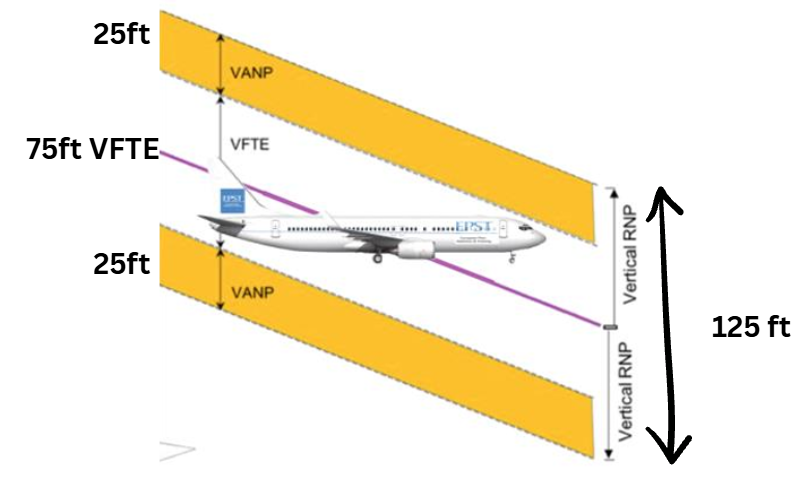
What are the values inserted for Vertical RNP? And what is the resulting VFTE?
Vertical RNP → 125ft. System assumes 50ft vANP so VFTE never exceeds 75ft
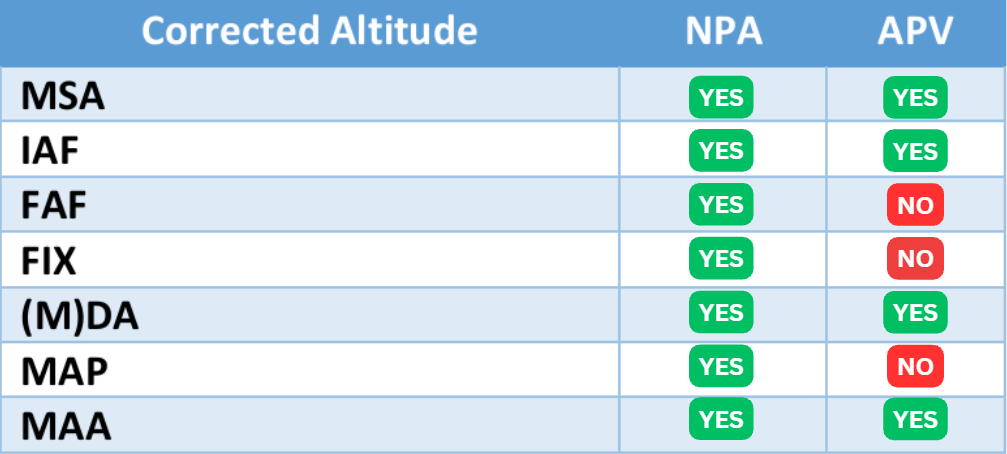
What can RNP approaches be?
Non Precision Approaches (NPA) → LNAV Minima
Approach with Vertical guidance (APV) → LNAV / VNAV Minima



Where is icing allowed / not allowed on the airframe?
Not allowed on the upper surfaces
Lower surfaces may only have a maximum 3mm light coating of frost
What are considerations with icing before Take Off
Leave flaps up until entering RWY (debris next to TWY/RWY that is avoided)
Taxi Slowy (low power and slow speed. Jet blast and low grip)
Enough space between aircraft
Engine Run Up → 30 second on N1 of 70%, each 30 minutes!
What are considerations in icing conditions for takeoff?
From adverse weather II (does not mean the anti-icing WAI/EAI operations)
→ FULL THRUST, no DERATED takeoff!
What are considerations in icing conditions for after landing?
Leave the flaps in landing setting until inspected by ground engineer!
What is the difference between de-icing and anti-icing?
De-Icing is a 1 step process → Removes ice that has already built up
Anti-Icing is a 2 step proceess
1: Ice buildup is removed
2: Protects against new ice buildup
What is the fluid type 1?
ORANGE = Unthickened to clear snow/ice with limited holdover time
What is the fluid type 2?
WHITE = Thickening agent, minimum 50% glycol with LONGER holdover time
What is the fluid type 3?
YELLOW = NOT USED ON JET AIRCRAFT (don't eat yellow snow)
What is the fluid type 4?
GREEN = Thickening agent, minimum 50% glycol with LONGEST holdover time
What is the holdover time, and when does it start during de/anti-ice operations?
The holdover time is the time for which it is expected that a given aircraft treatment by ground anti-icing fluid will remain valid
Begins at de-ice procedure, unless
2 step procedure → Starts at the start of 2nd step!
When does the predictive windshear system start and stop working, and where does it take it’s information from?
When T/O thrust is set on the RWY until 1200’ RA
Information from Weather Radar

Predictive Windshear Caution and Warnings?
Caution
→ MONITOR RADAR DISPLAY
Warning
→ WINDSHEAR AHEAD
Warning on APCH
→ GO AROUND, WINDSHEAR AHEAD
What is the pilot’s response to windshear (T/O, CRZ and APCH?)
T/O: Below 100kts with any WS alert = RTO
CRZ: Alter Flight Path OR, Windshear Escape Maneuver
APCH: GO AROUND OR Windshear Escape Maneuver
What is the startle (effect?)
Reaction on intense, sudden stimulus
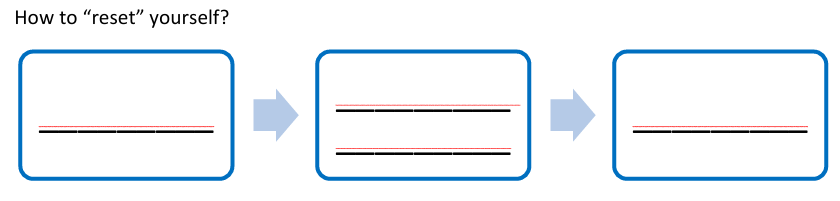

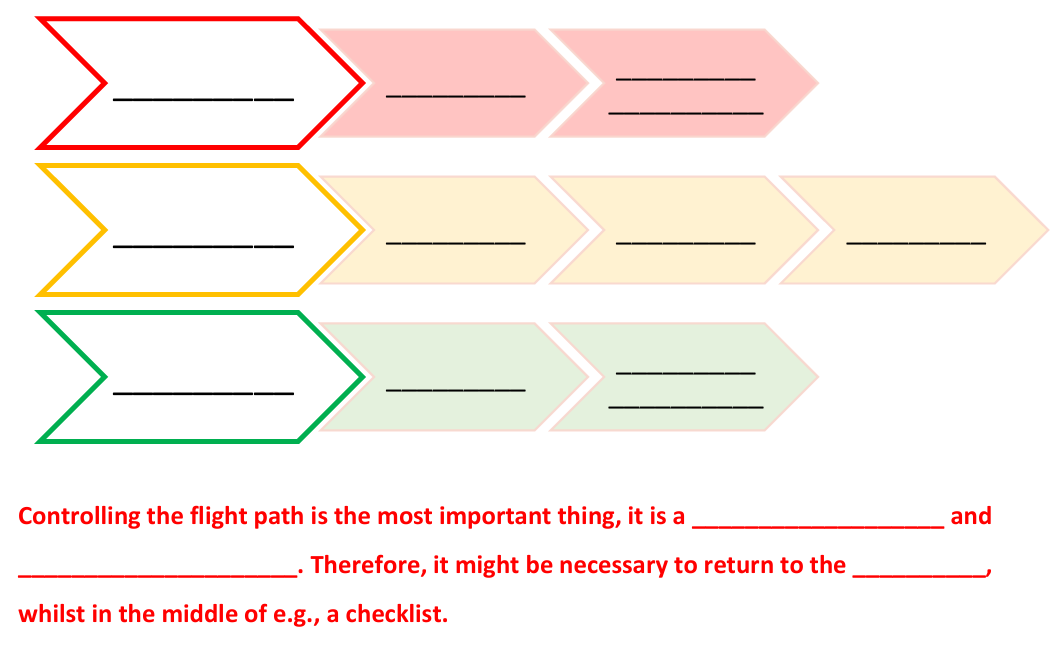

FLY THE AC
AVIATE
Pitch / Power
Flight Mode Annunciators
If possible = A/P ON
NAVIGATE
Lateral Profile
Engine Out Procedure
Terrain Clearance (MSA/MORA)
Clear of weather?
COMMUNICATE
Initial call to ATC if needed
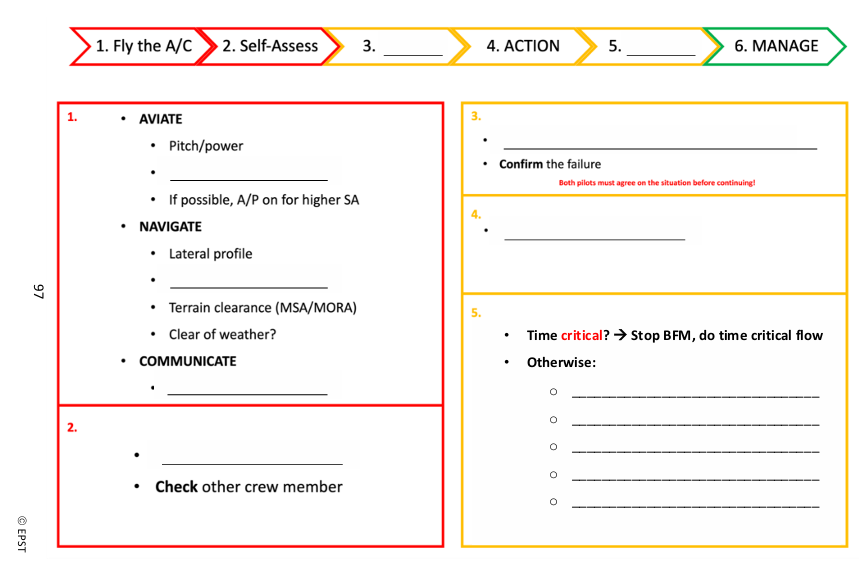

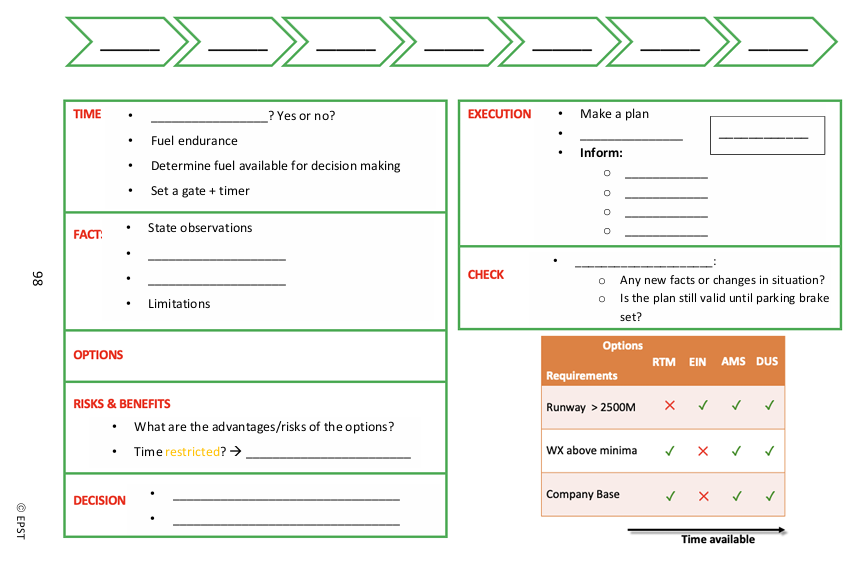

When are you time critical?
Uncontained Fire / Smoke
Any situation where fuel becomes critical (<30 minutes upon landing)
What is the Time Critical flow/procedure?
Make short term plan (3D)
Inform ATC
Do descent procedure / NAV setup
Inform Purser (NITS)
Do relevant NNC as far as possible
When are you Time Restricted ?
The checklist dictates ''plan to land at the nearest suitable airport''
Is a Cargo Fire regarded time critical?
Not initially, the non-critical flow shall be followed and the NNC performed, but
If after discharging the fire extinguishers the fire is still present → TC flow / Time critical situation

Engine Flameout
N1 Rotation with ENG FAIL indication

ENGINE SEPARATION
No EGT and FF indications

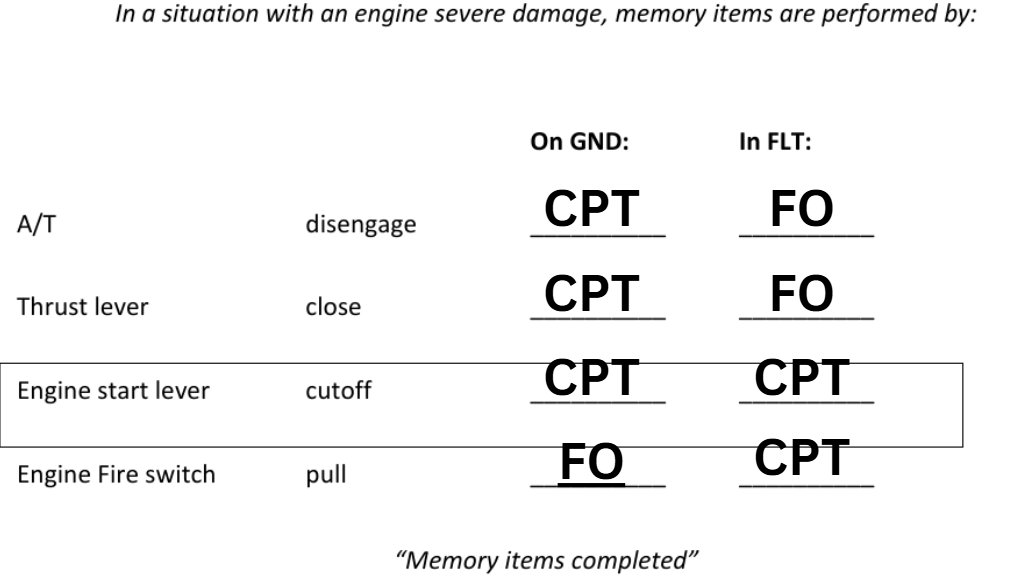
ENGINE SEVERE DAMAGE
NO N1 Rotation, WITH ENG FAILURE Indication
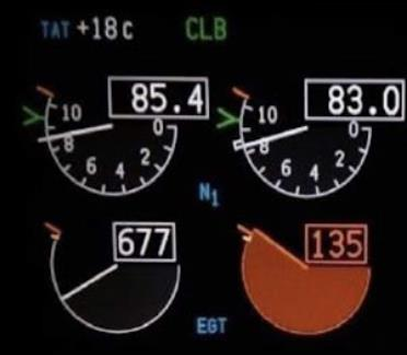
ENGINE LIMIT / SURGE / STALL
Limit exceeded, LOUD BANGS

Light Symbol

Precaution Symbol

Checklist continues on next page

Continuation of checklist from previous page

Task Divider

End of Checklist

Separator Line

= Options Symbol
→ Each diamond represent possible choice
When RTO? (< 80kts)
Any MASTER CAUTION
Significant Malfunction
When RTO? (80kts-V1)
Engine Failure
Any fire warning
Obstructed RWY
Controllability Problems
Predictive WS Warning
CPT Calls: REJECT
How does the RTO go?