Introduction to Causality 1 (September 9)
 Call Kai
 Learn
 Practice Test
 Spaced Repetition
 Match
 Flashcards
 Knowt Play
1/43

There's no tags or description
Looks like no tags are added yet.
44 Terms
Empirical observation
"This cereal sticks to a magnet."
Which of the following does this statement represent?
Theoretical Model
A(n) ______ is proposed to explain an empirical observation and includes a causal mechanism.
Causal Mechanism
"This cereal sticks to a magnet because of its iron content."
Within the proposed theoretical model, which of the following does this statement represent?
A theoretical model proposes an explanation for an empirical observation that includes a causal mechanism, from which a testable hypothesis is derived for empirical testing.
Which statement accurately reflects the relationship between a theoretical model, causal mechanism, and testable hypothesis?
Testable hypothesis
"Cereals that are high in iron stick to a magnet."
Which of the following does this statement represent?
Unit of analysis
The type of entity that constitutes an individual case in a study, at the level of which variables are analyzed and conclusions are drawn.
Selection-bias
______ refers to confounding bias due to participant self-selection into the treatment/control groups.
Confounding Variable
A pre-treatment variable that is associated with both the treatment and the outcome and may bias our estimation of the treatment effect.
Quasi-experiments
Selection bias is a key concern in…
Random assignment of observations by the researcher into the treatment and control group makes the treatment groups…
identical on average in terms of observed and unobserved pre-treatment characteristics
Matching
A quasi-experimental strategy that selects control units comparable to treated units in relevant pretreatment characteristics, so their observed outcomes can help estimate the treated units' missing counterfactual outcomes and thereby estimate causal effects.
Internal Validity
the extent to which causal assumptions are satisfied in the study
External Validity
The extent to which the conclusions can be generalized beyond a particular study
Placebo Effect
A change in a participant's outcome caused by their expectations about receiving treatment, rather than by the treatment's active effect.
Hawthorn Effect
A change in a participant's behaviour caused by awareness of being observed or studied by researchers.
Difference-in-Means Estimator
The difference between the treatment group's observed average outcome and the control group's observed average outcome. It is observable and, under randomization, can be used to estimate SATE
The sample-average treatment effect
The following expression defines….
n1i=1∑n{Yi(1)−Yi(0)}
The individual-level causal effect of a treatment
What does the following mathematical expression represent?
Y(1)−Y(0)
The difference between the average observed outcome of individuals who actually received treatment and the average observed outcome of individuals assigned to control, used to estimate SATE.
What does the following expression represent?
Yˉ(1)−Yˉ(0)
Randomization makes treatment and control groups comparable on average across possible assignments, allowing their observed mean outcome difference to estimate the average of the individual causal effects that cannot be directly observed
Why can researchers use the difference-in-means estimator to estimate SATE in a randomized controlled trial, even though SATE cannot be directly observed?
Find another healthy cereal that is identical to Total Cereal in its ingredients, texture, etc. except for its iron content
Which of the following describes how we apply matching in practice to the breakfast cereal example?
Honey Smacks cereal is not a good match because it differs from Total Cereal in ingredients other than iron content.
In the breakfast cereal example, is Honey Smacks a good match for Total Cereal, and why? Select the most accurate answer.
Would Total cereal stick to a magnet if it did not have iron?
Which of the following represents the counterfactual in the breakfast cereal example?
Matching cannot ensure the absence of unobserved confounders?
What is the problem with using matching in a quasi-experiment to test a causal inference?
Selection bias due to participant self-selection into treatment and control groups.
What is a common source of confounding bias in quasi-experiments?
Randomized Control Trials
________ are the gold standard for establishing causality in many scientific disciplines.
Double-blind experiments
___________ can be used to mitigate the risk of Placebo effects and Hawthorn effects in RCTs
Despite the relatively low cost and substantial life-saving benefits of preventative health products in developing countries, household investment in these products remains low.
Identify the insight/puzzle motivating the health savings experiment.
Simple saving technologies can increase investments in preventative health products.
What was the hypothesis in the health savings study?
B
Which of the following best describes the theoretical framework underlying Dupas and Robinson’s (2013) savings experiment in Kenya?
A. Household investment in preventative health products remains low in developing countries despite their substantial health benefits and relatively modest upfront costs.
B. Mental accounting, present-biased preferences, and social pressures help explain barriers to individual savings and why different features of savings technologies may help overcome them.
C. Providing individuals with simple savings technologies increases their investment in preventative health products.
D. Randomly assigning individuals to different savings technologies allows researchers to identify their causal effects on health investments.
B
Which research design did Dupas and Robinson (2013) employ to investigate the effect of savings technologies in Kenya?
A. A randomized survey experiment in which participants were presented with hypothetical savings technologies.
B. A randomized field experiment in which access to different savings technologies was experimentally varied.
C. A natural experiment exploiting existing variation in access to savings technologies.
D. A field experiment in which participants selected their preferred savings technology.
D
What did the control group receive in the Kenya savings experiment?
A. Neither encouragement to save nor a savings device.
B. A savings device without encouragement to save.
C. Encouragement to save and an unrestricted savings device.
D. Encouragement to save but no savings device.
A
How did the two savings-box treatment conditions in the health-savings experiment differ?’
A. T1 received a metal savings box and its key, whereas T2 received the same box but had to ask an officer to open it at a shop.
B. T1 received a metal savings box whose key was retained by officers, whereas T2 received the same box and its key.
C. T1 and T2 both received a metal savings box and its key, but only T2 was encouraged to save for healthcare.
D. T1 and T2 both received a metal savings box whose key was retained by officers, but only T2 could request access to the money.
C
According to the lecture, what was the outcome variable in the Kenya savings experiment?
A. The total amount of household savings after 6 and 12 months(in Kenyan shillings).
B. The amount of savings for health products after 3 and 6 months(in Kenyan shillings).
C. The amount of savings for health products after 6 and 12 months (in Kenyan shillings).
D. The number of preventative health products owned after 6 and 12 months.
B
Why were both the control and treatment groups encouraged to save for healthcare in the Kenya savings experiment?
A. To eliminate differences in saving behaviour between the groups before treatment.
B. To distinguish the causal effect of savings technologies from the effect of encouragement to save.
C. To ensure that participants in every group had equal access to savings technologies.
D. To distinguish the causal effect of encouragement to save from the effect of savings technologies
C
What do the relatively similar attrition rates across treatment conditions in the Kenya savings experiment suggest about the study's validity?
A. They establish both internal and external validity because attrition is similar across groups.
B. They reduce concerns about external validity but provide no information relevant to internal validity.
C. They reduce concerns about differential attrition threatening internal validity, but attrition may still threaten external validity if those who drop out differ systematically from those who remain.
D. They establish that attrition is unrelated to participant characteristics and therefore cannot introduce selection bias.
C
What is subset analysis (subclassification) in causal inference?
A. A method of statistical control that compares pre-treatment characteristics across treatment and control groups within subsets.
B. A method of statistical control that compares mean outcomes between subsets defined by different pre-treatment characteristics.
C. A method of statistical control that compares mean outcomes across treatment and control groups within subsets defined by shared values of pre-treatment variables.
D. A method of statistical control that compares mean outcomes across treatment and control groups within subsets defined by shared values of outcome variables.
A
Why might researchers conduct subset analysis after identifying potential imbalance in pre-treatment characteristics?
A. By holding selected pre-treatment characteristics constant within each comparison, researchers reduce potential confounding attributable to differences in those characteristics.
B. By holding selected pre-treatment characteristics constant within each comparison, researchers establish that the original experimental groups were balanced.
C. By holding selected pre-treatment characteristics constant within each comparison, researchers eliminate potential confounding attributable to all other characteristics.
D. By holding selected pre-treatment characteristics constant within each comparison, researchers isolate the causal effects of those characteristics on the outcome.
C
How was subset analysis implemented in the Kenya savings experiment lecture?
A. Average savings were compared between married and unmarried women within each experimental condition.
B. Average savings were compared across experimental conditions separately for married and unmarried participants, regardless of gender.
C. Average savings were compared across experimental conditions separately for married and unmarried women, holding gender and marital status constant within each comparison.
D. Gender and marital status were compared across experimental conditions after restricting the sample to women.
D
Why does comparing married women across experimental conditions address potential imbalance in gender and marital status?
A. It establishes that gender and marital status have no effect on savings.
B. It ensures that gender and marital status are equally distributed throughout the original sample.
C. It eliminates differences in all observed pre-treatment characteristics across experimental conditions.
D. It holds gender and marital status constant, preventing differences in these characteristics from explaining differences in mean outcomes within the subset.
A
What does the subset analysis in the Kenya savings experiment suggest about the possibility that imbalance in gender and marital status accounts for the original findings?
A. Both savings technologies retain positive estimated treatment effects, with the safe box having the larger effect in both subsets, suggesting that the original findings are not solely attributable to imbalance in these characteristics.
B. Both savings technologies retain positive estimated treatment effects, but their relative effectiveness reverses across subsets, suggesting that the original findings depend on group composition.
C. Both savings technologies retain approximately identical estimated treatment effects across subsets, suggesting that gender and marital status are unrelated to savings behaviour.
D. Both savings technologies retain positive estimated treatment effects only among married women, suggesting that marital status accounts for the original findings.
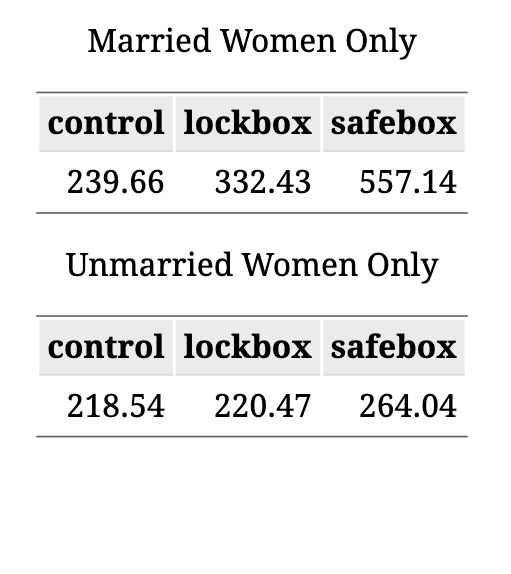
B
Which pre-treatment characteristics were examined for balance in the Kenya savings experiment lecture?
A. Gender, age, and income.
B. Gender, age, and marital status.
C. Gender, marital status, and education.
D. Age, marital status, and income.
B
Given the hypothesis that cereals high in iron stick to a magnet, which correctly identifies the components of the research design?
A. Unit of analysis: cereal type; treatment variable: exposure to a magnet (yes/no); outcome variable: whether the cereal sticks to a magnet (yes/no).
B. Unit of analysis: cereal type; treatment variable: iron content (high/low); outcome variable: whether the cereal sticks to a magnet (yes/no).
C. Unit of analysis: cereal type; treatment variable: whether the cereal sticks to a magnet (yes/no); outcome variable: iron content (high/low).
D. Unit of analysis: iron content; treatment variable: cereal type; outcome variable: whether the cereal sticks to a magnet (yes/no).
The experimental sample is non-representative of a target population.
Sample Selection bias occurs when…