BIO CHAPTER 2-3 Chemistry and Molecules of Life
 Call Kai
 Learn
 Practice Test
 Spaced Repetition
 Match
 Flashcards
 Knowt Play
1/41

There's no tags or description
Looks like no tags are added yet.
42 Terms
atom
is the smallest unit of matter that retains the properties of an element
protons
positively charged
neutrons
neutral
Matter
anything that occupies space and has mass.
electrons
negativley charged
Mass
measure of the amount of material in an object
element
substance that cannot be broken down into other substances by chemical reactions.
Atomic #
an element’s unique # of protons
where are protons, nuetrons located
nucleus
what is nucleus surrounded by
electron cloud
Mass #
total sum of protons and neutrons in the nucleus.
Isotopes
Atoms of the same element that have the same number of protons but a different number of neutrons
Radioactive isotopes
have unstable nuclei that spontaneously decay, emitting high-energy particles
Covalent Bonds
Formed when two atoms share a pair of valence electrons
Hydrogen Bonds
Weak attractions between the slightly positive (δ+) hydrogen atom of one polar molecule and an electronegative atom (δ−) of another molecule
Electronegative Elements
Elements like Oxygen (O) and Nitrogen (N) act as "electron hogs," pulling shared electrons toward themselves about 90% of the time
Polar
Molecules with unequal charge distribution across a neutral molecule due to electronegative atoms
Nonpolar
Molecules where electrons are shared equally (such as hydrocarbons made mostly of Carbon and Hydrogen)
Hydrophilic
Polar or charged substances that readily dissolve in or interact with water (e.g., alcohol, salts, sugars)
Hydrophobic
Nonpolar substances that will not dissolve in water (e.g., fats, oils, waxes)
Cohesion
Water molecules stick to each other via hydrogen bonding creating high surface tension
High Specific Heat (Temperature Stabilization)
Water resists rapid temperature changes because heat must first break hydrogen bonds before raising water temperature
Density of Ice
Water expands when it freezes because stable hydrogen bonds hold the molecules in a open crystalline lattice, making ice less dense than liquid water so it floats
Universal Solvent
Water dissolves polar solutes and ionic compounds by surrounding charged particles
Self-Dissociation
Water molecules can spontaneously break apart into hydrogen ions and hydroxide ions
Acids ph
Solutions with a pH lower than 7
Bases
Solutions with a pH greater than 7
Neutral
Pure water has a pH of 7
Logarithmic Scale
Each integer unit shift on the pH scale represents a 10-fold change in H+ concentration
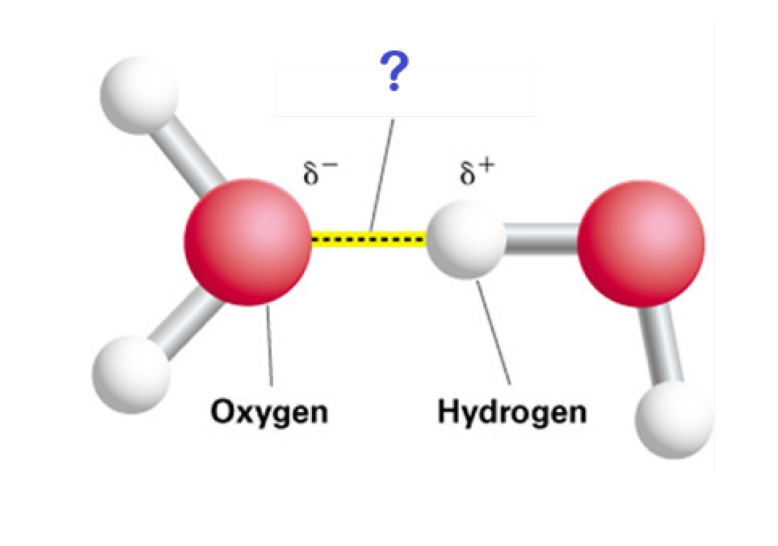
what does this represent
hydrogen bonds
Why is water able to dissolve substances so well?
Water’s polarity attracts other polar molecules.
Which of the following is an important property of water?
Cohesion – Water molecules stick to each other
Adhesion – Water sticks to other substances
Water expands when it freezes, leading ice to float
Water has high specific heat, which is temperature stabilizing for all living systems.
A person with lactose intolerance will suffer from digestive discomfort if milk products are consumed. This occurs because
the lactose molecules are not being hydrolyzed.
Both starch and cellulose consist of joined monosaccharide monomers, but the way that they are joined makes starch digestible by humans and cellulose not. Identify the major theme in Biology that this relates to.
Relationship of Structure to Function
Cells constantly rearrange molecules by breaking existing chemical bonds and forming new ones.
Identify the major theme in Biology that this relates to
Pathways that transform matter and energy
Proteins have different properties & functions based on their amino acid content.
Identify the major theme in Biology that this relates to.
Relationship of Structure to Function
What statement correctly describes a hydrogen bond?
A weak bond between two molecules resulting from an attraction between a proton (or, H+) covalently bonded to an electronegative atom (e.g., O, N, P, etc) in one molecule and another electronegative atom in the other molecule.
As you can see from the picture, the DNA double helix “ladder” has a constant width along its length. This is because _____
a single-ring base is always opposite a double
Which of the following statements comparing DNA & RNA is TRUE?
RNA has uracil (U) nucleotides instead of thymine (T)
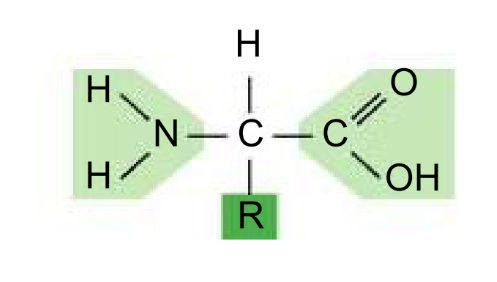
This molecule is the monomer of a
protein
Which is NOT a carbohydrate?
waxes
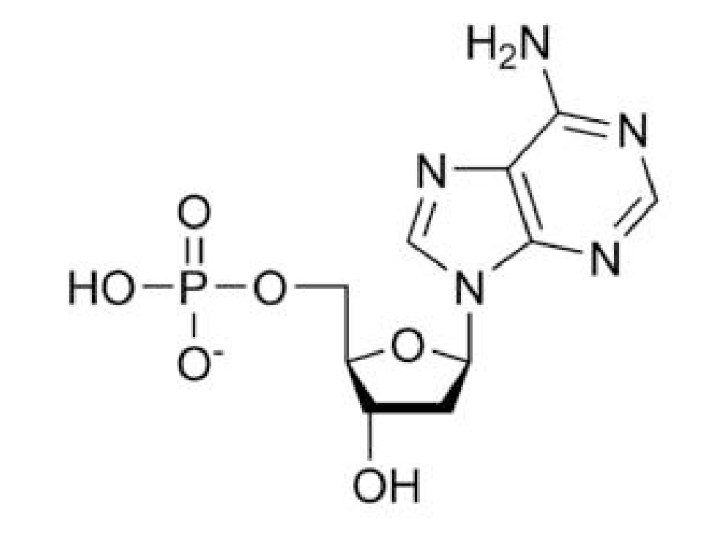
The monomer of DNA is
nucelotides