Bio ch7- Metabolism: Energy, Enzymes
 Call Kai
 Learn
Learn Practice Test
 Spaced Repetition
 Match
Match Flashcards
 Knowt Play
1/37

There's no tags or description
Looks like no tags are added yet.
Name | Mastery | Learn | Test | Matching | Spaced | Call with Kai | Chat |
|---|
No analytics yet
Send a link to your students to track their progress
38 Terms
Bioenergetics
study of energy flow through a living system
Metabolism
all chemical reactions of a cell or organism
Metabolism = anabolic reactions + catabolic reactions
metabolic pathway
series of biochemical reactions that converts 1+ substrates into final product
2 types of metabolic pathways
anabolic
catabolic
anabolic reaciton
smalll molecules made into larger ones
energy is required (reactant side)
catabolic reaction
larger moecules broken into smaller ones
energy is released (product side)
energy
ability to do work
2 types of energy
KE → motion
PE → stored
Gibb’s freee energy
amount of energy available to do work
ΔH = change in total energy of system
ΔS = change in entropy
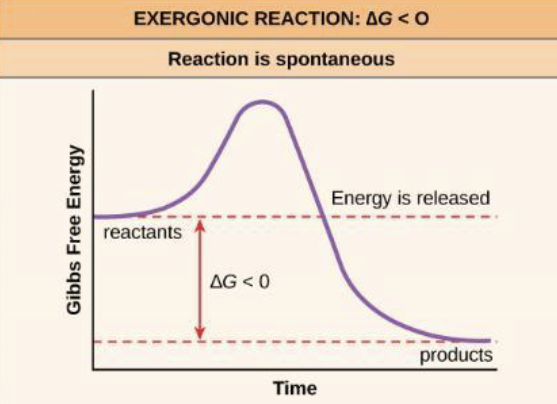
exergonic reactions
energy is released
ΔG < 0
spontaneous → occur without added energy
products < reactants (free energy)
water is on reactant
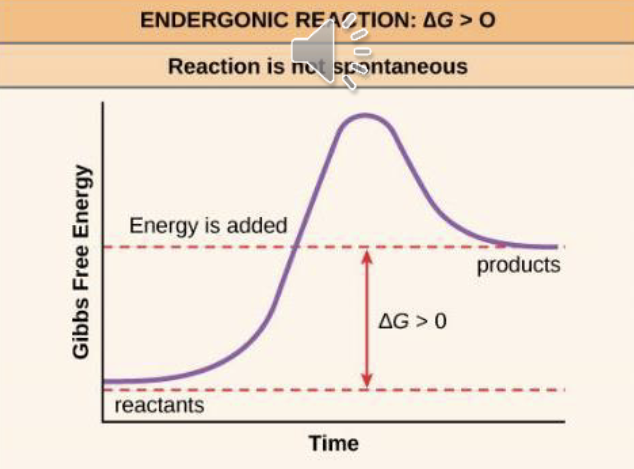
endergonic reacitons
require input of energy
ΔG > 0
products > reactants (free energy)
water is on products
activation energy
energy required for reaction to proceed
lets reactants unstable → bonds broken → transition state (reaction occurs fast)
when a reaction is catalyzed, the activation energy is
lower
thermodynamics
study of energy and energy transfer involving physical matter
first law of thermodynamics
energy cannot be created or destroyed
second law of thermodynamics
transfer of energy is not complete
energy is lost
entropy
measure of randomness/disorder
what provides the energy for cell’s endergonic reactions?
hydrolysis of ATP
ATP structrue
Adenosine backbone (adenine + ribose) + 3 phosphate groups

phosphate groups in order (furthest from ribose sugar)
alpha, beta, gamma
ATP equation
ATP + H2O → ADP + Pi + (-ΔG)
ATP hydrolysis
ATP hydrolyzes quickly because it is unstable
reversible
sodium-potassium pump
3 Na+ out
2 K+ in
enzymes
protiens that speed up reactions by lowering activaition energy
are specific because of its 3D shape
substrates
reactants
induced fit
active site shifts a little in shape to optimize reactions
slight changes → maximizes catalysis
“lock-and-key” model
2 parts of active site
binding site: binds and orientates substrates
catalytic site: reduces chemicals activaiton energy
how does an enzyme help the substrate reach its transiiton state (4)
position 2 substrates so they are aligned for reaction
provide optimal enviornment → acidic or polar
contort/stress → less stable = more likley to react
temporarily react with substrates → chemically change it to make it less stable
how can enzymes be regulated (4)
modifications to temperature and/or pH
make molecules that inhibit/promote enzyme function
availability of coenzymes or cofactors
compartamentalized
2 types of enzyme inhibition
competitive inhibition
noncompetitive inhibition
competitive inhibition
binds to active site
competes with substrate for active site
slow but DOES NOT affect the maximal rate
noncompetitive inhibition
binds to enzyme
causes slower reaction since it binds to enzyme at different location
slow but DOES affect maximal rate
maximal rate
speed of a reaction when substrate is not limited
allosteric inhibitors
modify the acitve site of the enzyme so that the substrate that binds to it is reduced or prevented
decrease enzyme activity
allosteric activators
modify the active site of the enzyme so that the need for the substrate increases
increase enzyme activity
cofactors
inorganic ions
coenzymes
organic molecules
feedback inhibition
end-product of the pathway inhibits an upstream step
how cells self-regulate