Opioid Med Chem
 Call Kai
 Learn
Learn Practice Test
 Spaced Repetition
 Match
Match Flashcards
 Knowt Play
1/21

There's no tags or description
Looks like no tags are added yet.
Name | Mastery | Learn | Test | Matching | Spaced | Call with Kai | Chat |
|---|
No analytics yet
Send a link to your students to track their progress
22 Terms
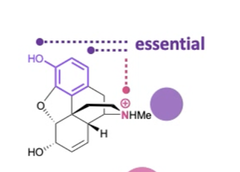
Show the SAR of morphine.
- HBD is essential at the top e.g., OH, Amines (primary, secondary amines)
- Tertiary amine is essential.
- Aromatic ring is essential.

Why is an HBD at the top essential in morphine?
It acts as a hydrogen bond donor (HBD) and is critical for receptor binding.

What role does the tertiary amine play in morphine's activity?
It can be protonated at physiological pH and forms an essential ionic interaction with the opioid receptor.

Why is the aromatic ring essential for morphine's analgesic activity?
It enables π-π stacking with the receptor; removal leads to complete loss of activity.

How does increasing the size of the methyl group ,to a ethyl or propyl etc, on the tertiary amine affect morphine's activity?
- No increase in size e.g., methyl, has agonist activity (axial binding).
- Moderate increases promote antagonist activity (equatorial binding). e.g., propyl
- Much larger groups restore agonist activity (axial binding). e.g., large aromatic substituents

Why is the enantiomer of morphine inactive as an analgesic?
The positions of key functional groups are misaligned and too far from the binding region, despite preserved π-π stacking from phenol ring.

Is the alkene group in morphine required for opioid receptor activity?
No, it is not essential for activity at the receptor.
What is the significance of the 6-OH (bottom OH) group in morphine?
It is not essential; removing or modifying it reduces polarity and enhances blood-brain barrier penetration.

What other features of morphine can be altered to affect activity?
- Increase in size at the R group attached to the tertiary amine increases antagonist behaviour. However, much larger causes agonist activity, this is because agonist binding region is axially whilst antagonist is equitorially.
- Enantiomer of morphine is not active as positions of important functional groups are too far away from binding region. Cannot act as an analgesic even though aromatic ring can still pi-pi stack as other functional group position changes are too much.
- Alkene is not essential to activity at opioid recepotr.
- Bottom (6) OH is not essential, no need for HBD or HBA. Changing bottom OH decreases polarity allowing it to cross the BBB more easily.
What molecules bind to μ-opioid receptor (MOR)?
- Endorphins
- Enkephalins
- Dynorphins
What are endorphins?
- Natural, opiate-like neurotransmitters
- They are linked to pain control and pleasure.
- Selective to MORs.
What are dynorphins?
- Neuropeptides that modulate pain perception and stress response.
- Selective to MORs and κ-opioid receptors.
What are enkephalins?
- endogenous opiates responsible for pain relief.
- Selective to MORs.
Describe selectivity to the μ-opioid receptor (MOR).
- Tyrosine residue is essential as it can form H-bonds with the receptor.
- Terminal nitrogen (amine) is essential to activity as forms ionic interactions with the receptor.
- Phenylalanine is essential as it provides hydrophobic interactions.

Describe the Portoghese theory.
- A unifying model for how opioid ligands (e.g., morphine, endorphins) bind to receptors
- Proposes 2 or 3 key interactions are needed for strong binding and activation
- Typically involves an amine (ionic), aromatic ring (hydrophobic), and OH group (H-bonding).
How can the structure of morphine be altered to affect its activity?
- Removal of the D ring produces morphinans.
- Removal of C and D ring produces benzomorphans.
- Removal of B, C and D ring produces phenylpiperidines.
How does morphinan activity compare to morphine?
Morphinans are often more potent than morphine due to being less polar and therefore having improved lipophilicity, while retaining key binding features.

How does benzomorphan activity compare to morphine?
Benzomorphans show variable activity; they may be less selective and have more mixed agonist-antagonist effects due to increased flexibility.

How does phenylpiperidine activity compare to morphine?
Phenylpiperidines can be as potent or more potent than morphine due to their:
• Flexibility allowing better receptor fit
• Lipophilicity allowing improved BBB penetration.
• Hydrophobic interactions from phenethyl groups on nitrogen
Portoghese's theory supports this, as they retain two essential features:
• A protonated amine (ionic interaction)
• An aromatic ring (hydrophobic interaction)

Why does the positively charged nitrogen in opioids contribute to constipation?
Enhances binding to μ-opioid receptors in the gut, reducing peristalsis and secretions, leading to slower transit and harder stools.

How do opioids suppress cough?
Opioids act on μ-opioid receptors in the brainstem, especially in the medulla, to suppress the cough reflex. Drugs like codeine and dextromethorphan reduce the sensitivity of cough centers to stimuli.
What is snyder theory?
The brain has specific receptors for opioids because it produces its own endogenous opioids, like endorphins, enkephalins, and dynorphins.