Cannabis
 Call Kai
 Learn
 Practice Test
 Spaced Repetition
 Match
 Flashcards
 Knowt Play
1/38

There's no tags or description
Looks like no tags are added yet.
39 Terms
Who is Paracelsus
Swiss physician born Phillip von Hohenheim who is known as the father of toxicology
Why is the drug dosage for smoking marijuana so much different than drinking a bottle of beer?
2 individuals can have the same amount of marijuana in a joint but based on smoking dynamics/mechanism, doses could be very different (how deep you inhale, how long, etc.)
Major active ingredient in Cannabis (major psychoactive component)
delta-9-tetrahydocannabinol (THC)
Historical use of cannabis
Used for euphoric effects for over 4000 years
Medicinal properties recognized in China 2700 years ago for relief of pain, muscle spasms, convulsions, epilepsy, asthma, rheumatism.
French psychiatrist de Tour Moreu described cannabis effects as “a gradual weakening of the power to direct thoughts at will” - what term encompasses this, that is a known effect of cannabis?
Disinhibition
Historical use of cannabis in the uS
Mexican labourers introduced the drug to southern US around 1910. Alcohol prohibition in the 1920s increased the spread of drug use to other urban centers
Cannabis methods of absorption (pharmacokinetics)
Absorbed either through smoking or edibles.
Smoking - efficient way to get drug into system
Edibles - problem is that feedback is not as quick as smoking, don’t titrate as much as people who smoked
Cannabis distribution (pharmacokinetics)
Lipophilic drug - very high Vd because the drug stays in the fat cells for a long time
Cannabis metabolism (pharmacokinetics)
THC breaks down into a variety of THC derivatives, before being conjugated and eliminated via urine and feces (main)
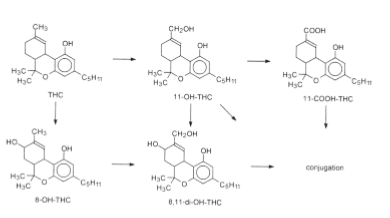
Cannabis elimination (pharmacokinetics)
70% of dose excreted in 72 hours (40% feces, 30% urine)
Half life of cannabis
20-57 hours for infrequent users
3-13 days for frequent users
What cannabis metabolite is measured in blood and oral fluid specimens
THC
What cannabis metabolite is measured in urine
11-carboxy-THC

Between smoking and edibles, which method of absorption provides a higher maximum blood concentration (assuming equal doses)
Smoking > edibles (does not have to deal with first past metabolism)
Between smoking and edibles, which method of absorption has a shorter time to reach maximum blood concentration (assuming equal doses)
Smoking has shorter time smoking than edibles (<1hr up to 5hr)
Why is oral fluid [THC] NOT a reliable indicator of blood concentration?
Detecting THC in oral fluid is only evidence of buccal contamination (that the product was ingested). It can only confirm that the individual consumed cannabis
Effects of Cannabis on the body
Euphoria
Relaxation
Altered time perception
Lack of concentration
Impaired learning and memory
Mood changes (panic reactions and paranoia)
Lung cancer, dysfunction of immune system
Is Cannabis considered a stimulant, sedative, or hallucinogen?
None. Due to the spectrum of behavioral effects, it prevents unique classification
Subjective effects of marijuana are related to…
Brain concentration of THC. THC equilibrium time in brain accounts for lag between Cmax/Tmax in blood and max subjective effects
Smoking lag time of subjective effects behind time of peak concentration
10-30 minutes lag
Edibles lag time of subjective effects behind time of peak concentration
1-3 hour lag
Difference in bioavailability of cannabis between smoking and edibles
Smoking: 18-50%
Edibles: 6-18% (degradation in stomach/first past metabolism)
Product cause of effects of Smoked vs Edible cannabis
Smoking: Effects due to pyrolysis products
Edibles: Effects due to THC and 11-OH-THC
Indications of medical marijuana
Anti-nausea following chemotherapy
Anti-hypertensives to manage glaucoma
Anti-spasmotics in MS
Appetite enhancing drugs (eg. individuals with AIDS, muscle wasting disease)
What is THC hyperemesis syndrome
a medical condition caused by long-term, heavy cannabis use that leads to repeated cycles of severe nausea, intense vomiting, and abdominal pain
THC and its effect on the developing brain
Early onset marijuana users (use starting before 16-18 years) had significantly poorer
Sustained attention
Cognitive inhibition (ability to control distracting stimuli)
Abstract reasoning
Drop from childhood average to adult low-average IQ (even after sustained absence the individuals never acheived predicted trajectory in IQ)
Purpose of the Cannabis act
Create a struct legal framework for controlling the production, distribution, sale, possession of cannabis across Canada.
Main goals of the Cannabis act
Keep cannabis out of the hands of youth
Keep profits out of pockets of criminals
Protect public health and safety by allowing adults to access legal cannabis
How does the Cannabis act protect youth?
Illegal to sell/provide cannabis to any person under 18 (14 year jail time for giving/selling cannabis to youth or using a youth to commit a cannabis related offence
Prohibited products that are appealing to youth, or labelling/packaging in a way that appeals to youth
Prohibited to sell cannabis through self service displays or vending machines
Prohibited to promote cannabis, except in narrow circumstances where the promo could not be seen by a young person
Under the Cannabis act, adults who are 18 years or older would be able to legally:
Possess up to 30g of cannabis (dried or non dried equivalent)
Share up to 30 g with other adults
Purchase dried or fresh cannabis/oil from a provincially licensed retailer
Grow up to 4 cannabis plants per residence for personal use from licensed seed or seedlings
Make cannabis products at home, provided that organic solvents are not used
With the cannabis act, who is responsible for overseeing the system?
Shared responsibility of federal, provincial, and territorial governments
Under the Cannabis act, the Federal government’s responsibilities would be to:
Set strict requirements for producers who grow and manufacture cannabis
Set industry wide rules and standards, including:
Types of cannabis products that will be allowed for sale
Packaging and labelling requirements
Standardized services and potency
Prohibit the use of certain ingredients
Good production practices
Tracking of cannabis from seed to sale to prevent illicit market diversion
Restrictions on promotional activity
Provincial/territorial government responsibilities under the cannabis act
License and oversee the distribution and sale of cannabis, subject to federal conditions.
THey can also provide more strict rules than the feds about min age, possession limit, etc. But they cannot be less strict
Will be there restrictions on concentration of THC in Canada?
Intention is to set regulatory requirements that standardize the amount of THC in a portion of cannabis products, and that THC amounts will be clearly stated on product labels. This allows consumers to have clear info for decision making
Why is the legal minimum age of use 18, and not 25 as suggested by multiple experts?
Govt has to strike a balance between known health risks of cannabis and the realty that Canadian youth and young adults use cannabis at rates that are among the highest in the world
Penalties for illegal distribution or sale of cannabis
Tickets for small amounts, up to 14 years in jail
Penalties for possession of cannabis over 30 g
Tickets for small amounts, up to 5 years in jail
Penalties for production of cannabis beyond personal cultivation limits or with combustible solvents
Tickets for small amounts. Up to 14 years in jail
Penalty for taking cannabis across Canada’s borders
Up to 14 years in jail