Lab Practical 2 review: respiratory anatomy and physiology
 Call Kai
 Learn
 Practice Test
 Spaced Repetition
 Match
 Flashcards
 Knowt Play
1/69

Earn XP
Description and Tags
I put physiology first for some reason
70 Terms
What is the formula for Inspiratory Capacity?
Tidal volume (TV, air exchanged during a normal breath) + Inspiratory Reserve Volume (IRV, extra air inhaled after an inhalation). 3600ml
What is the formula for functional residual capacity?
Residual volume (RV, air remaining in the lungs after full forceful expiration) + expiratory reserve volume (ERV, extra air exhaled after forceful expiration). 2400ml.
What is vital capacity?
Tidal volume (TV) + IRV + ERV = 4800 ml
Total lung capacity
This is the sum of ALL lung volumes, amounting to TV + IRV + ERV + RV, or a total of approximately 6000ml
What are the hallmarks of obstructive pulmonary disease?
Increased airway resistance, or bronchitis. Total lung capacity, functional reserve volume, and reserve volume would all be elevated because of HYPERinflation in the lungs.
What are the hallmarks of restrictive pulmonary disease?
Reduced total lung capacity as a result of illness or environmental agents (like tuberculosis or fibrosis). Subsequently, vital capacity, total lung capacity, functional reserve capacity, and reserve volume all decrease. Lung expansion is COMPROMISED.
What does gas exchange occur across?
Gas exchange occurs across the respiratory membrane (O2 and CO2).
What is gas exchange influenced by?
1) Partial pressure gradients and gas solubilities
2) Thickness and surface area of respiratory membrane
3) Ventilation-perfusion coupling: matching of alveolar ventilation with pulmonary blood perfusion
What is true about partial pressure gradients?
Gases like to move from -
HIGH to LOW. Venous blood reaches alveoli, and then oxgen moves from the alveoli into the blood.
How does CO2 move in between the blood and alveoli?
Carbon dioxide moves from the blood into the the alveoli (high 45 - low 40), and is exhaled
What happens when oxygenated blood reaches the capillary bed?
It is unloaded into the tissues.
What happens to oxygen in the tissues at the capillary beds?
It is unloaded from the tissues into the blood
What is perfusion?
This is the blood flow reaching the alveoli. The partial pressure of blood controls perfusion by changing the arteriolar diameter.
Ventilation
Through PCO2 control of bronchial diameter, this is the amount of gas reaching the alveoli
What is the partial pressure of Co2 in arterial blood?
400mmHg
What are the two ways oxygen is transported in the blood?
1) 2% is dissolved in plasma
2) 98% is bound to Hb in red blood cells
What is the composition of a hemoglobin molecule?
Four polypeptide chains, each with an iron-containing heme group, and each can transport 4 oxygen molecules
What are three ways carbon dioxide is transported?
1) 7-10% plasma dissolved
2) 20% is bound to the globin part of hemoglobin. It is called carbaminohemoglobin.
3) 70% is transported as bicarbonate ions in plasma
What enzyme catalyzes the reaction of carbon dioxide and water into carbonic acid, and subsequently hydrogen ions and bicarbonate ions?
Carbonic anhydrase
What are some of the functions of the respiratory system?
O2/CO2 exchange in the body, speech, smell, maintaining pH of body fluids by getting rid of Co2, blood pressure regulation, lymph and blood flow, dissolving blood clots, urination/defecation/childbirth
What cavity lies below the nasal cavity?
The oral cavity
What are the two divisions of the respiratory system?
1) Conducting division - air from nostrils through major bronchioles
a) Upper respiratory tract = from the nose to the superior margin of the larynx
b) Lower respiratory tract = larynx to the lungs
2) Respiratory division - alveoli and gas-exhange
What is the lung air flow?
Bronchi - bronchioles - alveoli
What are the functions of the external nose?
1) Warming/cleansing/humidifying
2) Odor
3) Amplification for voice
What cartilage separates the bridge of the nose?
The septal cartilage
What is the bone/process on the mid portion of the nose?
This is the maxillary bone, or frontal process
What are the cartilages towards the lower end of the nose?
The minor and major atar cartilages
Where are the choanae of the nose?
These are the posterior openings of the nose (posterior to the nares)
What are the right and left divisions of the nose?
The nasal fossae
What is the inferior boundary of the nasal septum?
The vomer
What is the superior boundary of the nasal septum?
The ethmoid bone
What is the anterior boundary?
The septal cartilage, which is composed of hyaline cartilage
What bones comprise the roof of the nasal cavity?
The ethmoid and sphenoid bones, with the hard palate forming its floor
What separates the nasal cavity from the oral cavity?
The palate (made up of vomer)
Where does the conchae begin?
The conchae begins at the vestibule
What tissue lines the conchae?
Stratified squamous epithelium, has vibrissae hairs. There are the superior, middle, and inferior nasal conchae, with meatuses in between
What cells make up the olfactory epithelium?
Ciliated pseudostratified columnar epithelia, which are immobile cilia
What cells make up respiratory epithelium?
Ciliated pseudostratified columnar epithelia, which are mobile cilia
How long does the pharynx extend?
The pharynx extends from the choanae to the larynx and has three regions
Nasopharynx
This is air ONLY and has pseudostratified columnar epithelium. The pharyngeal tonsils are found in the nasopharynx.
Oropharynx
The oropharynx extends from the soft palate to the epiglottis
Laryngopharynx
The top portion of the epiglottis to the top portion of the cricoid cartilage
What type of tissue line the oropharynx and laryngopharynx?
Stratified squamous epithelium
How long is the cartilaginous chamber?
4cm, epiglottis closes the airway
How many cartilages make up the larynx?
Nine cartilages make up the larynx
What cartilage connects the larynx to the trachea?
The cricoid cartilage (which is shaped like a ring)
The larynx diagram
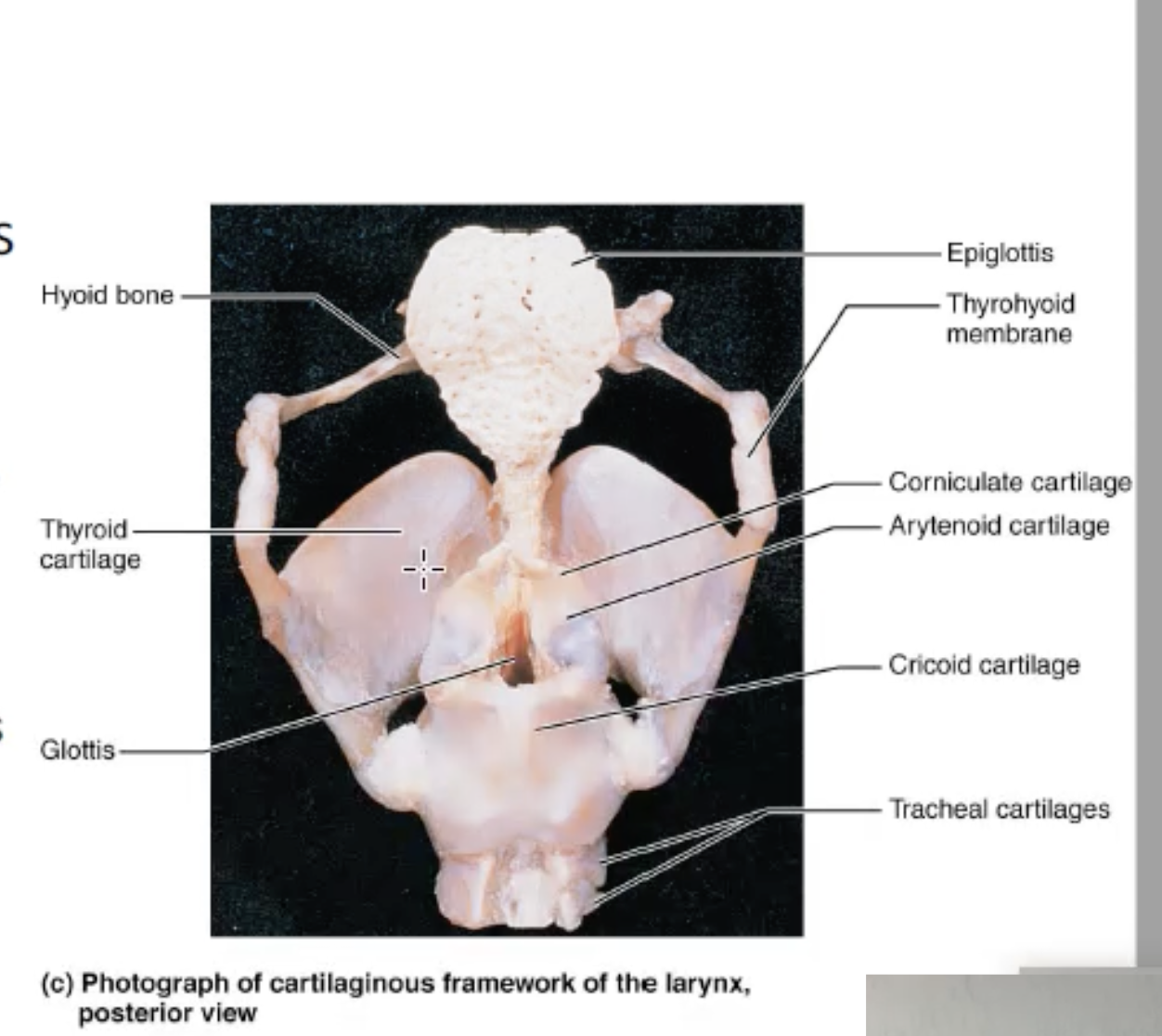
Where is the laryngeal prominence?
On the superior portion of the thyroid cartilage; testosterone stimulates the growth of the prominence, “Adam’s Apple”
The larynx

What tissue are the vocal ligaments covered with?
Stratified squamous epithelium
How long is the trachea?
About 12cm long, and is ANTERIOR to the esophagus. It is composed of 16-20 C-shaped rings of HYALINE cartilage
What is the trachea lined with?
The trachea is lined with pseudostratified columnar epithelium + goblet cells and ciliated cells
What is the inferior most fork of the trachea?
The carina
The right lung has how many lobes?
Three (separated by horizontol and oblique fissure)
The left lung has how many lobes
Two
What is a main difference between the right and left main bronchus?
The right, or main bronchus, is wider and more vertical, with the three lobes, The left is narrower and more horizontal, with a superior and inferior lobar branch.
What kind of tissue are lung bronchi lined with?
Ciliated pseudostratified columnar epithelium
What is the lamina propia?
The lamina propia has mucous glands and lymphoid nodules
Where does the bronchial tree get blood from?
The bronchial artery (from aorta)
What is true of the bronchioles?
They have ciliated cuboidal epithelium and a layer of smooth muscle, but no mucous or goblet cells
How many terminal bronchioles does each bronchial divide into?
50-80 terminal bronchioles
What are the two types of cells lining the alveoli?
1) Squamous alveolar cells (95%)
2) Cuboidal alveloar cells (type 2) for repair and secretion of pulmonary surfactant
What is each alveolus surrounded by?
Blood capillaries
The visceral pleura is…
the actual serous membrane
The parietal pleara is…
what adheres to the mediastinum on the inner surface of the rib cage
What is the role of the intercostal muscles between the ribs?
The intercostal muscles stiffen the thoracic cage in respiration, preventing it from caving inward
What are the three accessory muscles?
Pectoralis muscles, scalenes, sternocleidomastoid
Inhalation is…
an ACTIVE process
What are the three types of lung cancer?
1) Adenocarcinoma - making up 40% of cases. This is in the peripheral regions, developing from bronchial glands and alveolar cells
2) Squamous cell carcinoma - 20% of cases, arising in the bronchial epithelium
3) Small cell carcinoma (15%); lymphocyte-like cells that originate in primary bronchi, then metastasize.