orgo ch 7 practice problems I
 Call Kai
 Learn
 Practice Test
 Spaced Repetition
 Match
 Flashcards
 Knowt Play
1/28

There's no tags or description
Looks like no tags are added yet.
29 Terms
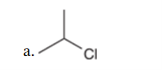
2-chloropropane
secondary halide

2-bromo-2-methylpropane
tertiary halide

1-iodopropane
primary halide

R-2-bromobutane
secondary halide

1-chloro-2,2dimethylpropane

4-bromo-3,3dimethyl-4propylheptane
draw sec-butyl chloride

draw 4-iodo-4-(1-methylethyl)heptane

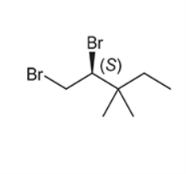
draw (S)-1,2-dibromo-3,3-dimethylpentane
Draw all constitutional isomers with the molecular formula C4H9Br, and then arrange them in order of increasing reactivity toward an SN2 reaction. Which isomer would be the most reactive toward an SN1 reaction? Explain.
tertiary substrate will be most reactive to SN1

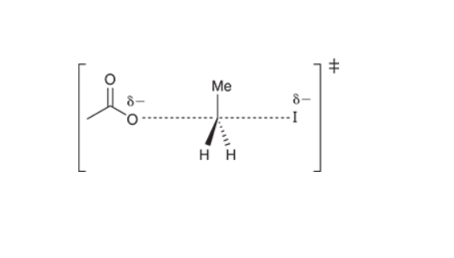
Draw the transition state for the substitution reaction that occurs between ethyl iodide and sodium acetate (CH3CO2Na)
(S)-2-Iodopentane undergoes racemization in a solution of sodium iodide in DMSO. Explain.
The substrate is secondary, DMSO is a a polar aprotic solvent and iodide is a strong nucleophile, these factors suggest SN2 process.


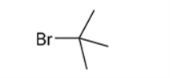
No, this process cannot be used to prepare the given compound. Preparation of this compound would require the use of a tertiary alkyl halide, which will not participate in an SN2 reaction because of steric crowding. (tertiary alkyl halide in picture)

A. R
B. R
C. The process is SN2 and does proceed with inversion of configuration, however the chiral centers still have the same configuration due to priority rules associated with assigning R/S.

these are SN2 reactions


For each synthesis below, provide a suitable starting material (an alkyl halide or an alcohol):

For each synthesis below, provide a suitable starting material (an alkyl halide or an alcohol):

For each synthesis below, provide a suitable starting material (an alkyl halide or an alcohol):
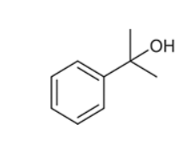

For each synthesis below, provide a suitable starting material (an alkyl halide or an alcohol):
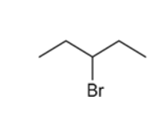

For each synthesis below, provide a suitable starting material (an alkyl halide or an alcohol):


For each synthesis below, provide a suitable starting material (an alkyl halide or an alcohol):
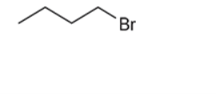


the second method is more efficient because the substrate is not sterically hindered and the nucleophile is strong, supporting SN2 progression
When (R)-3-bromo-2,3-dimethylpentane is treated with sodium hydroxide, four different alkenes are formed. Draw all four products and rank them in terms of stability. Which will be the major product?
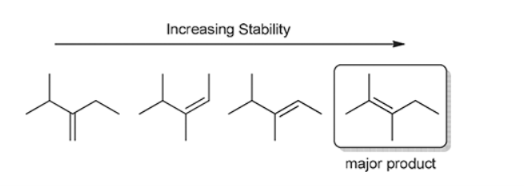
When 3-bromo-2,4-dimethylpentane is treated with sodium hydroxide, only one alkene is formed. Draw the product and explain why this reaction has only one regiochemical outcome.
NaOH is a strong base and the product is an alkene, indicating E2, the removal of a hydrogen from C2 or C4 results in the same product, so only onw alkene is formed


a.) one (only one beta position)
b.) three
c.) two
d.) two
e.) five