3. Philippine Health Care Delivery System
 Call Kai
 Learn
 Practice Test
 Spaced Repetition
 Match
 Flashcards
 Knowt Play
1/46

There's no tags or description
Looks like no tags are added yet.
47 Terms
Alma-Ata Declaration (1978)
Declares health as a fundamental human right.
Stresses that “the attainment of the highest possible level of health is a most important worldwide social goal.”
Aims to reduce the global disparities in health.
Requires the involvement of various social and economic sectors beyond just the health sector.
Primary Health Care
Based on scientifically sound and socially acceptable methods and universally accessible and acceptable to all individuals and families.
Requires full participation at a cost that the community and country can afford.
Promotes self-reliance and self-determination
Goes beyond traditional healthcare to focus on health equity and social policy.
Health Care System
Organized plan of health services
Health Care Delivery
Rendering of health services to people.
Health Care Delivery System
Network of facilities and personnel rendering care to people.
better health for all.
The ultimate goal of primary health care is _____________________.
Education for Health
Locally Endemic Disease Prevention & Control
Expanded Program of Immunization
Maternal & Child Health Care, including Family Planning
Essential Drugs Arrangement
Nutritional Food Supplement, an adequate supply of safe and basic nutrition
Treatment of communicable & Noncommunicable Disease
Safe Water & Sanitation
8 ELEMENTS OF PHC:
Equitable Distribution of Health care
According to this principle, primary care and other services to meet the main health problems in a community must be provided equally to all individuals irrespective of their gender, age, and caste, urban/rural and social class.
Community participation
A comprehensive healthcare relies on adequate number and distribution of trained physicians, nurses, allied health professions, community health workers, and others working as a health team and supported at the local and referral levels.
Multi-sectional approach
The recognition that health cannot be improved by intervention within just the formal health sector; other sectors are equally important in promoting the health and self-reliance of communities.
Use of appropriate technology
Medical technology should be provided that is accessible, affordable, feasible, and culturally acceptable to the community.
Planning
Management of Primary Health Care:
Setting priorities and determining performance targets
Organizing
Management of Primary Health Care:
Designing the patterns of reporting and communication.
Determining positions, teamwork assignments, and distribution of authority and responsibility.
Staffing
Management of Primary Health Care:
Acquiring and retaining health workers and promoting the professional development of the human resources
Directing
Management of Primary Health Care:
Acquiring and retaining health workers and promoting the professional development of the human resources
Controlling
Management of Primary Health Care:
Monitoring and performance evaluation of staff and activities and taking appropriate actions for corrective action to increase performance
Authority
The manager's right to make decisions and allocate resources.
Responsibility
The employee's duty to perform assigned tasks.
Accountability
Reporting and justifying task outcomes to superiors.
Centralization
Decision-making at top levels.
Decentralization
Decision-making at lower levels.
Formalization
Written documentation for control.
Line Authority
Types of Authority:
Direct control over subordinates.
Functional Authority
Types of Authority:
Power over specific activities.
Staff Authority
Types of Authority:
Advisory role within a specialist’s expertise.
Staffing
Assign individuals to roles based on competencies and qualifications.
Match key result areas (KRAs) with staff competencies.
Adjust and review requirements for existing programs.
The Philippine Health Care System (Dizon, 1977)
A complex network of organizations providing diverse health services
1991 Devolution
Health service delivery shifted to LGUs, leading to ongoing fragmentation issues.
Fragmentation
Human Resource
Private Sector Role
Key Challenges during the 1991 Devolution of Philippine PHC
Filipinos become among the healthiest people in Southeast Asia by 2022, and in the entirety of Asia by 2040.
DOH Vision
To lead the country in the development of a productive, resilient, equitable and people-centered health system for Universal Health Care
DOH Mission
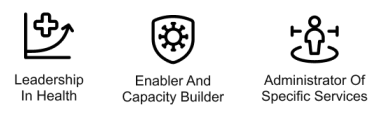
DOH has three major roles in the health sector:
Integrity
Excellence
Compassion & Respect for Human Dignity
Commitment
Professionalism
Teamwork
Stewardship of the Health of the People
DOH Core Values
Integrity
DOH Core Values:
The Department believes in upholding truth and pursuing honesty, accountability, and consistency in performing its functions.
Excellence
DOH Core Values:
The DOH continuously strive for the best by fostering innovation, effectiveness and efficiency, pro-action, dynamism, and openness to change.
Compassion & Respect for Human Dignity
DOH Core Values:
Whilst DOH upholds the quality of life, respect for human dignity is encouraged by working with sympathy and benevolence for the people in need.
Commitment
DOH Core Values:
With all our hearts and minds, the Department commits to achieve its vision for the health and development of future generations.
Professionalism
DOH Core Values:
The DOH performs its functions in accordance with the highest ethical standards, principles of accountability, and full responsibility.
Teamwork
DOH Core Values:
The DOH employees work together with a result-oriented mindset.
Stewardship of the Health of the People
DOH Core Values:
Being stewards of health for the people, the Department shall pursue sustainable development and care for the environment since it impinges on the health of the Filipinos.
Primary level
Levels of Health Care Facilities:
Basic health services offered by rural health units, clinics, and community hospitals. Operated by organizations like the DOH, Philippine Medical Care Commission, and civic/religious groups.
Secondary Level
Levels of Health Care Facilities:
Non-departmentalized hospitals (e.g., emergency and regional hospitals) providing care for symptomatic diseases requiring moderately specialized knowledge.
Tertiary Level
Levels of Health Care Facilities:
Advanced care in medical centers and specialized hospitals with sophisticated facilities and expertise for complex conditions.
Village or Grassroot Health Workers
Intermediate Level Health Workers
First Line Hospital Personnel
Three Levels of Primary Health Care Workers:
Village or Grassroot Health Workers
Three Levels of Primary Health Care Workers:
• First point of contact in the community for health care.
• Provide basic curative and preventive care while promoting a healthy environment.
• Engage in community improvement activities, like food production programs.
• Includes community health workers, volunteers, and traditional birth attendants.
Intermediate Level Health Workers
Three Levels of Primary Health Care Workers:
• First source of professional health care.
• Address health issues beyond the capacity of village workers.
• Offer supervision, training, supplies, and support to front-line workers.
• Includes doctors, nurses, and midwives.
First Line Hospital Personnel
Three Levels of Primary Health Care Workers:
• Provide specialized and hospital-based care for serious cases.
• Collaborate closely with intermediate and village health workers.
• Includes specialists, nurses, dentists, pharmacists, and other health professionals.