Module 4: Tissues & Integumentary system
 Call Kai
 Learn
 Practice Test
 Spaced Repetition
 Match
 Flashcards
 Knowt Play
1/57

Earn XP
Description and Tags
Vocabulary flashcards covering the characteristics, classifications, structures, histological features, and functions of human tissues (epithelial, connective, muscular, and nervous) from Exercise 5.
58 Terms
Tissue
A group of similar cells and extracellular material that originates from the same region of the embryo and works together to perform a structural or physiological role in an organ.
Epithelial Tissue
A primary tissue type consisting of tightly packed, minimally excitable cells with little matrix, maintaining mitotic capability, featuring apical and basal surfaces attached to a basement membrane, and lacking blood vessels (avascular).

Simple Epithelium
An epithelial layer classification characterized by having only ONE layer of cells, all of which touch the basement membrane.
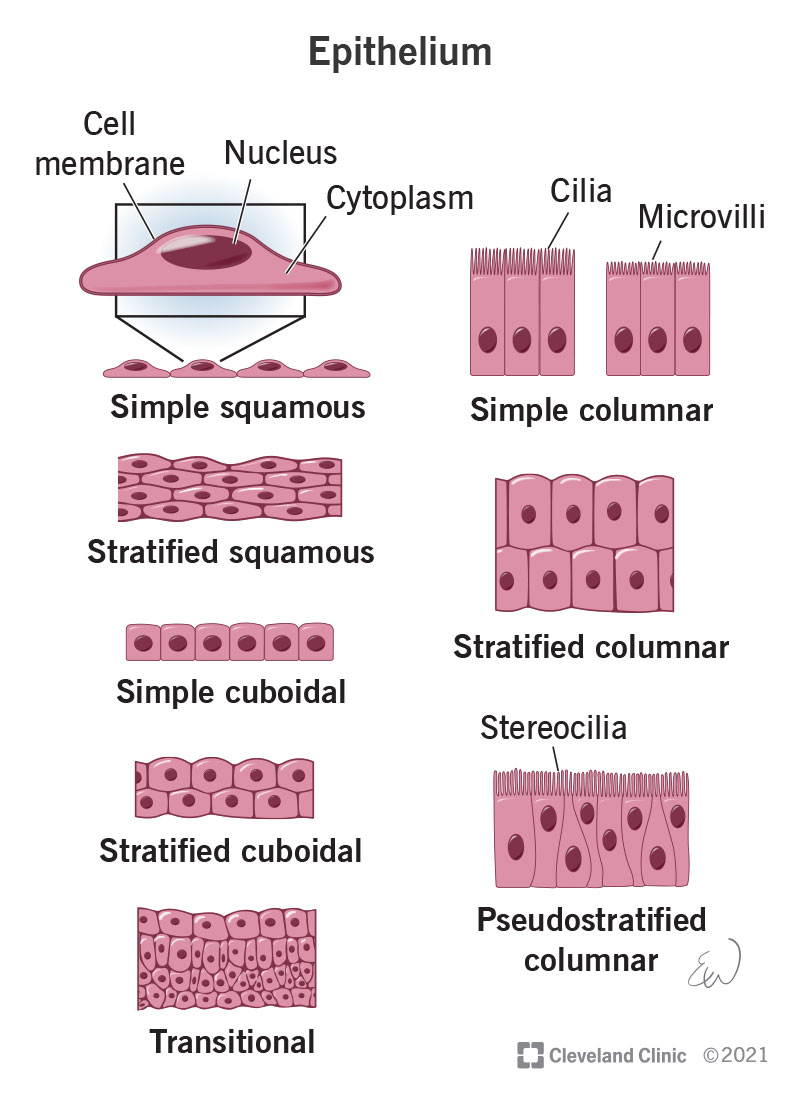
Stratified Epithelium
An epithelial layer classification characterized by having MORE THAN ONE layer of cells, named according to the shape of the cells at the apical surface.


Simple Squamous Epithelium
A single layer of flat cells that functions in diffusion, smooth lining, and serous fluid secretion; located in the lungs (alveoli), kidneys, kidney tubules, and lining the heart and blood vessels.
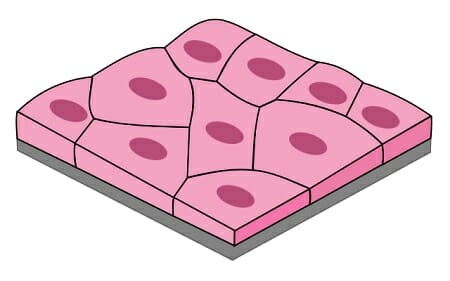

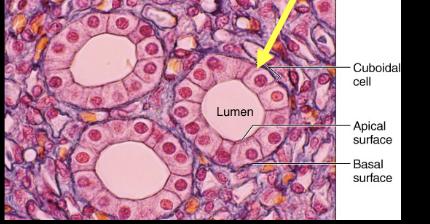
Simple Cuboidal Epithelium
A single layer of small cube-shaped or wedge-shaped cells that functions in absorption and secretion; located primarily in kidney tubules and the liver.
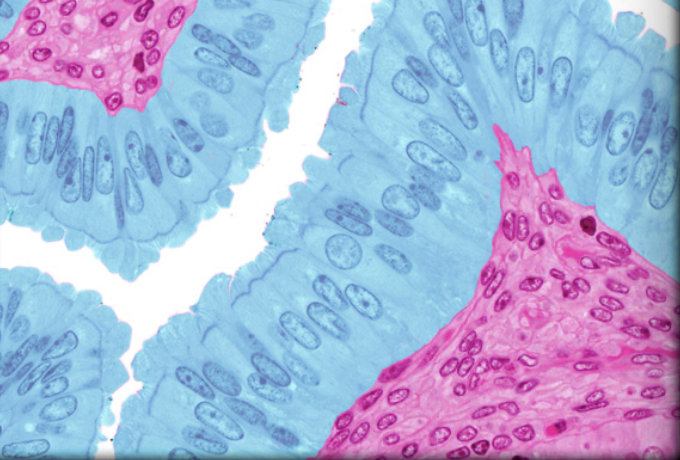
Simple Columnar Epithelium
A single layer of cells taller than they are wide, often with goblet cells or microvilli; functions in absorption and secretion; located in the stomach, intestines, gall bladder, and uterine tube.


Pseudostratified Ciliated Columnar Epithelium
A single layer of cells of varying heights where all cells touch the basement membrane but appear stratified; functions in mucous secretion and the movement of mucus away from the lungs; located in the trachea.

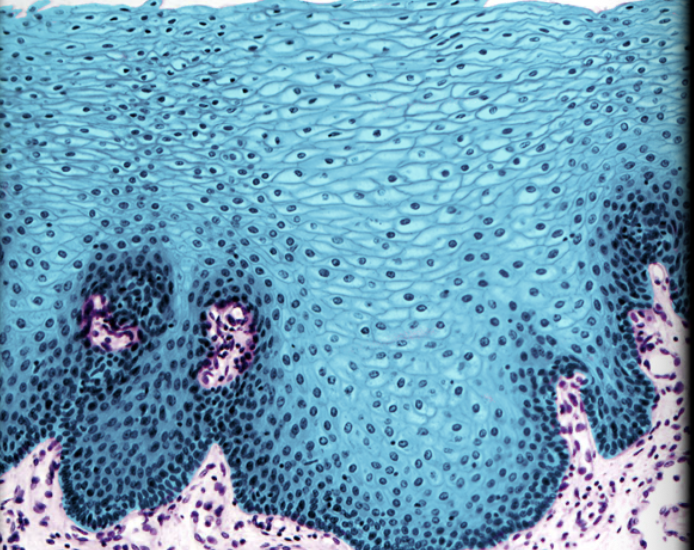
Nonkeratinized Stratified Squamous Epithelium
Multiple layers of cuboidal cells that flatten toward the surface without the waxy protein keratin, remaining moist; located in the lining of the oral cavity, esophagus, and vagina to resist mechanical abrasion.
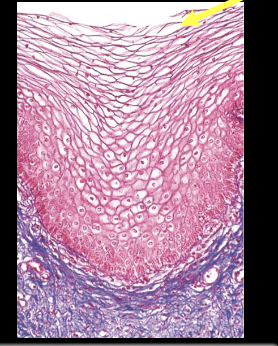

Keratinized Stratified Squamous Epithelium
Multiple layers of cuboidal cells that flatten and fill with the waxy protein keratin as they die toward the dry apical surface; found in the epidermis of the skin.

Stratum Basale
The deep dividing layer of stratified squamous epithelium where stem cells divide and push older cells upward toward the surface.


Transitional Epithelium
Stratified epithelium composed of multiple layers of cuboidal cells that stretch and flatten (transition to squamous) when the organ fills; lines the urinary bladder and ureters.

Connective Tissue
The most abundant, widely distributed, and histologically variable primary tissue; composed of cells that typically do not touch each other surrounded by extensive extracellular matrix.
Mesenchyme
Embryonic connective tissue that exists before birth and differentiates to give rise to all adult connective tissues.
Areolar Connective Tissue
A loose connective tissue featuring scattered pink collagen fibers with black elastic and reticular fibers and numerous cells; binds epithelia to lower layers and protects organs from infection.
Reticular Connective Tissue
A loose connective tissue consisting of black-stained, branched reticular fibers that form the supportive stroma framework around parenchyma cells in the liver, spleen, lymph nodes, and thymus.
Adipose Tissue
A connective tissue dominated by large, pale adipocytes with thin margins and peripheral nuclei pushed aside by a large central fat vacuole; functions in lipid storage and shock absorption.
Dense Regular Connective Tissue
A dense connective tissue containing densely packed, parallel wavy collagen fibers with fibroblasts compressed in rows; provides tensile strength in one direction in tendons and ligaments.
Dense Irregular Connective Tissue
A dense connective tissue containing clumps or bundles of collagen fibers arranged in random directions with little ground substance; provides strength to resist tearing in the dermis and organ sheaths.
Elastic Connective Tissue
A dense connective tissue characterized by dense, dark squiggly elastic fibers; allows stretch and recoil in large arteries, the trachea, and vocal cords.
Hyaline Cartilage
Supportive connective tissue featuring a clear, glassy matrix with invisible collagen fibers and sparsely arranged chondrocytes in lacunae; usually covered with a perichondrium; located in movable joints, costal cartilages, larynx, trachea, and fetal skeleton.
Fibrocartilage
Supportive connective tissue with easily visible parallel collagen fibers and rows of large chondrocytes in lacunae; never covered by a perichondrium; resists compression and absorbs shock in the pubic symphysis, intervertebral discs, and knee meniscus.
Elastic Cartilage
Supportive connective tissue featuring abundant black-staining elastic fibers forming a web-like mesh around chondrocytes in lacunae; always covered with perichondrium; found in the external ear and epiglottis.
Compact Bone
Supportive connective tissue composed of a calcified extracellular matrix arranged in concentric lamellae around central canals, with osteocytes trapped in lacunae interconnected by canaliculi.

Osteon
The structural and functional unit of compact bone, consisting of concentric rings of matrix (lamellae) surrounding a central canal.
Blood
A fluid connective tissue consisting of a liquid ground substance (plasma) and formed elements: erythrocytes, leukocytes, and platelets.
Erythrocyte
The most numerous formed element in blood, appearing as pink biconcave discs lacking a nucleus; responsible for transporting oxygen and carbon dioxide.
Leukocyte
A large, nucleated formed element in blood with purple-staining nuclear lobes that functions in immune protection and defense against disease.
Platelet (Thrombocyte)
Tiny, irregularly sized purple cell fragments in blood smaller than erythrocytes that function in blood clotting.
Muscular Tissue
A primary tissue type consisting of highly excitable cells with little extracellular matrix that contract in response to stimuli to produce movement and generate body heat.
Skeletal Muscle
Voluntary muscle tissue consisting of long, cylindrical, striated, unbranched fibers with multiple peripheral nuclei located just under the plasma membrane.
Cardiac Muscle
Involuntary muscle tissue found only in the heart, consisting of short, typically branched, striated cells with a single central nucleus and intercalated discs.
Intercalated Discs
Microscopic structures visible as dark transverse bands that physically and electrically bind adjacent cardiac muscle cells (cardiocytes) together.
Smooth Muscle
Involuntary, non-striated muscle composed of short, overlapping, spindle-shaped (fusiform) cells with a single centrally located nucleus; found in the walls of hollow internal organs.
Neuron
A highly excitable cell of nervous tissue composed of a cell body (soma), dendrites, and an axon; specialized to receive, process, and conduct electrical nerve impulses.

Neuroglia
Non-excitable, highly numerous cells of nervous tissue that maintain mitotic capability and act to nourish, protect, and support neurons.

Central Nervous System Glia
The four types of neuroglial cells located within the central nervous system: oligodendrocytes, astrocytes, microglia, and ependymal cells.
Peripheral Nervous System Glia
The two types of neuroglial cells found in the peripheral nervous system: satellite cells and Schwann cells.
Epidermis