acoustics exam 3, acoustic theory and vowel resonance
 Call Kai
 Learn
 Practice Test
 Spaced Repetition
 Match
 Flashcards
 Knowt Play
1/65

There's no tags or description
Looks like no tags are added yet.
66 Terms
periodic source of speech production
vocal fold vibration
aperiodic source of speech production
noise from glottis, frication
where are vfs located
larynx
where is glottal noise located
vocal tract, supraglottal noise, stops, release, fricatives
how does the pharynx act as a filter?
size determines f1, changing size affects resonance
how does the oral cavity act as a filter?
size determines f2, changing shape impacts resonance
landmarks of pharynx
superior constrictors (nasopharynx) middle constrictors (oropharynx) inferior constrictors (laryngopharynx)
the oral cavity is formed by the space between what?
teeth, alveolar ridge, velum, hard palate, tongue
how does the velum change shape?
contraction of levator palatini closes velopharyngeal port, raises velum (oral speech sounds), relaxation of levator palatini opens vp port, lowers velum (nasal speech)
tongue extrinsic muscles
styloglossus, hyoglossus, genioglossus, palatoglossus
styloglossus
brings tongue up and back /u/
hyoglossus
brings tongue down and back /a/
genioglossus
brings tongue up and forward /i/
palatoglossus
elevates tongue
intrinsic muscles of the tongue
superior longitudinal, inferior longitudinal, transverse, vertical
superior longitudinal
elevates tongue tip /l/
inferior longitudinal
lowers tongue tip /i/
vertical muscle
flattens tongue
transverse muscle
narrows tongue
orbicularis oris
rounds lips and bilabial closure /p, b, m/ /u, w/
risorius
spreads lips /i/
vocal tract as a resonator
can be modeled as a tube closed at one end (glottis) and open at the other (lips)
how is resonance in the vocal tract determined?
cavity size, peak resonance=formants
what are formants?
peak resonances
what are nodes?
points that appear to stand still, have minimum displacement/velocity and maximum pressure
What are antinodes?
points that vibrate, have maximum displacement/velocity and minimum pressure
how do nodes affect formant frequency?
raises formant frequency
how do antinodes affect formant frequency?
lower formant frequency
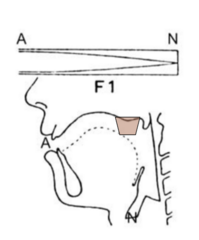
high F1 constriction location
near pharynx (node)
low f1 constriction location
near lips (antinode)
low f2 constriction location
near pharynx (antinode)
high f2 constriction location
near front of mouth (node)
low F2 constriction location
near lips (antinode)
low f3 constriction locations
near pharynx, near center of mouth, near lips (antinodes)
high f3 constriction locations
near uvula, near front of mouth (nodes)
constant filter+changing source
change pitch of same vowel
constant source+changing filter
pitch stays constant, vowel changes
Production of /ə/
uniform tube, tongue, jaw, lips relaxed, neutral f1 and f2
production of /i/
high and front, large pharynx, small oral cavity, elevated tongue to middle of mouth, genioglossus active, low f1 and high f2
production of /u/
high back and rounded, large pharynx, large oral cavity, lip protrusion lengthens vocal tract, low f1 and low f2
production of /a/
low and back, small pharynx, large oral cavity, high f1, low f2
why do vowels vary across speakers?
people differ in overall vocal tract length and size in parts of tract, affect resonance and formants
what correlates to a high f1?
small pharynx, open mouth
what correlates to a low f1?
large pharynx, small mouth
what correlates to a high f2?
short oral cavity
what correlates to a low f2?
long oral cavity
ranges of f1 for men
250-750
ranges of f2 for men
850-2400
ranges of f3 for men
2250-3000
ranges of f1 for women
300-900
ranges of f2 for women
900-3000
ranges of f3 for women
2650-3400
vowel production in clinical populations
deaf speakers have deviant vowel spaces, jaw+tongue placement are more constricted. impaired vowel production in people with apraxia, dysarthria, cerebral palsy, and foreign accents
attack
transition into vowel
steady state
vowel formant is steady
decay
transition into following phonemes
vowels vs consonants
vowels have longer duration and greater amplitude
formant 1
formant 2

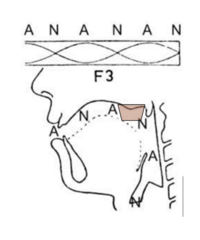
formant 3
direction of transition
bilabial-falling, alveolar-flat, velar-rising
major landmarks of oral cavity
teeth, alveolar ridge, velum
cavities of vocal tract
oral cavity, nasal cavity, vocal folds, pharyngeal cavity, esophagus
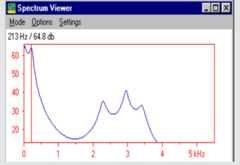
/i/ resonance

/a/ resonance

/u/ resonance