exam 1: cells/growth + tissue types
 Call Kai
 Learn
Learn Practice Test
 Spaced Repetition
 Match
Match Flashcards
 Knowt Play
1/90

There's no tags or description
Looks like no tags are added yet.
Name | Mastery | Learn | Test | Matching | Spaced | Call with Kai | Chat |
|---|
No analytics yet
Send a link to your students to track their progress
91 Terms
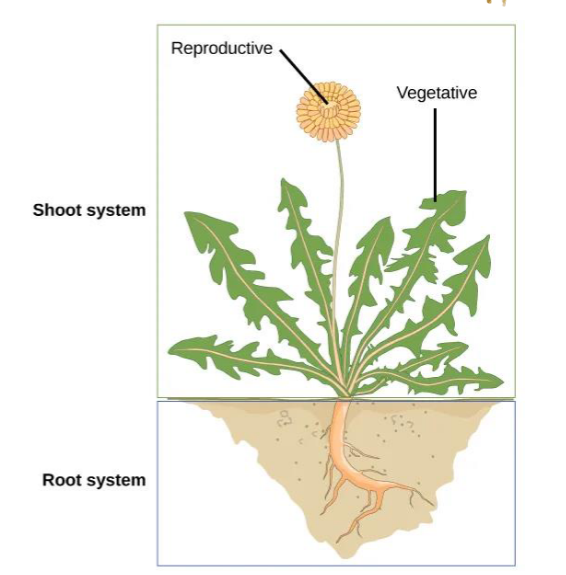
What are the 2 main organ systems of plants?
Shoot (aboveground)
vegetative organs
leaves + stems
reproductive organs
flowers + fruits
Root System (underground)
only one organ → roots
Shoot System
aboveground. It has vegetative (leaves + stems) and reproductive (flowers + fruits) organs.

Vegetative Organs
Leaves and stems
Vegetative organs handle the daily survival, growth, and nourishment of the plant. They do not take part in sexual reproduction, though some can create new plants asexually.
Reproductive Organs
Flowers and fruits
Reproductive organs produce offspring and pass on genetic traits. handle sexual rep.
Root System
Underground! It's only organ is roots.
Determinate Growth
The type of growth that stops after a time. Max size is genetically determined
Usually a plant cannot heal/regrow
It's maximum size rarely achieved in nature
ex: leaves, flowers and fruits
what parts of a plant have determinate growth?
leaves, flowers, fruits
Indeterminate Growth
plant is able to keep growing through life. No max size genetically!
Usually a plant can heal/regrow.
It can be limited by resources and environmental factors
ex: roots and stems
which parts of a plant have indeterminate growth?
roots and stems
Cell Theory
1665 – Robert Hooke sees 'chambers' on cork tissue under microscope – calls them "cells"
• 1838 – Schleidern and Swann stated that:
1. All plants and animals are made of cells
2. Cell is the basic unit of life
• 1858 – Virchow added that:
3. Cells arise by reproduction from previous cells - "Omnis cellula e cellula
what r the 3 principles of cell theory?
1) All plants and animals r made of cells
2) cell is the basic unit of life
3) Cells arise by reproduction from previous cells (Omnis cellula e cellula)
Cell Theory - Virchow
Added that cells arise by reproduction from previous cells - "Omnis cellula e cellula"
What r the 4 components all cells have (eukaryotic + prokaryotic) ?
1. Plasma Membrane
2. Cytoplasm
3. DNA
4. Ribosomes

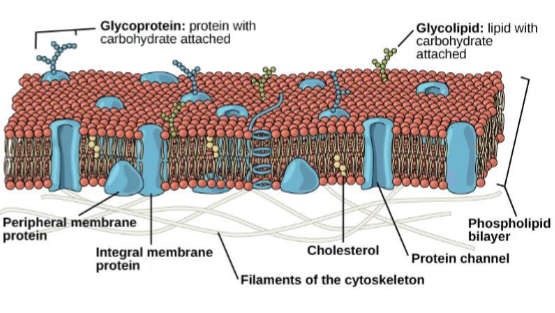
Plasma Membrane
A phospholipid bilayer with embedded proteins. It serves as a barrier between the cell and the environment. It controls the passage of organic molecules, ions, water, oxygen, and cellular waste
Cytoplasm
The entire region of the cell between the plasma membrane and the nuclear envelope.
Composed of organelles suspended in a gel-like material - the cytosol - and protein threads - the cytoskeleton

Nucleus
In eukaryotic cells, DNA is typically housed in the nucleus.
directs the synthesis of ribosomes and proteins.
It stores chromatin (DNA + proteins) and the nucleolus (where ribosomes r made)
Separated from the rest of the cell by the nuclear envelope

Chromatin
Clumps of DNA and protein that resemble jumbled threads
during cellular growth and maintenance, proteins atttach to chromosomes

Nucleolus
The part of the nucleus where ribosomes are made

Nuclear Envelope
A double membrane that separates the nucleus from the rest of the cell

Chromosomes
During cellular replication, DNA is visible in the form of chromosomes.
linear in eukaryotes
chromatin is a loose, uncoiled strand used for daily cell functions, while a chromosome is a tightly packed package used safely during cell division

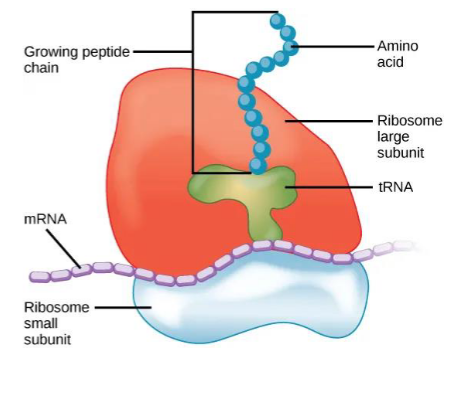
Ribosomes
Structures responsible for protein synthesis. They can either float free in the cytoplasm or be embedded in the endoplasmic reticulum.
They receive instructions from the nucleus in the form of mRNA on the specific order of amino acids to build a given protein.
they r NOT ORGANELLES!!
Unique Components of eukaryotic cells
Endomembrane System
Vesicles and peroxisomes
Endoplasmic reticulum
Golgi apparatus
Mitochondria
Endomembrane System
Includes the ER and Golgi!
Modify, package, and transport lipids and proteins

endoplasmic reticulum
unique to euk. and part of endomembrane system
a series of interconnected sacs and tubules that:
modifies proteins
synthesizes lipids

golgi apparatus
unique to euk. and part of endomembrane system
A series of flattened membranes that receives proteins + lipids from ER, which it then sorts, tags, packages, and distributes

Vesicles and Peroxisomes
Bud off from the endomembrane and serve as transport units for diverse materials
unique to euk.
Mitochondria
The 'powerhouse' of the cell - it is the site of cellular respiration.
makes ATP from glucose and other nutrients
uses oxygen and produces CO2 as a waste product
Contains its own DNA and ribosomes!
in euk only
what r components unique to plant cells?
Cell wall
central vacuole
plastids such as chloroplast

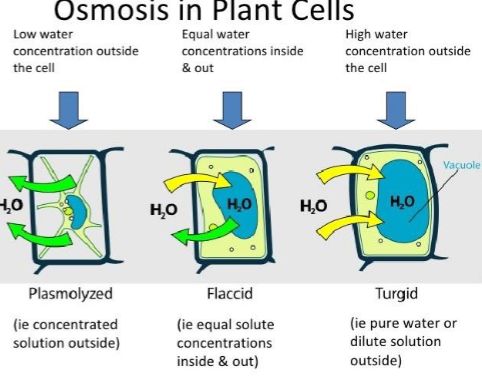
Central Vacuole
A large, membrane-bound structure that stores water and can fill much of the plant cell.
Plays a key role in osmosis → regulating water concn in the cell
also stores nutrients, ions, and waste products.
surrounded by tonoplast (membrane)

Osmosis
Releasing water under dry conditions and absorbing water under wet conditions
done by central vacuole in plant cell
Tonoplast
The membrane that surrounds the Central Vacuole in plant cells

Chloroplast
A type of plastid that stores chlorophyll and other pigments for photosynthesis.
pigments r stored in thylakoids which r found in stacks called grana
Contains its own DNA and ribosomes.

Thylakoids
The interconnected sacs that store chloroplast pigments
found in stacks called grana

Grana
Stacks of Thylakoids in chloroplast

what r some other plastids in a plant cell besides the chloroplast?
chromoplast (stores orange/yellow pigments)
amyloplast (stores starch)
Chromoplast
Plastids that store orange/yellow pigments
Amyloplast
Plastids that store starch
Cell Wall Parts
Middle lamella
thin layer of pectin binding adjacent cells
primary cell wall
on surface of all plant cells
secondary wall
plasmodesmata (pores)

Middle Lamella
A thin layer of pectin binding adjacent cells in the cell wall!

Primary Cell Wall
Occurs on the surface of all plant cells - initially deposited on the surface of middle lamella
composed of cellulose microfibrils bundled together
thin + elastic to allow for cell enlargement
only cell wall present in some cells

What is the primary cell wall composed of?
cellulose microfibrils! A threadlike component of the cell wall

Secondary Cell Wall
Made of layers deposited inner to the primary wall.
Occurs as cell reach mature size.
lignin is deposited together w/ cellulose to add rigidity
thicker than primary wall
as it grows, it pushes cell membrane in → can lead to cell death
Makes up 90% of wood tissue!!

Lignin in secondary cell wall
Deposited together with cellulose - adding rigidity

Plasmodesmata
Pores that allow for communication between cells in the cell wall

what does the orientation of cellulose microfibrils determine in the cell wall?
Direction of cell enlargement + strength!
think of it like a spring, it can expand longitudinally but not laterally! only 1 axis of growth

Plant Growth
All tissues originate from meristematic tissue and later differentiate and specialize
Totipotent
plant tissue is totipotent → can regenerate the entire plant
the genetic ability of a single cell to divide, grow, and differentiate into a complete, fertile adult plant
Meristems
Regions of continuous cell division and growth located in different points of the plant.
all plant tissues originate from meristemic tissue
there r 3 types: apical, lateral, intercalary
3 Types of Meristems
Apical meristems
at extreme top and bottom of plant, responsible for height and growth in soil
SAM + RAM
Lateral meristems
girth
Intercalary meristems
only in grasses
ultimate sources of all cells in plant: apical + lateral meristems
Apical Meristem
Located at very end of stems (shoot apical meristems) and roots (root apical meristems).
They produce 3 types of primary meristematic tissues:
protoderm (epidermis)
ground meristem (everything else)
procambium (vascular transport tissue)

3 types of Primary Meristematic Tissues
protoderm (epidermis)
ground meristem (everything else)
procambium (vascular transport tissue)
they are primary meristems. They are the embryonic precursors that give rise to the primary tissues.
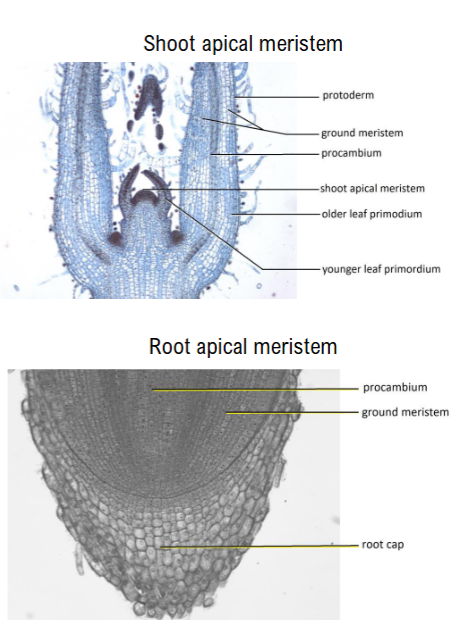
how does apical meristem give rise to primary tissue?
1) Apical Meristem (The ultimate "stem cell" source at the growing tips)
2) Primary Meristems (Protoderm, Procambium, and Ground Meristem)
3) Primary Tissues (The mature, functional systems: Dermal, Vascular, and Ground tissues)
Protoderm
Gives rise to epidermis
- Dermal tissue
type of primary meristemic tissue

Ground Meristem
Gives rise to ground tissue (photosynthetic, storage, support)
type of primary meristemic tissue
catch all category, everything that’s not in epidermis or vascular tissue
pith, cortex, mesophyll, etc.

Procambium
Gives rise to vascular tissue which aids in transport
xylem + phloem
type of primary meristemic tissue
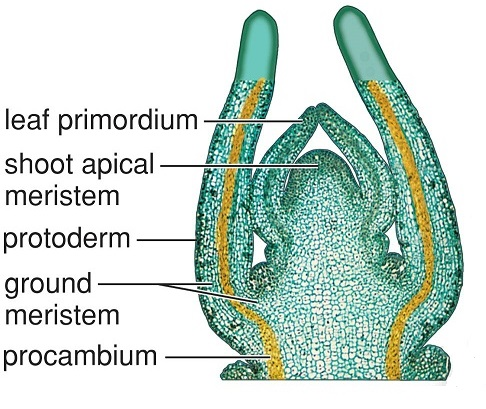
Lateral Meristem
Responsible for secondary growth!
increase of girth.
Located in 2 regions:
vascular cambium
cork cambium

Vascular Cambium
Gives rise to vascular tissue (secondary xylem + phloem)
region of lateral/secondary meristem
arises from procambium

Cork Cambium
Arises from the pericycle and the cortex
produces periderm (secondary dermal tissue) → bark
region of lateral/secondary meristem
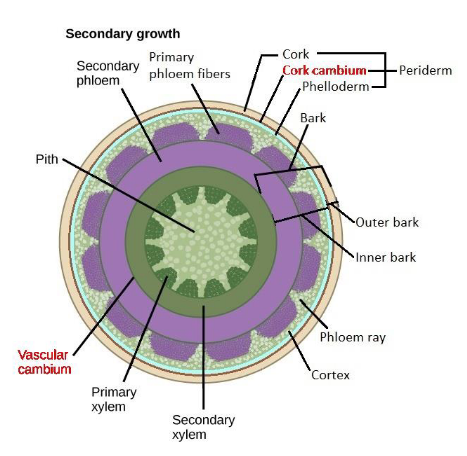
periderm
secondary dermal tissue
produced by cork cambium which is a region of lateral meristem
the protective, woody outer layer that replaces the epidermis in plants that undergo secondary growth (widening) “bark”

meristems in a seed
The 3 types of primary meristematic tissue can be observed in the embryo of a seed

turgor pressure
when plants fill w water it exerts turgor pressure against the cell wall → makes for rigid boxes
what are cells glued together with?
pectin
plant tissue
aggregates of diff types of cells derived from groups of specialized cells called meristems
the aggregated tissue is strong + flexible
what r the 3 main tissue systems of a plant?
ground tissue system
mesophyll, pith, etc.
vascular tissue system
xylem + phloem
dermal tissue system
epidermis and periderm
simple tissues
composed of one type of cell
perform essential functions like storage, photsynthesis, support, storage, regulation
3 main types: parenchyma, collenchyma, sclerenchyma
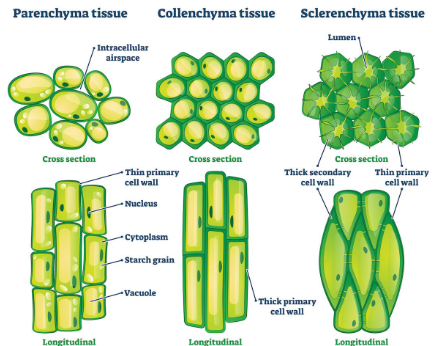
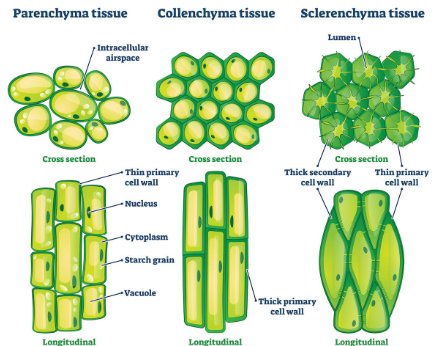
parenchyma cells
most common, usually spherical or elongated, but can have diff shapes “brick like”
thin primary cell walls, but may develop lignified secondary walls
living cells perform metabolic functions like:
photosynthesis and respiration
storage and secretion
only type of cell that when mature can be reprogrammed into other cell types for tissue culture and wound healing!
can turn into sclerenchyma or collenchyma, but they can’t turn into parenchyma

which type of cell can reprogram into other cell types and has a thin primary cell wall?
parenchyma cells

parenchyma tissue
when parenchyma cells aggregate to form simple tissues. Can be:
cortex and pith
serve as storage and support purposes (ground tissue)
mesophyll
can serve a photosynthetic (palisade) and regulatory (spongy) role in leaves.
cortex
region btwn plants epidermal and vascular tissue in most stems + roots
outside vascular ring for storage, transport, support
formed by parenchyma cells/tissue

pith
innermost core for nutrient storage. inside cylinder of vascular tissues
formed by parenchyma cells/tissue

mesophyll
can serve a photosynthetic (palisade) and regulatory (spongy) role in leaves.
made up of parenchyma cells/tissue

what type of cell are the cortex, pith, and mesophyll made up of?
parenchyma cells! these r simple parenchyma tissues
collenchyma cells + tissue
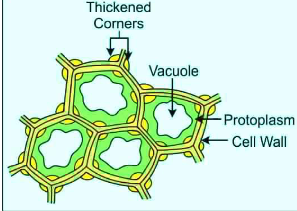
columnar/cylindrical structure.
elongated, often containing chloroplast, and alive at maturity
cell walls r composed of alternating layers of pectin and cellulose - usually thicken at corners
strong and flexible
provides support to young stems and leaves to allow for growth (usually in newer/growing part of plant)
outermost cells of cortex might aggregate into rights around the stem

which type of cell has a cell wall composed of alternating layers of pectin and cellulose that thicken at the corners
collenchyma! cell walls r strong and flexible to provide support to young stems + leaves
what is the function of collenchyma cells?
provides support to young stems and leaves to allow for growth
sclerenchyma cells + tissue
thick lignified secondary cell walls. DEAD at maturity
2 types:
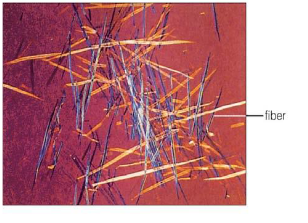
fibers
long, narrow cells w thick pitted cell walls tapered at ends that aggregate into continuous cylinder around stems or form strands
sclerids
can have many shapes and can form sheets or be in small clusters

which type of cell is dead at maturity?
Sclerenchyma cells! live to make thick lignified secondary cell walls then die
what r the 2 types of sclerenchyma tissue?
fibers
sclerids
fibers
a type of sclerenchyma tissue
long, narrow cells with thick, pitted cell walls tappered at the ends
Can aggregate into continuous cylinder around stems or form strands.
sclerids
a type of sclerenchyma tissue
can have many shapes (from simple stone shapes to highly branched).
Can form sheets (e.g. seed coat) or be in small clusters

what r some examples of complex tissue?
vascular system, epidermis, periderm
complex tissue: vascular system
interconnected network of cells traversing entire plant
composed of:
Vessel elements and tracheids (water- conducting cells)
• Fibers (sclerenchyma cells for support)
• Living parenchyma cells (help load minerals in and out of conducting cells)
• Sieve-tube members (food conducting cells)
• Companion cells (specialized parenchyma cell)

complex tissue: epidermis
usually a single layer of cells in outer part of plant - as many as 6 layers in succulents
covered in cutin
complex tissue composed of:
epidermal cells
somewhat elongated, without chloroplast
guard cells
specialized to open/close stomata
subsidiary cells
support epidermis and in close association w guard cells and functions to open/close stomata
trichomes - outgrowths of one or more cells
in roots they form root hairs.
in leaves they form protective strucutures to prevent water loss and increase absorption in root
cutin
waxy waterproof material that covers epidermis

trichomes
part of epidermis
they r outgrowths of one or more cells
in roots they form root hairs
in leaves they form protective structures

what forms root hairs in stems
trichomes
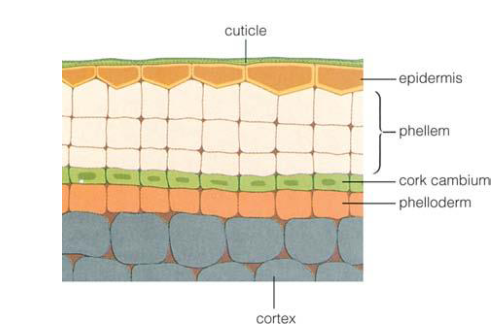
periderm
a protective layer that forms in older stems and roots → replaces epidermis
a type of complex secondary tissue
its composed of:
phellem (cork) cells
phellogen/cork cambium
phelloderm
what is periderm composed of?
phellem (cork) cells
phellogen/cork cambium
phelloderm
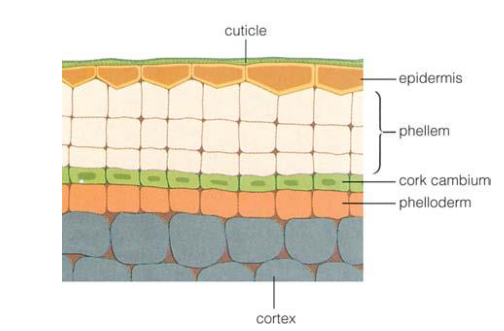
Phellem (cork) cells
one of the cells making up the periderm
DEAD at maturity (sclerenchyma) and with waxy suberin embedded in cell walls
outermost tissue of periderm
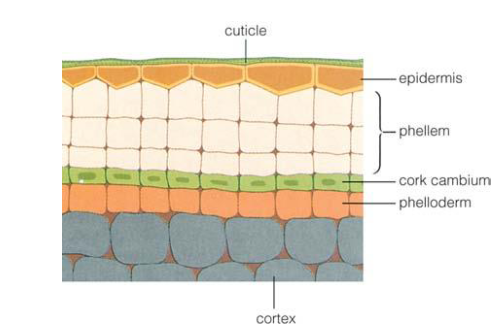
Phellogen
also known as cork cambium!
the middle tissue making up the periderm
Creates the periderm by dividing to produce new cells on both sides

phelloderm
parenchyma like cells btwn the cor cambium and cortex
innermost tissue in periderm so live longer than phellem cells
