Tectonics topic 2.3 (distribution of earthquakes, volcanoes and tectonic hazards)
 Call Kai
 Learn
Learn Practice Test
 Spaced Repetition
 Match
Match Flashcards
 Knowt Play
1/5

There's no tags or description
Looks like no tags are added yet.
Name | Mastery | Learn | Test | Matching | Spaced | Call with Kai | Chat |
|---|
No analytics yet
Send a link to your students to track their progress
6 Terms
distribution of earthquakes
Earthquakes occur along all types of plate boundaries and the largest concentration is at pacific ring of fire.
At plate boundaries, plates are pushed by tectonic forces, stress builds up and energy is eventually released
Example :
Broad belt of earthquakes along convergent plate boundaries in the pacific ring of fire
Narrow belt of earthquakes along divergent plate boundary at mid atlantic ridge
Narrow belt of earthquakes along the transform platte boundary at the San Andreas fault.
Earthquakes occur more commonly along convergent plate boundaries at subduction zones as more stress is built up during subduction
Exceptions : some earthquakes may occur away from plate boundaries (eg within Eurasian plate)
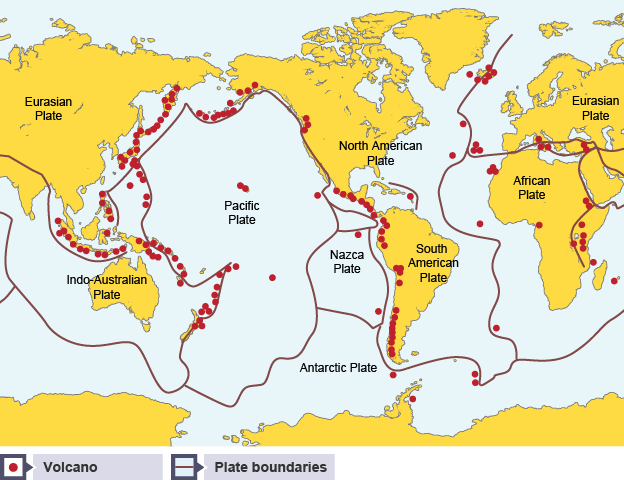
pacific ring of fire
Pacific ring of fire → broad belt around the pacific ocean where most earthquakes and active volcanoes occur
Compromise all 3 types of plate boundaries
Convergent : pacific plate moving towards the philippine plate
Divergent : pacific plate moving away from the cocos plate
Transform : pacific plate sliding past the north american plate at the san andreas fault

distribution of volcanoes
Volcanoes are generally located near convergent and divergent plate boundaries → at these plate boundaries, magma rises up to the surface, forming volcanoes
Belts of volcanoes may be observed along :
Convergent plate boundaries : a belt of volcanoes along subduction zones in the pacific ring of fire
Divergent plate boundaries : a belt of volcanoes along divergent plate boundaries between the north american and eurasian plates
Volcanoes are NOT found near transform plate boundaries and continental-continental convergent plate boundaries (magma do not rise to earth’s surface to form volcanoes at these boundaries)
Exceptions : hot spot volcanoes (found away from plate boundaries)
Example : The Piton de la Fournaise is a hot spot volcano located on the island of Reunion in the Indian Ocean, away from plate boundaries
earthquake hazards
ground shaking
soil liquefaction
landslides
tsunamis
volcanic eruption hazards
tephra
volcanic gases
lava flows
pyroclastic flows
lahars
volcanic landslides
distribution of tectonic hazards
earthquake hazards → generally located within the same geographic region as earthquake
volcanic hazards → generally found along convergent and divergent plate boundaries
Exception : not all tectonic activities localized
Hazards such as tsunamis and volcanic ash may spread beyond geographic regions
Tsunami waves and volcanic ash may trave thousand of kilometres from where they originated
Example (tsunami) : The 2004 Indian Ocean tsunami travelled almost 5000km to Africa, with sufficient energy to cause deaths and death
Example (volcanic ash) : during the eruption of Mount Pinatubo in 1991, ash spread across SEA.