ALL COLOUR BELT THEORY
 Call Kai
 Learn
 Practice Test
 Spaced Repetition
 Match
 Flashcards
 Knowt Play
1/94

Earn XP
Description and Tags
Comprehensive vocabulary flashcards covering Taekwondo patterns, stance specifications, the Theory of Power, anatomical tools, directions, shapes, and motion terminology.
95 Terms
Chon-Ji
Taekwondo pattern meaning Heaven and Earth; represents the creation of the world and the beginning of human history. It is the first pattern learned and consists of 19 movements.
Dan-Gun
Taekwondo pattern named after the legendary founder of Korea; consists of 21 movements.
Do-San
Taekwondo pattern named after the pseudonym of patriot Ahn Chang-Ho (1876-1938); its 24 movements represent his entire life dedicated to Korean education and independence.
Won-Hyo
Taekwondo pattern named after the monk Won Hyo, who introduced Buddhism to Korea in the year 686 AD; consists of 28 movements.
Yul-Gok
Taekwondo pattern named after the pseudonym of scholar Yi I, known as the Confucius of Korea; its 38 movements refer to his birthplace at 38∘ latitude.
Joong-Gun
Taekwondo pattern named after patriot Ahn Joong-Gun, remembered for resisting Japanese occupation; its 32 movements represent his age at death.
Toi-Gye
Taekwondo pattern named after scholar Yi Hwang, a leading Neo-Confucian thinker; its 37 movements refer to his birthplace at 37∘ latitude.
Hwa-Rang
Taekwondo pattern named after the Hwa Rang youth group; its 29 movements refer to the 29th Infantry Division where Taekwon-Do matured.
Parallel Ready Stance
Narani Junbi; features a 50/50 weight distribution, a width of 1 shoulder width, and a length of 0.
Closed Ready Stance
Moa Junbi
; features a 50/50 weight distribution, a width of 0, and a length of 0.
Walking Stance
Gunnun Sogi; features a 50/50 weight distribution, a width of 1 shoulder width, and a length of 1.5 shoulder widths.
L-Stance
Niunja Sogi; features a 70/30 weight distribution, a width of 1 shoulder width, and a length of 1.5 shoulder widths.
Fixed Stance
Gojung Sogi; features a 50/50 weight distribution, a width of 1 shoulder width, and a length of 1.5 shoulder widths.
Sitting Stance
Annun Sogi; features a 50/50 weight distribution, a width of 1.5 shoulder widths, and a length of 0.
Bending Ready Stance
Guburyo Junbi; features a 100/0 weight distribution and dimensions that are not fixed.
Vertical Stance
Soojik Sogi; features a 60/40 weight distribution, a width of 0, and a length of 1 shoulder width.
Rear Foot Stance
Dwitbal Sogi; features a 90/10 weight distribution, a width of 0, and a length of 1 shoulder width.
Low Stance
Nachuo Sogi; features a 50/50 weight distribution, a width of 1 shoulder width, and a length of 1.5 shoulder widths.
Attention Stance
Charyot Sogi; features a 50/50 weight distribution, a width of 1 shoulder width, and a length of 0.
One Leg Stance
Weebal Sogi; features a 100/0 weight distribution and dimensions that are not fixed.
X-Stance
Kyocha Sogi; features a 90/10 weight distribution, a width of 0, and a length of 1 shoulder width.
Korean term for Belt
Ti
Korean term for Uniform.
Dobok
Korean term for Left.
Wen
Korean term for Right.
Orun
Theory of Power
Acronym CREMBS: Concentration, Reaction Force, Equilibrium, Mass, Breath Control, Sine Wave.
Korean term for Punch.
Jirugi
Korean term for Kick.
Chagi
Korean term for Block.
Makgi
Korean term for Strike.
Taerigi
Korean term for Thrust.
Tulgi
Korean term for Snap.
Busigi
Korean term for Flying.
Twimyo
Korean term for Jumping.
Twiggi
Korean term for Inward.
Anuro
Korean term for Outward.
Bakuro
Korean term for High.
Nopunde
Korean term for Middle.
Kaunde
Korean term for Low.
Najunde
Korean term for Rising.
Chookyo
Korean term for Checking.
Momcho
Korean term for Downward.
Naeryo
Korean term for Guarding.
Daebi
Korean term for Pushing.
Miro
Korean term for Upward.
Ollyo
Korean term for U-shape.
Digutja
Korean term for W-shape.
San
Korean term for Pressing.
Noollo
Korean term for Reverse. (movement)
Bandae
Korean term for Double.
Doo
Korean term for Twin.
Sang
Korean term for Flat.
Opun
Korean term for Straight.
Son
Korean term for Angle.
Giokja
Korean term for horizontal
Soopyong
Korean term for Vertical.
Soojik
Korean term for Hooking.
Golcho
Korean term for Fingertip.
Sonkut
Korean term for Knifehand.
Sonkal
Korean term for Forefist.
Ap Joomok
Korean term for Palm.
Sonbadak
Korean term for Backfist.
Dung Joomok
Korean term for Forearm.
Palmok
Korean term for Inner.
An
Korean term for Outer.
Bakat
Korean term for Elbow.
Palkup
Korean term for X-Fist.
Kyocha Joomok
Korean term for Waist.
Hori
Korean term for Ball of Foot.
Ap Kumchi
Dwit Chook
Korean term for Back Heel.
Korean term for Footsword.
Balkal
Korean term for Instep.
Baldung
Korean term for Sole
.
Balbadak
Korean term for Back Sole.
Dwit Kumchi
Korean term for Scooping.
Duro
Korean term for Circular.
Dollymyo
Korean term for Turning.
Dollyo
Korean term for Mid-air Kick
Twio Dolmyo Chagi
Korean term for Rising Motion Kick
Olgi Chagi
Korean term for Consecutive.
Yonsok
Korean term for Combination.
Honhap
Korean term for Fast.
Balli
Korean term for Continuous.
Iojin
Korean term for Connecting.
Yon Gyol
Korean term for Slow.
Neurin
Korean term for Stamping.
Gurunon
Korean term for Normal.
Potonguro
Vital Spots
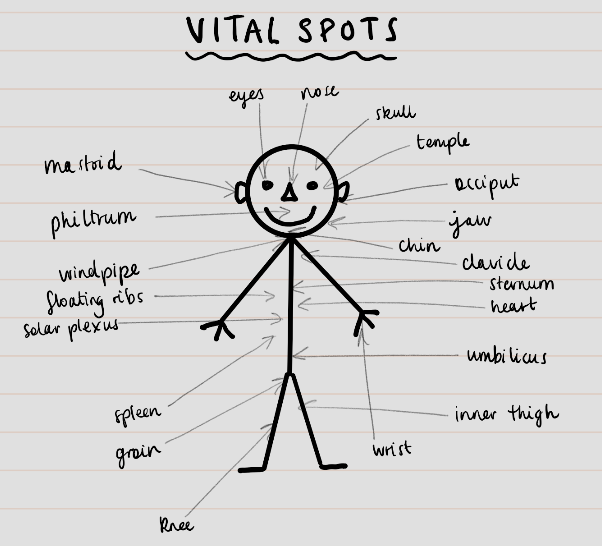
Knee
Moorup
White Belt
Signifies innocence, and the beginning with a student with no knowledge of Taekwon-Do.
Yellow Belt
Signifies the earth from which a plant sprouts and takes root as Taekwon-Do foundations are being laid.
Green Belt
Signifies the plant's growth as Taekwon-Do skills begin to develop.
Blue Belt
Signifies the heavens, towards which the plant matures into a towering tree as training in Taekwon-Do progresses.
Red Belt
Signifies danger, cautioning the student to exercise control and warning any opponent to stay away.
Black Belt
Opposite of white, therefore signifying maturity and proficiency in Taekwon-Do. It also indicates the wearer is impervious to darkness and fear.