ch20 - antimicrobial medications
 Call Kai
 Learn
 Practice Test
 Spaced Repetition
 Match
 Flashcards
 Knowt Play
1/25

There's no tags or description
Looks like no tags are added yet.
26 Terms
review
Discovery of microbial world by van Leeuwenhoek
Koch – discover that a specific microbe is responsible for a specific disease → Germ Theory of Disease
Next question: How do we treat these diseases?
History and Development of Antimicrobial Drugs
Search for a “magic bullet” that would kill microbial pathogens without harming human host
Discovery of antimicrobial drugs
Salvarsan
First successful antimicrobial
Discovered by Paul Erlich for treatment of syphilis
Discovery of antibiotics
Alexander Fleming
Discovered penicillin accidentally while working with Staphylococcus
Produced by Penicillium
Fleming unable to purify compound
Eventually abandoned his study
Ernst Chain and Howard Florey successfully purified penicillin
1941 - clinical trials on human subjects with life-threatening S. aureus infection
Mass production for treatment of wounded soldiers (WWII)
1960s - drug structure altered to give them new properties
Penicillin G altered to create ampicillin
Broadened spectrum of drug

derivatives of penicillin

Characteristics of Antimicrobial Medications
Most antibiotics come from soil microbes
• Bacteria: Streptomyces and Bacillus species
• Fungi: Penicillium and Cephalosporium
Antimicrobial action
Bactericidal – kill bacteria
Bacteriostatic – inhibit growth of bacteria
Rely on host immunity to eliminate pathogen
selective toxicity
Inhibits or kills microbial pathogen but has little or no toxic effect on human host
Drugs target components that are different from or absent in human cells
spectrum of activity
Range of microbes affected
Narrow spectrum – affect narrow range of bacteria
Requires identification of pathogen, testing for sensitivity
Less disruptive to normal microbiota
Broad spectrum – affect wide range of bacteria
Important for treating acute life-threatening diseases
Especially when no time to culture for identification
Disrupt normal microbiota
Antibiotics must reach area of infection and be excreted
Some antibiotics:
Are not absorbed from GI tract
Do not cross blood-brain barrier
Cannot enter abscesses or phagocytic cells
Time it takes body to eliminate drug
Dictates frequency of dosage
Liver or kidney damage tend to excrete drugs more slowly
Mechanisms of Action of Antibacterial Medications
Targets antibacterial medications
Cell wall synthesis
Protein synthesis
Nucleic acid synthesis
Metabolic pathways
Cell membranes
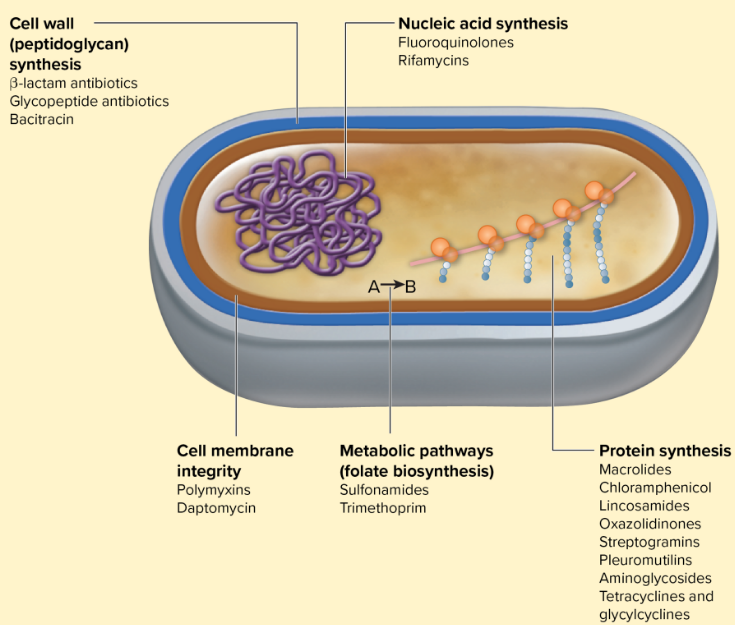
antibacterial drugs inhibiting cell wall synthesis
Bacteria cell walls contain peptidoglycan
Does not affect eukaryotic cell
Lack of cell wall in animals
Differences in cell wall of plants
Result: low toxicity, high effectiveness
Antimicrobials include
β lactam drugs
Vancomycin
Bacitracin

β lactam antibacterial drugs
Penicillins and cephalosporins
Disrupt cell wall synthesis - Inhibits peptide bridge formation between PTG backbone
Only effective against actively growing cells – kills by osmotic lysis
completely inhibit enzymes that help form cross-links between adjacent glycan chains

vancomycin
Inhibits formation of glycan polymer and/or peptide chains
No effect on Gram (-) organisms - does not cross outer membrane
Last line of defense against MRSA
Given intravenously due to poor absorption from GI tract
bind to the amino acid side chain of NAM molecules, blocking formation of cross-links between adjacent glycan chains
bacitracin
Interferes with transport of PTG precursors
High toxicity limits use to topical applications
Common ingredient in over-the-counter first-aid ointments
interferes with the transport of peptidoglycan precursors across the cytoplasmic membrane
inhibition of protein synthesis regarding antibacterial drugs
Target is prokaryotic ribosome
Selective toxicity = differences in prokaryotic (70S) and eukaryotic (80S) ribosomes
Mitochondria also have 70S ribosomes
May account for some toxicity of these antibiotics

inhibition of nucleic acid synthesis
Fluoroquinolones
Inhibit action of DNA gyrase
Supercoiling of DNA occurs
• Examples: Ciprofloxacin and ofloxacin
Rifamycins
Block prokaryotic RNA polymerase
Block initiation of transcription
Example: Rifampin
used to treat tuberculosis and Hansen’s disease
preventing meningitis after exposure to N. meningitidis
Inhibition of metabolic pathways
Competitive inhibitors of essential metabolites or growth factors (vitamins)
Examples: Sulfonamides and trimethoprim
Inhibit folic acid production
Basis for selective toxicity: Human lack folic acid pathway (enzymes)
damage cell membrane
Few drugs
Example = Polymixin B
Common ingredient in first-aid skin ointments
Alters permeability of membranes of Gram (-) cells
Leads to leakage and cell death
Limits use to topical application
Drugs against Mycobacterium species
Limited range of antimicrobial treatment due to
Chronic nature of disease
Slow growth
Waxy lipid in cell wall
Mycolic acid is impervious to many drugs
First-line drugs – effective, low toxicity; use in combination
Rifampin – inhibits mRNA synthesis
Streptomycin → inhibits protein synthesis
Isoniazid → inhibits synthesis of mycolic acid
Ethambutol → inhibits enzymes for cell wall synthesis
Pyrazinamide → interferes with protein synthesis
Second-line drugs
Used for resistant strains
Less effective, have greater toxicity risk
Antimicrobial Susceptibility Testing
Susceptibility of organism to specific antimicrobials is unpredictable
For treatment
Try different drugs until get favorable response
For serious infection, use several drugs at one time with hope that one is effective
Better approach
Identify pathogen
Determine susceptibility
Prescribe drug that acts against target organism only
To determine MIC
MIC = Minimum Inhibitory Concentration
Quantitative test
determine lowest concentration of antimicrobial drug needed to prevent growth of specific organism
Disk diffusion method (Kirby-Bauer disk diffusion)
Determine susceptibility of bacterial strain to different antibiotics
Method:
Spread bacteria onto plate
Place antibiotic impregnated disks on plate and incubated
Measure clear zone around disk
Zone of inhibition reflects susceptibility
epsilometer (E) test
Modification of disk diffusion test
Uses strips impregnated with gradient concentrations of antibiotic
Zone of inhibition
Is tear-drop shaped
Zone will intersect strip at MIC
Broth dilution method
1. Growth determined by turbidity
2. MIC = Lowest concentration that prevents growth
Resistance to Antimicrobial Medications
increasing use/misuse selects for resistant microorganisms
Hundreds of tons used each year
Antimicrobial resistance is alarming
Impact on cost, complications, and outcomes of treatment

Bacteria may develop acquired resistance due to
Spontaneous mutations
Changes in existing genes during replication and passed to next generation = vertical transfer
Horizontal gene transfer between organisms
Resistance genes spread to different strains, species, even genera
Achieve via transfer of plasmid (R plasmids) or transposons
Combination therapy of multiple antibiotics
Often used to prevent resistance
What can we do to slow emergence and spread of resistance?
Responsibilities of Physicians and Healthcare Workers
To prescribe antibiotics for specific organisms
Educate patients on proper use of antibiotics
Responsibilities of Patients
Follow instructions carefully
Not skipping doses and complete prescribed treatment
Educate public
Concerning appropriateness and limitations of antibiotics
Antibiotics have no effect on viral infections
Misuse selects antibiotic resistance in normal flora
Resistance to Antimicrobial Medications
Overuse is a worldwide concern
Transport of resistant organisms globally
Antimicrobials available without prescription
Use of antibiotics in animal feed
Enhances growth of animals
Selects for antimicrobial resistant organisms
Resistant Salmonella strains linked to animals
Why should we be concerned about antibiotic resistance?
Antibiotic resistant bacteria are harder to kill therefore, harder to treat disease
Superinfection: overgrowth of normal microbiota that is resistant to antibiotics
Originally only 3% of S. aureus resistant to penicillin G; now >90% are resistant