307 exam 2 book Qs
 Call Kai
 Learn
Learn Practice Test
 Spaced Repetition
 Match
Match Flashcards
 Knowt Play
1/72

There's no tags or description
Looks like no tags are added yet.
Name | Mastery | Learn | Test | Matching | Spaced | Call with Kai | Chat |
|---|
No analytics yet
Send a link to your students to track their progress
73 Terms
Which of the following findings is NOT consistent with a diagnosis of megaloblastic anemia?
absolute increase in reticulocytes
Which one of the following findings would be inconsistent with elevated titers of intrinsic factor blocking antibodies?
decreased MMA
In the following description of a bone marrow smear, find the statement that is inconsistent with the expected picture in megaloblastic anemia:
The marrow appears hypercellular with a myeloid-to-erythroid ratio of 1:1 due to prominent erythroid hyperplasia. Megakaryocytes appear normal in number and appearance. WBC elements appear larger than normal, with especially large metamyelocytes, although they otherwise appear morpholocially normal. Erythroid precursors also appear large. There is nuclear-cytoplasmic asynchrony, with the nucleus appearing more mature than expected for the color of the cytoplasm.
“with the nucleus appearing more mature than expected for the color of the cytoplasm.”
Specific to lab diagnosis of B12 deficiency:
serum gastrin & MMA
A patient with an MCV of 136, and oval mac, hypersegmented neutrophils, and dacrocytes on PBS but normal serum B12 and folate may have?
myelodysplastic syndrome
A sign of hemolysis that is typically associated with both fragmentation and macrophage-mediated hemolysis is:
elevated urinary urobilinogen levels
Which of the following tests provides a good indication of accelerated erythropoiesis?
reticulocyte count
An elderly white woman is evaluated for worsening anemia, with a decrease of approximately 0.5 mg/dL of hemoglobin each week. The patient is pale, and her skin & eyes are slightly yellow. She complains of extreme fatigue and is unable to complete daily tasks without napping in midmorning and midafternoon. She also tires with exertion, finding it difficult to climb even five stairs.
Which of the features of this description points to a hemolytic cause for her anemia?
Yellow skin & eyes
A 5yo girl was seen by her physician several days before the current visit and was diagnosed with pneumonia. She was prescribed a standard course of antibiotics. Her mother has brought her to the physician again because the girl’s urine began to darken after the first visit and now is alarmingly dark. The girl has no history of anemia, and there is no family history of any hematologic disorder. The CBC shows a mild anemia, polychromasia, and a few schistocytes. This anemia could be categorized as:
Acquired, fragmentation
A patient has a personal and family history of a mild hemolytic anemia. The patient has consistently elevated levels of total and indirect serum bilirubin and urinary urobilinogen. The serum haptoglobin level is consistently decreased, whereas the reticulocyte count is elevated. The latter can be seen as polychromasia on the patient’s PBS. Spherocytes are also seen. Which one of the findings reported for this patient is inconsistent with a classical diagnosis of fragmentation hemolysis?
spherocytes on the PBS
Which of the following sets of test results is typically expected with chronic fragmentation hemolysis?
decreased haptoglobin, positive urine hemoglobin, positive urine sediment
Happens inside the stomach during B12 absorption:
B & C
CD55 and CD59 deficiency
PNH
In HS, a characteristic result in the CBC results is:
increased MCHC
Which one of the following sets of results is consistent with HS?
increased OF, negative DAT
Lab test results for patients with HPP include all of the following except:
increased MCV and normal RDW

A 24yo woman was brought to the ER with a 2 day history of fever, chills, excessive sweating, nausea, and general malaise. Because she had recently returned from a family trip to Ghana in western Africa, the treating physician ordered a CBC and examination of thin & thick PBS. the following are the patient’s lab results:
WBC: 11
HGB: 8.7 g/dL
HCT: 22%
MCV: 92 fL
PLT: 176
what is the likely diagnosis for this patient? what clues in the history support this diagnosis?
Malaria; trip to Ghana + thick/thin smears
The substitution of valine for glutamic acid at position 6 of the ß chain of hemoglobin results in a hemoglobin that:
polymerizes to form tactoid crystals
Patients with SCD usually do not exhibit symptoms until 6 months of age because?
higher levels of Hb F are present
Which of the following is the most definitive test for Hb S?
Hb electrophoresis at acid pH
The screening test for Hb S that uses a reducing agent, such as sodium dithionite, is based on the fact that hemoglobins that sickle:
are insoluble in reduced, deoxygenated form
A 1yo indian patient presents with anemia, and both parents claim to have an “inherited anemia” but can’t remember the type. The PBS shows target cells, and the hemoglobin solubility test is negative. Alkaline hemoglobin electrophoresis shows a single band at the “Hb C” position and a small band at the “Hb F” position. Acid Hb electrophoresis shows two bands. The most likely diagnosis is?
Hb CC
During a holiday visit, the children of a 76yo man noticed that he seemed more forgetful than usual and that he had difficulty walking. Concerned about the possibility of a mild stroke, the children insisted that he see his physician. The physician diagnosed peripheral neuropathy affecting the father’s ability to walk. In addition, the physician noted that he was pale and slightly jaundiced and ordered a complete blood count (CBC). The results were as follows:
WBCs (×109/L) | 3.2 |
RBCs (×1012/L) | 2.22 |
HGB (g/dL) | 8.5 |
HCT (%) | 27.0 |
MCV (fL) | 121.6 |
MCH (pg) | 38.3 |
MCHC (g/dL) | 31.5 |
RDW (%) | 18.0 |
Platelets (×109/L) | 115 |
Reticulocytes (%) | 1.8 |
What do you expect to see on his PBS?
macrocytic, normochromic
During a holiday visit, the children of a 76yo man noticed that he seemed more forgetful than usual and that he had difficulty walking. Concerned about the possibility of a mild stroke, the children insisted that he see his physician. The physician diagnosed peripheral neuropathy affecting the father’s ability to walk. In addition, the physician noted that he was pale and slightly jaundiced and ordered a complete blood count (CBC). The results were as follows:
WBCs (×109/L) | 3.2 |
RBCs (×1012/L) | 2.22 |
HGB (g/dL) | 8.5 |
HCT (%) | 27.0 |
MCV (fL) | 121.6 |
MCH (pg) | 38.3 |
MCHC (g/dL) | 31.5 |
RDW (%) | 18.0 |
Platelets (×109/L) | 115 |
Reticulocytes (%) | 1.8 |
Based on the available test results, what can you conclude about the cause of the patient’s anemia?
B12/folate deficiency
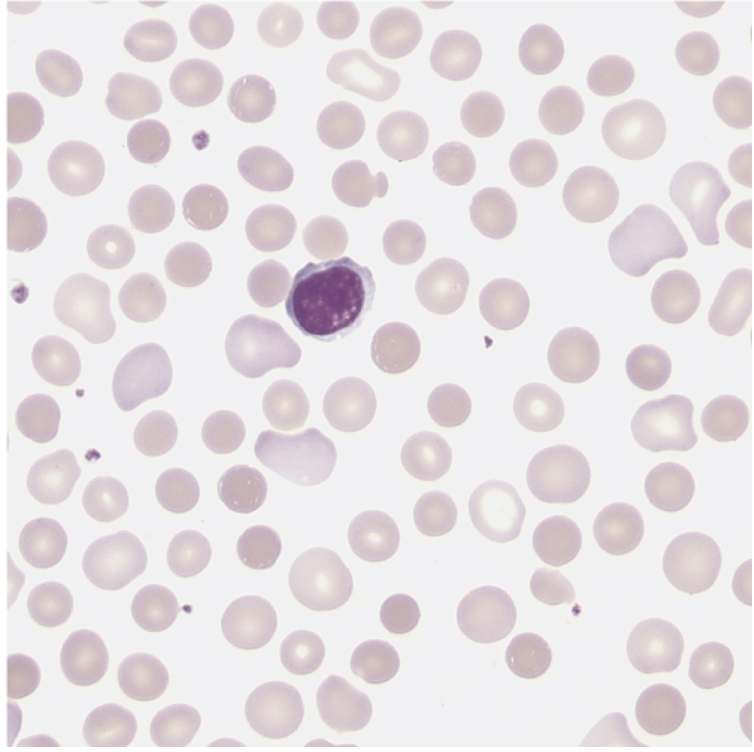
A 45-year-old man sought medical attention for the onset of chest pain. Physical examination revealed slight jaundice and splenomegaly. The medical history included gallstones, and there was a family history of anemia. A complete blood count (CBC) yielded the following results:
WBCs (×109/L) | 13.4 |
RBCs (×1012/L) | 4.20 |
HGB (g/dL) | 11.9 |
HCT (%) | 32.4 |
MCV (fL) | 77.1 |
MCH (pg) | 28.3 |
MCHC (g/dL) | 36.7 |
RDW (%) | 22.9 |
Platelets (×109/L) | 290 |
What is the most likely diagnosis?
Hereditary spherocytosis
A 45-year-old man sought medical attention for the onset of chest pain. Physical examination revealed slight jaundice and splenomegaly. The medical history included gallstones, and there was a family history of anemia. A complete blood count (CBC) yielded the following results:
WBCs (×109/L) | 13.4 |
RBCs (×1012/L) | 4.20 |
HGB (g/dL) | 11.9 |
HCT (%) | 32.4 |
MCV (fL) | 77.1 |
MCH (pg) | 28.3 |
MCHC (g/dL) | 36.7 |
RDW (%) | 22.9 |
Platelets (×109/L) | 290 |
What additional lab tests would be of value in establishing the diagnosis, and what abnormalities in the results of these tests would be expected to confirm your impression?
negative DAT, increased LDH & bili, increased OF, decreased EMA, corrected auto hemolysis
A patient has a clinical picture of megaloblastic anemia. The serum folate level is decreased, and the serum vitamin B12 level is 600 pg/mL (reference interval is 200 to 900 pg/mL). What is the expected value for the methylmalonic acid assay?
Within the reference interval
Which one of the following statements characterizes the relationships among macrocytic anemia, megaloblastic anemia, and pernicious anemia?
Megaloblastic anemia is macrocytic.
Which of the following CBC findings is most suggestive of a megaloblastic anemia?
Hypersegmentation of neutrophils
Folate and vitamin B12 work together in the production of:
DNA
The macrocytosis associated with megaloblastic anemia results from:
Reduced numbers of cell divisions with normal cytoplasmic development
Which one of the following groups has the highest risk for pernicious anemia?
Persons older than 60 years of age
The term hemolytic disorder in general refers to a disorder in which there is:
Increased destruction of RBCs in the blood, bone marrow, or spleen
RBC destruction that occurs when macrophages ingest and destroy RBCs is termed:
Macrophage mediated
Under normal circumstances, the major fraction of bilirubin in the plasma is:
Macrophage-secreted indirect bilirubin
A patient has anemia that has been worsening over the last several months. The hemoglobin level has been declining slowly, with a drop of 1.5 g/dL of hemoglobin over about 6 weeks. Polychromasia and anisocytosis are seen on the peripheral blood film, consistent with the elevated reticulocyte count and red cell distribution width (RDW). Serum levels of total bilirubin and indirect fractions are normal. The urinary urobilinogen level also is normal. When these findings are evaluated, the conclusion is drawn that the anemia does not have a hemolytic component. Based on the data given here, why was hemolysis ruled out as the cause of the anemia?
Evidence of increased protoporphyrin catabolism is lacking.
The altered shape of the spherocyte in HS is due to:
A mutated RBC membrane protein affecting vertical protein interactions
The RBCs in HE are abnormally shaped and have unstable cell membranes as a result of:
Defects in horizontal membrane protein interactions
The most common manifestation of G6PD deficiency is:
Acute hemolytic anemia caused by drug exposure or infections
Which of the following laboratory tests would be best to confirm PNH?
Flow cytometry for FLAER binding, CD24 on granulocytes, and CD14 on monocytes
Which one of the following is a feature found in all microangiopathic hemolytic anemias?
Intravascular RBC fragmentation
Typical laboratory findings in TTP and HUS include:
Schistocytosis and thrombocytopenia
The pathophysiology of idiopathic TTP involves:
Formation of platelet-VWF thrombi due to autoantibody inhibition of ADAMTS13
Which of the following laboratory results may be seen in both traumatic cardiac hemolytic anemia and exercise-induced hemoglobinuria?
Decreased serum haptoglobin
One week after returning from a vacation in Rhode Island, a 60-year-old man experienced fever, chills, nausea, muscle aches, and fatigue of 2 days’ duration. A complete blood count (CBC) showed a WBC count of 4.5 × 10⁹/L, a hemoglobin level of 10.5 g/dL, a platelet count of 134 × 109/L, and a reticulocyte count of 2.7%. The medical laboratory scientist noticed tiny ameboid ring forms in some of the RBCs and some tetrad forms in others. These findings suggest:
Babesiosis
What RBC morphology is characteristically found within the first 24 hours following extensive burn injury?
Schistocytes and microspherocytes
A 36-year-old woman was brought to the emergency department by her husband because she had experienced a seizure. He reported that she had been well until that morning, when she complained of a sudden headache and malaise. She was not taking any medications and had no history of previous surgery or pregnancy. Laboratory studies showed a WBC count of 15 × 109/L, a hemoglobin level of 7.8 g/dL, a platelet count of 18 × 109/L, and schistocytes and helmet cells on the peripheral blood film. Chemistry test results included markedly elevated serum lactate dehydrogenase activity and a slight increase in the level of total and indirect serum bilirubin. The urinalysis results were positive for protein and blood, but there were no RBCs in the urine sediment. Prothrombin time and partial thromboplastin time were within the reference interval. When the entire clinical and laboratory picture is considered, which of the following is the most likely diagnosis?
TTP
Immune hemolytic anemia is due to a(n):
Allo- or autoantibody against an RBC antigen
The pathophysiology of immune hemolysis with IgM antibodies always involves:
Complement
In hemolysis mediated by IgG antibodies, which abnormal RBC morphology is typically observed on the peripheral blood film?
Spherocytes
The most important finding in the diagnostic investigation of a suspected autoimmune hemolytic anemia is:
Demonstration of IgG and/or C3d on the RBC surface
In autoimmune hemolytic anemia, a positive DAT is evidence that an:
IgG antibody is sensitizing the patient’s red blood cells
Which of the following is not a mechanism of drug-induced hemolytic anemia?
IgM autoantibody sensitization of RBCs after exposure to cold temperatures
A group A Rh-negative mother gave birth to a group O Rh-positive baby. The baby is at risk for HDFN if:
The mother was previously immunized to the D antigen
A qualitative abnormality in hemoglobin may involve all of the following except:
Decreased production of a globin chain
A patient presents with mild normochromic, normocytic anemia. On the peripheral blood film, there are a few target cells, rare nucleated RBCs, and hexagonal crystals within and lying outside of the RBCs. Which abnormality in the hemoglobin molecule is most likely?
Substitution of lysine for glutamic acid at position 6 of the β chain
Through routine screening, prospective parents discover that they are both heterozygous for Hb S. What percentage of their children potentially could have sickle cell anemia (Hb SS)?
25%
Painful crises in patients with SCD occur as a result of:
Vasoocclusion
DNA analysis documents a patient has inherited the sickle mutation in both β-globin genes. The two terms that best describe this genotype are:
Homozygous/disease
In which of the following geographic areas is Hb S most prevalent?
Sub-Saharan Africa
Which hemoglobinopathy is more common in Southeast Asian patients?
Hb E
Thalassemia is caused by:
Absent or reduced synthesis of a polypeptide chain of hemoglobin
The hemolytic anemia and ineffective erythropoiesis associated with β-thalassemia is due to:
Precipitation of excess α chains in RBCs and their precursors
β-thalassemia minor (heterozygous) usually exhibits:
Increased Hb A2
RBC morphologic features in β-thalassemia major usually include:
Microcytes, hypochromia, target cells, RBC inclusions, NRBCs
β-thalassemia major of the genotype β0/β0 can be differentiated from the β+/β+ genotype by the amount of:
Hb A
What abnormal hemoglobin is present in adults with α-thalassemia, genotype (– –/α –)?
H
Hb Bart is composed of:
Four γ chains
When one α gene is deleted (α–/αα), a patient has:
Normal hemoglobin levels
A patient with a hemoglobin concentration of 8.0 g/dL and an MCV of 62 fL had microcytes, target cells, and a few sickle cells on his peripheral blood film. High-performance liquid chromatography showed 25% Hb A, 65% Hb S, 6% Hb A2, and 4% Hb F. These results are most compatible with:
Hb S-β+-thalassemia
Hb H inclusions in a supravital stain preparation appear as:
Small, evenly distributed, greenish-blue granules that pit the surface of RBCs
Which of the following laboratory findings is inconsistent with β-thalassemia minor?
Elevated MCHC and spherocytic RBCs
A 9-month-old infant of Asian heritage is seen for severe fatigue and pallor. Her hemoglobin concentration is 6.5 g/dL with an MCV of 59 fL; microcytosis, hypochromia, poikilocytosis, basophilic stippling, Howell Jolly bodies, Pappenheimer bodies, and nucleated RBCs are noted on the peripheral blood film. High-performance liquid chromatography showed 0% Hb A, 96% Hb F, and 4% Hb A2. These findings should lead the physician to suspect:
β-thalassemia major, β0/β0