Ch. 9 Alkyne Reactions
 Call Kai
 Learn
 Practice Test
 Spaced Repetition
 Match
 Flashcards
 Knowt Play
1/10

There's no tags or description
Looks like no tags are added yet.
11 Terms
1) excess NaNH2
2) H2O
elimination, vicinal or geminal dibromide is converted to an alkyne

HX
Hydrohalogenation, Markovnikov addition, excess gives two additions

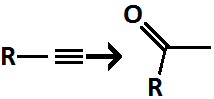
H2SO4, H2O, HgSO4
Hydration
-keto-enol tautermerization
-makes enol which instantly makes ketones
1) R2BH
2) H2O2, NaOH
hydroboration-oxidation, terminal alkyne undergoes anti-Markovnikov addition of H and OH to give an enol, which quickly tautomerizes to give an aldehyde.

X2
halogenation: when treated with this reagent, an alkyne undergoes addition of X and X (excess X2 gives a tetrahalide)

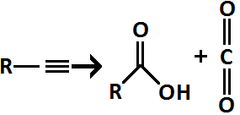
1) O3
2) H2O
Ozonolysis, oxidative cleavage of the C≡C bond. Internal alkynes are converted into two carboxylic acids, while terminal alkynes are converted into a carboxylic acid and carbon dioxide.
H2, Lindlar's catalyst
hydrogenation: when treated with these reagents, an alkyne is converted to a cis alkene

H2, Pt
hydrogenation, alkyne is converted to an alkane.

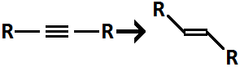
Na, NH3(l)
dissolving metal reduction, internal alkyne is converted to a trans-alkene.
-HX (xs)
Hydrohalogenation (with excess)
-makes two halogens on most substituted carbon

1. R2BH
2. H2O2, NaOH
-creates aldehyde group from terminal alkyne
