21: Introduction to Nucleic Acids
 Call Kai
 Learn
 Practice Test
 Spaced Repetition
 Match
 Flashcards
 Knowt Play
1/211

There's no tags or description
Looks like no tags are added yet.
212 Terms
What is transcription?
The process of using DNA as a template to synthesize mRNA.
What is translation?
The process of reading an mRNA sequence to determine the amino acid sequence of a protein.
What determines the amino acid sequence of a protein?
The sequence of nucleotides in the gene (DNA) that encodes that protein
What is the central dogma of molecular biology?
The general flow of genetic information from DNA to RNA to protein
What does DNA stand for?
Deoxyribonucleic acid.
What does RNA stand for?
Ribonucleic acid.
What are the three components of a nucleotide?
Nitrogenous base
Five-carbon sugar
At least one phosphate group.

What are the two components of a nucleoside?
A nitrogenous base
A sugar

Which pentose (5-carbon sugar) sugars are found in nucleic acids?
Ribose in RNA
2'-deoxyribose in DNA
Which component of a nucleotide contains the genetic base sequence?
The nitrogenous base.
Adenine (A)
Guanine (G)
Cytosine (C)
Thymine (T)
Uracil (U)

What are functions of the phosphate group in nucleotides?
It allows nucleotides to connect and form the sugar-phosphate backbone.
Provides DNA with a negative charge
What are the two chemical categories of nitrogenous bases?
Purines and pyrimidines.
What are the three pyrimidine bases?
Cytosine, thymine, and uracil.
What are the two purine bases?
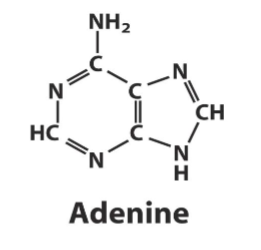
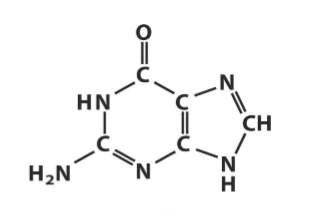
Adenine and guanine
How many rings do pyrimidines contain?
One six-membered ring.
How many rings do purines contain?
Two fused rings:
One six-membered
One five-membered ring.
Which nitrogen atom connects a pyrimidine to its sugar?
N1
Which nitrogen atom connects a purine to its sugar?
N9
Which nitrogenous base is found in RNA instead of DNA?
Uracil
Which nitrogenous base is found in DNA instead of RNA?
Thymine
Three characteristics of bases of nucleotides:
Planar
Aromatic
Heterocyclic (Ring containing more than one type of atom… ex: carbon and nitrogen)
Structure of pyrimidine:

Structure of Cytosine:

Structure of Thymine (DNA):

Structure of Uracil (RNA):

Structure of Purine:

Structure of Adenine:
S
Structure of Guanine:
Why are pyrimidines and purines considered electron-rich molecules?
Their aromatic ring systems contain electrons that are distributed across the ring structures, allowing them to undergo keto-enol tautomerism
What is tautomerism?
The ability of a molecule to exist in rapidly interconverting structural forms that differ in hydrogen and double-bond positions.
What is the difference between keto and enol forms?
Keto forms contain a carbonyl group (C=O); enol forms contain a hydroxyl group (–OH) attached to a carbon involved in a double bond.

Which tautomeric form of uracil predominates at pH 7?
Keto
Which tautomeric form of thymine predominates at pH 7?
Keto
Which tautomeric form of guanine predominates at pH 7?
Keto
Which tautomeric form of cytosine predominates at pH 7?
Enol
What determines whether nitrogen atoms can act as hydrogen-bond donors or acceptors?
Their protonation states and chemical environments.
Why do nitrogenous bases absorb UV light?
Their aromatic ring systems contain delocalized electrons that absorb UV energy.
The keto-enol tautomerism of pyrimidines uracil:

The keto-enol tautomerization of the purine guanine:

Why do nitrogenous bases absorb UV light?
Their aromatic ring structures contain delocalized electrons that absorb UV energy and jump to higher energy states
At approximately what wavelength do DNA and RNA absorb UV light strongly?
260 nm
Which sugar is found in RNA?
Ribose
Structure of Ribose:

Which sugar is found in DNA?
2'-Deoxyribose
Structure of 2'-Deoxyribose.
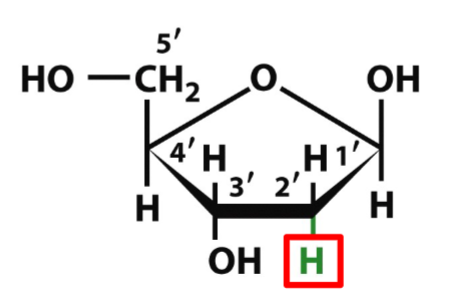
What is the main structural difference between ribose and 2'-deoxyribose?
Ribose has an –OH group at the 2' carbon; deoxyribose has an –H instead
Why is RNA more susceptible to hydrolysis than DNA?
RNA contains a 2'-OH group that can participate in reactions leading to backbone cleavage; DNA lacks this group
What do primed numbers indicate in nucleotide nomenclature?
The positions of atoms in the sugar.
What do non-primed numbers indicate in nucleotide nomenclature?
The positions of atoms in the nitrogenous base.
What is a 3' nucleotide?
A nucleotide with its phosphate group attached at the sugar's 3' position

What is a 5' nucleotide?
A nucleotide with its phosphate group attached at the sugar's 5' position.

Deoxyadenosine

Deoxyguanosine

Deoxythymidine

Deoxycytidylate

Adenosine
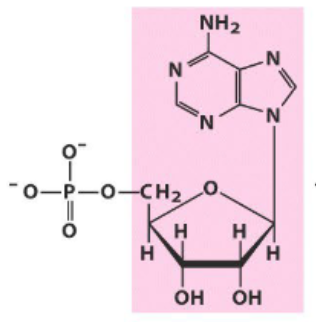
Guanosine

Uridine

Cytidine
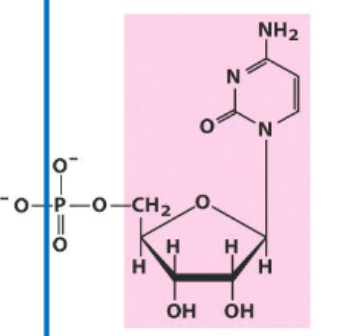
What are the two major functions of nucleotides?
Forming nucleic acid polymers and participating in metabolic reactions.
What are nucleotides responsible for when they form nucleic acid polymers?
Storing and transferring genetic information
What are the primary functions of ATP?
Energy carrier or energy transfer agent
Provides energy for other cellular work
What does ATP stand for?
Adenosine triphosphate
Adenosine and three phosphate groups.

How much ATP do humans recycle each day?
Humans typically recycle their weight of ATP each day
What type of bond connects adjacent nucleotides?
A phosphodiester bond.

Which positions of adjacent sugars are connected by a phosphodiester bond?
The 3' carbon of one sugar and the 5' carbon of the next sugar.

What is the primary structure of a nucleic acid?
The specific sequence, or order, of its nucleotides.

In which direction are nucleic acid sequences written and read?
5' to 3'.
Phosphate end to free hydroxyl group
From the N-terminus to the C-terminus in proteins

Why are DNA and RNA considered polyanions?
They contain many phosphate groups that carry negative charges
Why do nucleic acids carry an overall negative charge at physiological pH?
Their phosphate groups are predominantly deprotonated and contribute negative charges along the molecule.
Phosphates in these polynucleotides are acidic
What does the letter p indicate when written before a nucleotide sequence?
It indicates the presence of a 5′-phosphoryl group
What does the letter d indicate in nucleotide notation?
It indicates that the nucleotide contains deoxyribose, identifying it as DNA-related.
How can you distinguish DNA from RNA using their nucleotide sequences?
DNA contains thymine (T), whereas RNA contains uracil (U).
What does pApUpCpG represent?
An RNA sequence containing adenine, uracil, cytosine, and guanine, with phosphate groups indicated.
Can also be written as pAUCG

What is the primary biological role of DNA?
DNA stores genetic information and serves as hereditary material that is passed from generation to generation.
What happens when RNA becomes damaged?
Damaged RNA can be degraded and regenerated.
Why is DNA's stability especially important?
DNA must preserve hereditary information so that it can be accurately maintained and passed to future generations..
Why does DNA contain thymine instead of uracil?
Cytosine can spontaneously undergo deamination to form uracil
Thymine is simply uracil with an additional methyl group, 5-methyl-U
By using thymine, the body can recognize the additional methyl group as a natural product, rather than having uracil and being confused about whether this is natural or a product of cytosine deamination
Therefore, DNA repair enzymes recognize these “mutations” and replace uracil with cytosine
What is deamination?
The removal of an amino group from a molecule.
What happens when cytosine undergoes spontaneous deamination?
Cytosine is converted into uracil.
Why would it be difficult for DNA to use uracil instead of thymine?
The cell would have difficulty distinguishing normal uracil from uracil produced by cytosine deamination
What is thymine chemically?
Thymine is 5-methyluracil, meaning it is uracil with an additional methyl group.

What structural feature distinguishes thymine from uracil?
Thymine has an additional methyl group (–CH₃) at the 5-position of the pyrimidine ring.
Why is uracil considered foreign in DNA?
DNA normally uses thymine instead of uracil, so uracil can signal that cytosine has undergone deamination.
What is the significance of thymine's additional methyl group?
It distinguishes normal thymine from uracil, allowing cells to detect potentially damaged DNA.
What is the structural difference between the sugars in DNA and RNA?
RNA contains ribose with a hydroxyl group at the 2′ carbon, while DNA contains 2′-deoxyribose with a hydrogen at the 2′ carbon.
Why is RNA more susceptible to hydrolysis than DNA?
RNA contains a 2′-OH group that can participate in reactions leading to cleavage of its phosphodiester backbone.
How does the stability of DNA and RNA relate to their biological functions?
DNA must preserve genetic information, while RNA often performs temporary functions and can be degraded and regenerated.
What is alkaline hydrolysis?
The breakdown of chemical bonds through a reaction involving a basic solution
Which nucleic acid is susceptible to dilute-base hydrolysis?
RNA
Steps of alkaline hydrolysis:
A nucleotide (OH-) attacks and deprotonates the 2’ OH group on a sugar
The electron-rich oxygen acts as a nucleophile and attacks the adjacent phosphorus atom of the 3’-phosphodiester bond
It creates a temporary structure where phosphorus is bound to 5 oxygens. This structure quickly breaks, causing the phosphodiester backbone to break
A new cyclic structure forms, where phosphorus is now bound to only 4 oxygen atoms: 2′,3′-cyclic phosphate, where the phosphate forms a ring with the 2′ and 3′ oxygens of the ribose.
Water can attack the cyclic phosphate at either the 2’ or 3’ position, opening the ring.

What is the typical overall structure of DNA?
DNA forms a double helix consisting of two strands
What is the typical overall structure of RNA?
RNA is generally single-stranded
Can RNA form secondary structures despite being single-stranded?
Yes. RNA can fold back on itself and form structures such as stem-loops through base-paring

Who developed Chargaff's rules?
Erwin Chargaff, who analyzed the quantitative composition of DNA in the 1940s.
What are Chargaff's two rules?
The amount of adenine equals thymine, and guanine equals cytosine.
DNA base composition varies among species.
If DNA contains 15% adenine, what percentage of thymine, guanine, and cytosine does it contain?
15% thymine, 35% guanine, and 35% cytosine
Which two scientists developed the current model of DNA?
James Watson and Francis Crick.
Which four scientists are identified for discovering the double-helical structure of DNA?
Rosalind Franklin, Maurice Wilkins, James Watson, and Francis Crick.
What forms the DNA double helix?
Two polynucleotide chains winding around a common axis
