SDFs - Tablets
 Call Kai
 Learn
 Practice Test
 Spaced Repetition
 Match
 Flashcards
 Knowt Play
1/42

There's no tags or description
Looks like no tags are added yet.
43 Terms
What are tablets?
SDFs prepared by compression or by molding and contain medicinal substances with suitable pharmaceutical ingredients or excipients
How are tablets mainly given?
Orally
What are the advantages of tablets?
Very popular since oral route is very safe and convenient for administration
Chemical and physical stability over LDFs
Accurate dosing
Variable dosage strengths
Convenient to handle
Better patient compliance
Low price
Broad range of release patterns
Masking of bitter taste
Easy identification
Can be scored
What are some disadvantages of tablets?
Powders and granules are not always compressible
Cannot be prepared extemporaneously
Difficulty in swallowing
Bioavailability problem with poorly water-soluble drugs
Problem with drugs causing local irritation or other harmful effects to the GI mucosa
Hard to adjust dose if not scored
What are compressed tablets?
Prepared by a single compression of a formulation containing the drug and the most common tablet excipients (diluents, binders, disintergrants, lubricants, etc)
How do compressed tablets look like?
Coated or uncoated
Colored or uncolored
1, 2, or 3-layered
What are multiple compressed tablets?
Prepared by more than a single compression and may contain multiple layers
Each layer may have a different drug
Purpose: Physical or chemical incompatibility
What are sugar coated tablets made out of?
Aqueous solutions of sucrose (sugar) are deposited repeatedly on the tablets unit a smooth, aesthetically pleasing coat is formed
What is a disadvantage of sugar coated tablets?
Tedious, time consuming
Pan-specific
Requires expertise of skilled technicians
May result in tablets may be twice in size and weight
What is an advantage of sugar coated tablets?
Useful for drugs that irritate the gastric mucosa
What are film coated tablets?
Water-soluble/insoluble thin polymer coating on already compressed tablets to rupture or dissolve in GIT
Generally colored
What are enteric-coated tablets?
Have delayed-released features
Do NOT disintegrate in the stomach
Designed to release drug in the intestine (pH 5-7)
Purpose: For drugs that degrade in the stomach, drugs that irritate the gastric mucosa, and bypassing the stomach may enhance drug absorption
What types of tablets are there?
Capsules
Gelatin-coated tablets
Buccal tablets
Lozenges/Troches
Chewable tablets
Effervescent Tablets
Dissolving Tablets
What are caplets and what is their advantage?
Capsule-shaped uncoated or film coated tablets
Easy to swallow
What are gelatin-coated tablets and their advantages?
Geltabs-Tablets coated with gelatin
Easy to swallow and tamper evident
What are sublingual and buccal tablets?
Buccal tablets slowly dissolve in the buccal pouch
Sublingual tablets dissolve beneath the tongue
Drugs are absorbed through oral mucosa
Purpose: For drugs destroyed by gastric juice, drugs poorly absorbed from GIT & avoiding first-pass effect
What are lozenges/troches?
Dissolving slowly in the mouth
For local effects in mouth and throat
Most excipients should be water soluble (ex: glucose, sorbitol, mannitol, gelatin)
What are chewable tablets?
Tablets chewed and then swallowed
Can be taken without water
For large tablets that are hard to swallow
Disintegrants are NOT used
Flavors and colors are used
Ex) Antacid tablets + Vitamin tablets
What are effervescent tablets?
Compressed effervesent mixture
Flavors can be included
Tablets are placed in water and then taken
Rapid disintegration
Increase palatability
Ex) Alka-Seltzer, Aspirin Migraine Effervescent Tablet
What are dissolving tablets?
Rapidly dissolving tablets
Contain highly water-soluble excipients
Prepared in molds
Ex) Claritin Reditabs, Zyprexa, Zydis
What are some disadvantages about dissolving tablets?
Hard to mask taste
Microencapsulation or nanoencapsulation is needed
Products should not be gritty
Highly friable
What is Accu-Break?
Offering accurate tablet splitting through a drug-free layer in bilayer tablets
May have a single drug, a combination of drugs (in/compatible)
May be immediate or controlled release
Provides:
Dose accuracy
Titration and/or dose adjustment
Physically easy to break tablets
No waste from crumbling tablets
Cost savings
What are the 2 types of Accu-Break?
Accu-B & Accu-T tablets
What are Accu-B?
Bilayer tablets
Top layer: 1 drug or drug combo
Bottom layer: Drug free
Bisected, trisected, quadrisected, pentasected, octasected
What are the types of Accu-T?
Accu-T AIA
Accu-T AIB
Accu-T CR
What is Accu-T AIA?
Trilayer tablets, single drug in 2 layers, can be separated by a scored or unscored drug-free layer
What is Accu-T AIB?
Trilayer tablets, two different drugs in two laters, separated by a scored or unscored drug-free layer
What is Accu-T CR?
Multilayer tablets with 2 different drugs in immediate release and controlled release layers, separated by a scored or unscored drug-free layer
What are the types of tablet excipients?
Diluents
Binders
Disintegrants
Lubricants
What is the purpose of diluents?
Bulking agents or fillers
Make up the major portion of tablet when drug and other excipients are inadequate to make the bulk
Most common filler in tablets
What is an example of diluents?
Lactose
What is the purpose of binders?
Add cohesiveness to powders, providing the needed bonding to form granules
What is an example of binders?
Starch (10-15% paste)
What is the purpose of disintegrants?
Facilitate tablet breakup in contact with water in GIT
Half the amount is added before and remaining half granulation (within and outside granules)
It draws water into the tablet through pores, swell and finally cause the tablet to burst apart
What is an example of disintegrant?
Starch derivatives
What is the purpose of lubricants?
Reducing friction between materials during tablet manufacturing; used as very fine particles
What is an example of lubricants?
Magnesium stearate
What is the process of tablet formulation?
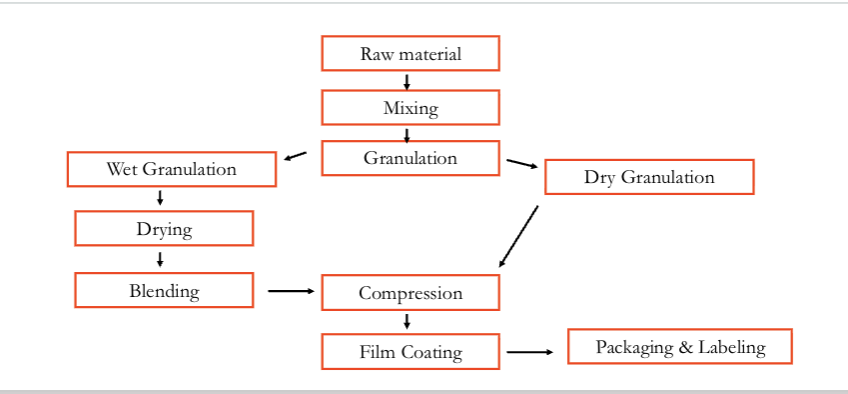
What is the purpose of granulation?
Increase bulk density of powder mixture, making sure the whole amount can be filled into the die
Improve flowability of powders, leading to a reduction of tablet weight variation
Improve mixing homogeneity, otherwise smaller particle separate out
Improve compatibility
Ensure color homogenity
What is the most widely used form of granulation?
Wet granulation
What is wet granulation?
Makes tablets with excellent physical properties
Liquid (H2O) is mixed with powders, passed through sieves, dried to obtain granules and then compressed
What is dry granulation?
For drugs that are sensitive to moisture and heat (aspirin, vitamins)
Too high a dose for direct compression
Powder mixture is either compressed into large flat tablets (slugging) or pressed in between rollers (roller compaction) to increase particle density, followed by breaking of the slug or compact mass and passing through the sieve to get granules
What is direct compression?
Simple and fast method for heat and moisture-sensitive drugs
Powders must have good flow properties and is directly compressed