Bio 211 midterm 2 exam
 Call Kai
 Learn
 Practice Test
 Spaced Repetition
 Match
 Flashcards
 Knowt Play
1/77

There's no tags or description
Looks like no tags are added yet.
78 Terms

Make a table that describes the draw overall structures of the lipids we have talked about. Type of Lipid | Description of Structure | Saturated or unsaturated? Both? Neither?
Triglyceride: glycerol + 3 fatty acids; phospholipid: glycerol + 2 fatty acids + phosphate-containing polar head; steroid/sterol: four fused carbon rings. Saturated fatty acids have no C=C bonds; unsaturated fatty acids have one or more C=C bonds. (Use the lipid types emphasized in your lecture.)
What is the purpose of the cell membrane?
To separate the cell from its environment and regulate what enters and leaves; it also supports signaling, recognition, and attachment.
Increasing # of double bonds for fatty acids increases fluidity. Why? What does this do to Tm?
Double bonds (usually cis) create kinks that prevent tight packing, increasing membrane fluidity and lowering the melting temperature (Tm).
The longer the fatty acid, the less fluid-like. Why is this the case? What does this do to Tm?
Longer fatty-acid tails have more van der Waals interactions and pack more strongly, reducing fluidity and increasing Tm.
How might sterols impact membrane permeability as well?
Cholesterol fits between phospholipids, restrains their movement at high temperatures, prevents tight packing at low temperatures, and generally reduces permeability to small polar molecules.
What is the purpose of allowing selective permeability in the cell?
To maintain homeostasis by controlling which substances enter and leave the cell.
What are some examples of cell organelles that have this phospholipid bilayer?
Plasma membrane, nuclear envelope, endoplasmic reticulum, Golgi apparatus, mitochondria, lysosomes, endosomes, and transport vesicles.
Why is the protein-mediated transport much faster for smaller solute concentration?
At low solute concentrations, transport proteins provide a specific pathway that moves solute efficiently; simple diffusion is slower. Protein-mediated transport eventually saturates when all carriers are occupied.
What molecule binds first? (Na+/glucose symporter)
Na+ binds first, promoting the transporter's shape change and allowing glucose to bind.
What provides the energy for moving glucose against its membrane?
The Na+ electrochemical gradient, which was created using energy from ATP by the Na+/K+ pump.
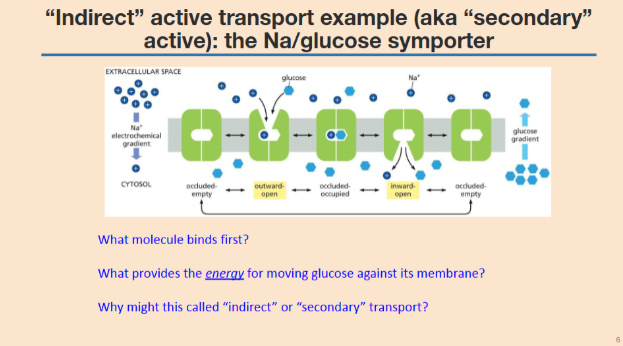
Why might this called "indirect" or "secondary" transport?
The symporter does not use ATP directly; it couples glucose movement to Na+ moving down its electrochemical gradient.

What would the distribution of charges be if the membrane potential was positive?
The inside of the cell is positive relative to the outside.
What happens to Vm if gated Na+ channels open?
Na+ enters the cell down its electrochemical gradient, making the inside more positive (depolarization).
What happens to Vm when gated Cl- channels open?
Cl− movement tends to drive Vm toward the chloride equilibrium potential; often it hyperpolarizes or stabilizes the membrane, depending on the gradients.
What would happen if the neurons were not close enough?
Neurotransmitters would be less likely to reach receptors across the synaptic cleft, reducing or preventing effective signal transmission.
What is the order of the main groups of molecules that can cross the cell membrane, from most difficult to easiest?
Large polar molecules/ions are most difficult; small uncharged polar molecules cross slowly; small nonpolar molecules (e.g., O2 and CO2) cross most easily. Exact order can depend on the course's categories.

Circle the light circles and box the dark circles. What does each shape represent? What does each channel/pump represent?
resting potential, depolarization, hyperpolarization, resting potential

Number each part of the action potential steps and where they occur on the curve.
Resting potential, threshold, depolarization, repolarization, hyperpolarization, resting potential.
Do you remember the sign of AG should be for each reaction? What is the overall formula for this?
ΔG < 0 for an energetically favorable (exergonic) reaction; ΔG > 0 for an energetically unfavorable (endergonic) reaction. Overall: ΔG = ΔG₁ + ΔG₂ for coupled reactions.
Where does the energy that cells use to create ATP (from ADP) come from?
Energy released by exergonic reactions, especially oxidation of nutrients such as glucose, is coupled to ATP synthesis.
Energy transfer: Removal of a hydride H− (essentially how many protons and electrons?) from a molecule releases a lot of ____!
energy
LOSS (removal) of an electron from an atom is called:
Oxidation.
GAIN (addition) of an electron to an atom is called:
Reduction.
What molecule(s) shuttle all of those electrons around?
NAD+/NADH and FAD/FADH2 are major electron carriers.
Electrons associated with electronegative atoms have less potential energy. Why might this be the case?
Electronegative atoms attract electrons strongly, placing them at lower potential energy.
Why not strip the e- and H+ off of glucose all at once? (and directly pass the e- and H+ to O2?)
it is less energy efficient
How does Phosphofructokinase act as the regulatory switch controlling the investment phase?
PFK-1 catalyzes a key committed, ATP-consuming step of glycolysis and is regulated by cellular energy signals, controlling glycolytic flux.

Can you identify where decarboxylation is occurring and dehydrogenation?
Step 3, 4, 6, 8

Identify the steps that involve REDOX reactions. What molecule is oxidized or reduced?
steps 3 and 4

Which steps generate GTP/ATP?
step 5

Which membrane contains the ETC? ATP synthase?
Both are located in the inner mitochondrial membrane.
Where products of each step found produced/found?
Glycolysis occurs in the cytosol; the citric acid cycle occurs in the mitochondrial matrix; the ETC and ATP synthase are in the inner mitochondrial membrane, pumping H+ into the intermembrane space.
What is so important about the cristae?
Cristae folds increase inner-membrane surface area for electron transport chain complexes and ATP synthase.

Consider the first step in the ETC: which molecule is oxidized? which is reduced?
NADH is oxidized to NAD+; the electron-accepting molecule in Complex I (FMN/iron-sulfur carriers in sequence) is reduced.
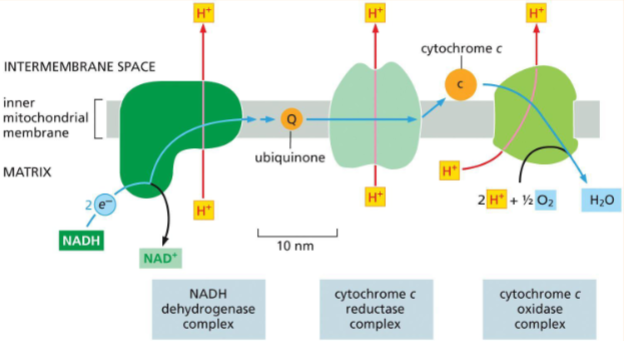
What is the final electron acceptor at the end of the ETC?
Oxygen (O2), which combines with electrons and protons to form water.

What are the other outputs of the reaction? (Glyceraldehyde-3-phosphate dehydrogenase, glycolysis step 6)
NADH and H+ are produced, along with 1,3-bisphosphoglycerate; inorganic phosphate is added to the substrate.

What molecule(s) is oxidized or reduced?
Glyceraldehyde-3-phosphate is oxidized; NAD+ is reduced to NADH.

What is the overall reaction occurring?
Glyceraldehyde-3-phosphate + Pi + NAD+ → 1,3-bisphosphoglycerate + NADH + H+.

Does this step only occur once?
No. It occurs twice per glucose because one glucose produces two glyceraldehyde-3-phosphate molecules.

Is this part of the energy-investment phase or the payoff phase?
The payoff phase.

How does the carbon count change during this step? (Isocitrate → α-ketoglutarate)
Carbon count decreases from 6 to 5 because one carbon is released as CO2.

What enzyme catalyzes this reaction?
Isocitrate dehydrogenase.

What are the other outputs of the reaction? (Isocitrate → α-ketoglutarate)
NADH and CO2 are produced; a proton may also be shown depending on the equation convention.
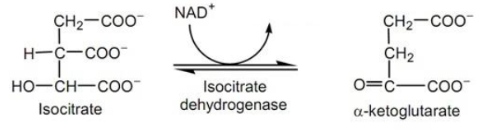
What molecule(s) is oxidized or reduced? (Isocitrate → α-ketoglutarate)
Isocitrate is oxidized; NAD+ is reduced to NADH.

Does this step only occur once? (Citric acid cycle)
No. It occurs twice per glucose because each glucose yields two acetyl-CoA molecules and two cycle turns.

Why is this step considered "oxidative decarboxylation"?
The substrate is oxidized (electrons transferred to NAD+) and a carboxyl group is removed as CO2.

What is the type of bond that connects two nucleotides that are contained within a single strand of DNA?
A phosphodiester bond.

Is this a non-covalent or covalent bond? (DNA backbone)
Covalent.

What is the type of bond/molecular force that holds TWO strand of DNA together?
Hydrogen bonds between complementary bases, with base-stacking interactions also stabilizing the double helix.
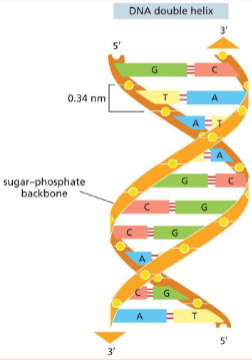
Is this a non-covalent or covalent bond? (between DNA strands)
Non-covalent.

What defines complementarity and antiparallel as it pertains to DNA structure?
Complementarity: A pairs with T and G with C. Antiparallel: the two strands run in opposite directions, 5′→3′ and 3′→5′.
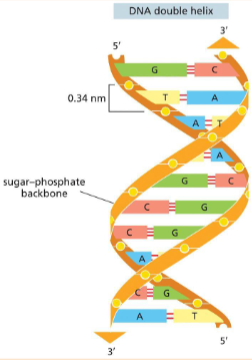
What direction (5' to 3' OR 3' to 5') is DNA a synthesized?
DNA is synthesized 5′→3′.

DNA forms a double helix and run in antiparallel to each other. What molecular forces (bonds) hold the two strands together? (note there are TWO types!)
Hydrogen bonds between complementary bases and base-stacking interactions between adjacent bases.

What is the charge of DNA?
Negative, because of the phosphate groups in its sugar-phosphate backbone.
Is DNA always in its chromosome form?
No. DNA is packaged as chromatin and changes compaction; chromosomes are especially condensed during cell division.
Why would it be an issue for DNA to stay in a very condensed state?
Transcription and DNA replication/repair proteins could not access the DNA efficiently.
What is the chemical property of serine (shown above)? (threonine is similar!)
Serine has a polar, uncharged hydroxyl (-OH) side chain.
How would the addition of a phosphate group impact the interaction of the histone with the DNA?
Phosphorylation adds negative charge, which can alter/weaken interactions with negatively charged DNA and recruit regulatory proteins.
What is the difference between introns and exons?
Introns are removed during RNA splicing; exons are retained in mature RNA and typically include protein-coding sequences.
Will both introns and exons be transcribed?
Yes. Both are transcribed into the initial pre-mRNA; introns are later removed during splicing.

Which strand is the template?
The template is the strand read by RNA polymerase 3′→5′. For the shown right-moving polymerase, use the lower strand if it runs 3′→5′ toward the right.

What is the direction of transcription occurring?
RNA polymerase moves along the template 3′→5′ and synthesizes RNA 5′→3′.
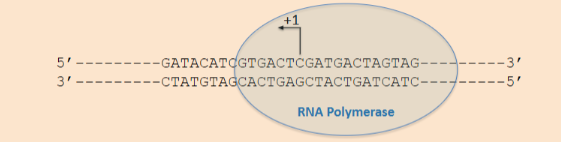
What is the mRNA sequence of the first 5 nucleotides?
Using the shown upper coding strand (5′-GATAC...-3′), the first five mRNA bases are 5′-GAUAC-3′. This depends on the transcription start location indicated in the figure.
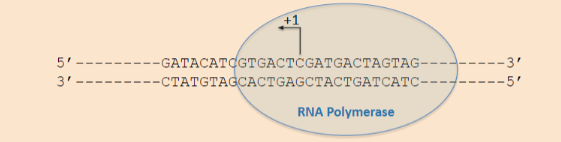
Where is the start codon?
The start codon is usually AUG in mRNA (ATG in the coding DNA strand); the exact location requires the gene's start site/sequence context.

If RNA Pol II movement is to the right, which strand would be the template?
The strand oriented 3′→5′ from left to right (the lower strand in a standard antiparallel diagram).
What would occur if only one activator was bound?
Transcriptional activation would likely be reduced compared with binding of all required activators; the exact outcome depends on the regulatory diagram.

Which sugar is for DNA and RNA? Label the structures.
DNA contains deoxyribose (2′ carbon has H); RNA contains ribose (2′ carbon has OH).
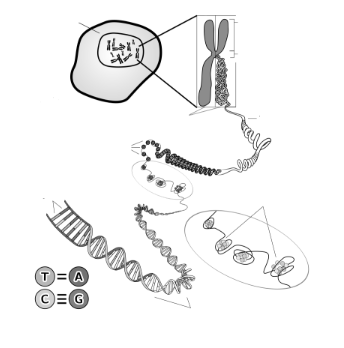
Label the different structures/components that make up DNA.
DNA contains phosphate groups, deoxyribose sugars, and nitrogenous bases (A, T, G, C) arranged in a sugar-phosphate backbone.
What does it mean that the two strands of DNA run "antiparallel!" to one another?
One strand runs 5′→3′ while the complementary strand runs 3′→5′.
What are the three chemical parts that make up a single DNA nucleotide?
Phosphate group, deoxyribose sugar, and nitrogenous base.
Why are the hydrogen bonds between bases relatively weak compared to the covalent bonds in the backbone?
Hydrogen bonds are individually weaker non-covalent interactions; covalent phosphodiester bonds share electrons and strongly link the backbone.

Circle which strand RNA polymerase will use as a template.
RNA polymerase uses the strand read 3′→5′. If transcription proceeds left-to-right in the diagram, Strand A is the template.

What direction will RNA polymerase move?
Along the template strand in the 3′→5′ direction.

In what direction is the mRNA sequence built?
5′→3′.

Write the sequence of the resulting mRNA transcript.
UGCAAUAUUAGCGAUCGAUGCAUGCAU

What role does the bolded TATAAT sequence play here?
It is a promoter sequence (TATA box-like element) that helps recruit transcription machinery and position transcription initiation.

If a mutation changed the sequence of TATAAT, how would this affect the transcription of the gene?
It could weaken promoter recognition and reduce or disrupt transcription initiation.

What type of chemical bond is RNA polymerase creating as it joins the RNA nucleotides together to form this strand?
Phosphodiester bonds.