Sex Differentiation
 Call Kai
 Learn
 Practice Test
 Spaced Repetition
 Match
 Flashcards
 Knowt Play
1/91

There's no tags or description
Looks like no tags are added yet.
92 Terms
Differentiation =
Primitive group of unspecialized cells develop a functional and specialized group of cells that provide a common function
Involves Formation of Three Germ Layers:
Embryonic tissue which form all adult tissues and organs
Ecto, meso, endoderm
Germ Layers formed during:
Gastrulation (re-arrangement of the embryonic cells)
Genetic Differentiation:
Genetically determined by the presence of Y chromosome
Takes place at fertilization
Sperm delivers an X (female)
or Y (male) chromosome
Sry gene of Y chromosome causes:
undifferentiated gonad to develop into testis
Responsible for expression of testis determining factor (TDF) secreted by sex cords
TDF controls pathway towards:
either male or female development
Sex cords:
structures inside undifferentiated gonad —> like germ cells for gonads
Chromosomal sex —>
gonadal sex —> hormonal sex —> phenotypic sex —> brain and/or behavioral sex
Single Pair of sex chromosomes:
mammals, some but not all vertebrates
Sex is environmentally determined:
sea worms, fish, reptiles
Multiple sex chromosomes:
invertebrates, insects, reptiles
Haplodiploidy:
bees, spiders
What is amniocentesis?
a prenatal medical procedure where a healthcare provider uses a thin, hollow needle to collect a small sample of amniotic fluid from the sac surrounding a fetus
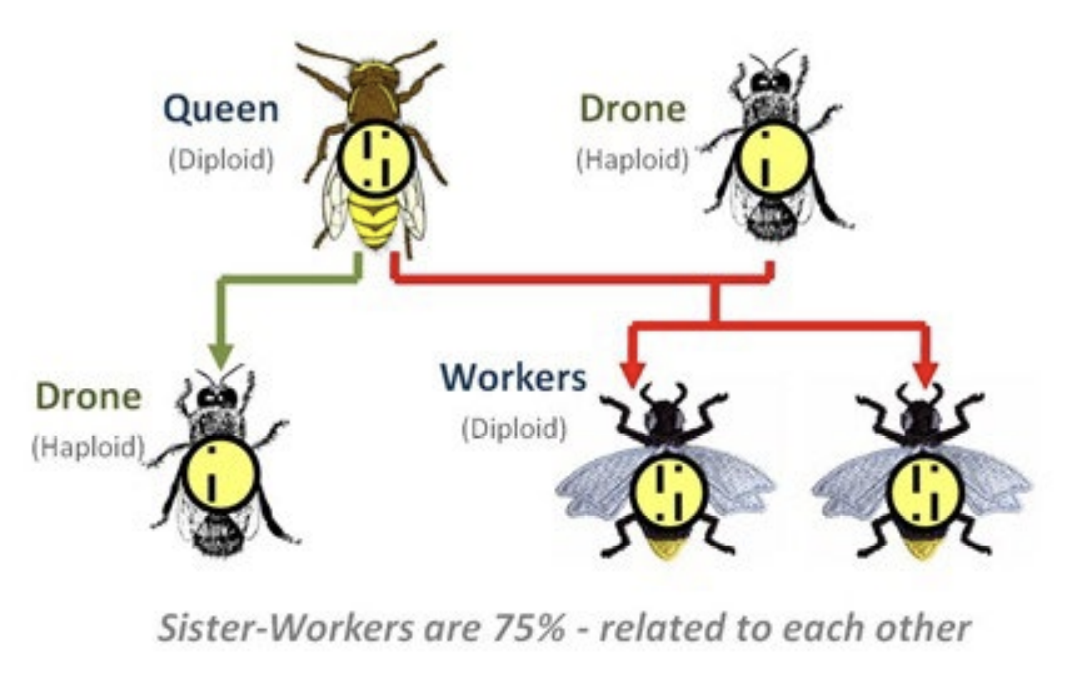
Haplo-Diploid Sex Determination in Bees:
this image
Both male and female gonad and duct system are:
retroperitoneal
as the gonads and reproductive ducts develop in the embryo, they form behind the peritoneal membrane rather than inside the peritoneal cavity
retroperitoneal =
“outside” the peritoneum
peritoneum =
cavity inside gut — serous membrane that lines the abdominal cavity and covers and supports abdominal and pelvic organs
Before gonadal differentiation:
germ cells form connective tissue in the gonads — not testes or ovaries yet
Development of primordial germ cells in the yolk sac happens during the:
first 15% of gestation
Migration of primordial germ cells from the yolk sac into:
genital ridge
Primordial germ cells =
stimulate connective tissue proliferation & Forming primitive sex cords
Genital ridge:
enlarges and gives rise to indifferentiated gonad
Genital ridge with stimulation of sex cords give rise to:
renal system
What is also developing at the same time as gonadal differentiation?
kidneys
Urine is produced and drained by:
mesonephric ducts (previously called Wolffian ducts)
What functions like the kidneys before they develop?
mesonephric ducts
What ducts becomes the male?
wolffian ducts
Paramesonephric ducts or Müllerian ducts form on:
either side of mesonephric ducts
Which ducts become the female?
paramesonephric ducts
While the mesonephric ducts function as the kidneys, the embryo is still in what stage?
sexually indifferent stage
Development of the urinary system:
pronephros
mesonephros
metanephros
pronephros =
primitive kidney
mesonephros =
closely associated with the unindifferentiated gonad
metanephros =
becomes the functional kidney
Development reproductive tract:
Two distinct tubules structures which give rise to male or female reproductive tracts
a. mesonephric duct (Wolffian Duct; male)
b. paramesonepheric duct (Mullerian Duct; female)
Overall steps of gonadal differentiation?
Development of primordial germ cells in the yolk sac
Migration of primordial germ cells from the yolk sac into the genital ridge
Genital ridge with stimulation of sex cords give rise to renal system
Development of the urinary system
Development reproductive tract
Eventually, which tract will be connected to the mesonephros?
male
Eventually, which tract will not be connected to the mesonephros?
female
In males, what causes the regression of paramesonephric ducts?
TDF in sex cords
in sex differentiation, does the mesonephric ducts regress in females?
yes
TDF & Sex cords —>
gonad —> testes —> makes sertoli cells
In the presence of Y chromosome and Sry gene…TDF:
Development of indifferentiated gonad to testes and Sertoli cells
Secretion of anti-mullerian hormone (AMH) by sertoli cells
Degeneration of Mullerian duct and development of Wolffian duct
Differentiation of interstitial Leydig cells
Secretion of testosterone and development of male reproductive duct system
What hormone causes the regression of mullerian ducts?
anti-mullerian hormone (AMH)
Before testicular descent, what happens?
testes stay put while the body lengthens
Four phases of Testicular Descent: Growth and elongation of
the body away from the stationary testes.
Four phases of Testicular Descent: Rapid growth of
the distal gubernaculum — Results in testes being pulled to the inguinal ring
Four phases of Testicular Descent: Shrinkage of
gubernaculum within scrotum pulls testes through inguinal ring
Four phases of Testicular Descent: Continued regression
of the gubernaculum situates testes within scrotum
Growth and regression of gubernaculums: Testicular factor
“descendin” has been shown to cause growth in gubernacular cells in vitro
Growth and regression of gubernaculums: Testosterone
or gonadotropins do not appear to play a major role in gubernacular growth
Growth and regression of gubernaculums: Intra- abdominal
pressure may play a larger role in the movement of testes from abdomen and into scrotum
Testes Fail to Descend?
Cryptorchid
Cryptorchid =
a. bilateral: both testes retained: sterile
b. unilateral: one testis retained: fertile-sub-fertile
Hormone production in cryptorchid males?
Hormone production is NOT decreased — will exhibit secondary sex characteristics and normal reproductive behavior
Cryptorchidism is:
heritable & likely that fertility will be compromised, so therefore cull
Possible to surgically or with pharmaceuticals:
lower retained testis
Descent of testes into the scrotum occurs: Bull & Ram
mid-gestation
Descent of testes into the scrotum occurs: Boar
last quarter of gestation
Descent of testes into the scrotum occurs: Stallion
just before birth/ at birth
Why are bilateral cryptorchids sterile?
Temperature regulation!
The temperature requirements for normal spermatogenesis must be different
If increase temperature of scrotum/insulate against heat loss:
If increase temperature of scrotum/insulate against heat loss
Increased # of abnormal sperm=decreased fertility
Female vs male formation?
female is inverse to everything talked about in the male
Female in the absence of Sry Gene:
No TDF
Development of ovaries
No Sertoli cells
Absence of AMH
Degeneration of Wolffian duct and development of Mullerian duct
Development of female reproductive tract
In the absence of testis determining factor:
cells in the sex cords differentiate into follicular cells
Genital ridge becomes ovary
in the female, ____ hormone is present?
müllerian
What cells produce the müllerian hormone?
follicular cells
Rete tubule formation in females:
is less pronounced and never connects, therefore there is no “tube” leading from ovary to oviduct
Rate tubules are part of:
mesonephric duct
ovary & oviduct are not:
physically connected
In females, Paramesonephric ducts become:
the oviduct, uterus, cervix, and vagina
The degree to which these ducts fuse determines the type of uterus
Females — Tubules fuse with urogenital sinus:
this creates the opening to the outside
Caudal vagina and vulva form from:
the ectoderm
Freemartinism =
Abnormal embryogenesis of the female reproductive tract
When twins are present, chorion (extraembryonic membranes) fuse so there is a common blood supply between two calves
So both conceptuses are exposed to same hormones, including testosterone and anti-müllerian hormone
Developmental effects of femartinism?
super short tract & not very developed horns
blind tract
How is the brain defeminized?
testosterone crosses the blood brain barrier and turns into estrogen — the estrogen inside the barrier defeminizes is and makes her not develop a surge center
No surge center =
no ovularion
The Freemartin in Cattle:
Female born twin to a bull
Placenta membranes of the 2 fetuses fuse
Common blood supply
At time of testis formation (d 40)
Before ovarian formation
At day 40, the main thing is:
AMH functioning
In fremartin females, testosterone:
coms from male first & later they build their own supply but they don’t have sertoli cells
Both fetuses:
share a common hormone environment
Testosterone & anti-mullerian hormone
Animals are chimeric (share blood types/WBC from other twin)
TDF (SRY) expressed in both individuals
AMH from bull - blocks Mullerian ducts & causes in some cases:
Posterior vagina, no anterior vagina
Testosterone from bull causes:
clitoral enlargement
Brain changes like that of male
Ovaries do not grow but are chimeric:
Ovotestis — partial development of each system
SRY and therefore AMH and Testosterone
Further changes and adult male behavior
acts more like a male
Freemartins can be used as:
Use as estrus detector — “gomer bulls”
“gomer bulls” =
an intact, sexually mature bull that has been surgically altered so he can find and mount cows in heat, but cannot impregnate them
When do testes typically develop?
~ day 35
When does the female tract develop?
~ day 40

What image needs to be known well?
this flow chart
HD =
Hypothalamic Differentiation
HYPOTHALAMIC GNRH SURGE CENTER IS NECESSARY FOR:
INITIATION OF THE ESTROUS CYCLE AND FOLLICULAR OVULATION IN THE FEMALE
HD in Male — Defeminization (Masculinization) of the brain in the male:
T from the fetal testis reaches the brain
T is converted to estradiol by aromatase enzyme in the hypothalamus
Regression of the hypothalamic GnRH surge center by estradiol
Defeminization of the hypothalamus (no surge center)
HD in Female — If synthesis of estradiol in the hypothalamus responsible for defeminization of the surge center, why doesn’t the female (with a lot circulating estradiol) become “defeminized”?
Estradiol in female binds with liver protein called alpha-fetoprotein
New complex cannot cross blood brain barrier where the surge center is located
Estradiol cannot affect the GnRH surge center