Sequences and Series
 Call Kai
 Learn
 Practice Test
 Spaced Repetition
 Match
 Flashcards
 Knowt Play
1/23

Earn XP
24 Terms
sequence
a list of numbers that typically starts with term 1 (assume it is unless explicitly said)
terms
the numbers that make up a sequence
explicit rule
A formula that defines the nth term of a sequence directly, allowing for the calculation of any term without referring to previous terms.
recursive rule
A formula that defines each term of a sequence based on the preceding term(s), requiring knowledge of previous terms to calculate subsequent ones.
domain of a sequence
the set of all possible input values (n) for which the sequence is defined, typically the non-negative integers.
range of a sequence
the set of all possible output values that a sequence can produce
finite sequence
a sequence with a specific number of terms that ends after a certain point.
infinite sequence
a sequence that continues indefinitely without terminating, having no specific end.
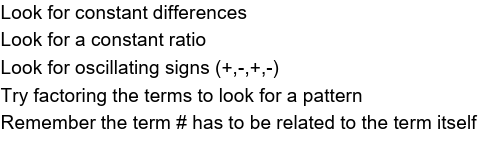
finding the pattern to a sequence
series
sum of a sequence
partial sum
for infinite sequences, they have no definitive sum since they are infinite. therefore, we take the sum for a specified domain

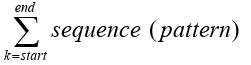
summation/ sigma notation
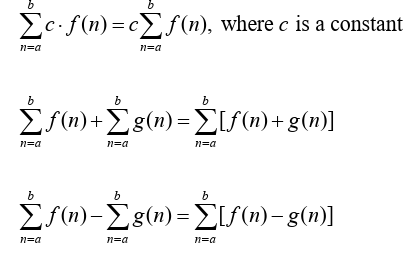
properties of summations
simply ways to manipulate summations to use the formulas for special series (in the next cards)
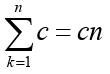
sums of a constant
literally taking the same number and adding it however many times
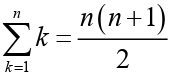
sum of the first n positive integers
sum of consecutive positive integers from 1 to n (more like a specific case for the arithmetic series formula)
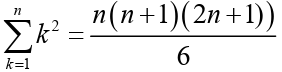
sum of the squares of the first n positive integers
arithmetic sequence
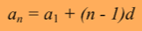
a type of a sequence in which there is a common difference
explicit rule for arithmetic sequence
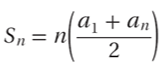
arithmetic series
sum of the terms in an arithmetic sequence
geometric sequence
a type of sequence in which there is a common ratio
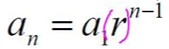
explicit rule for a geometric sequence
geometric mean
the term between two positive numbers in a geometric sequence

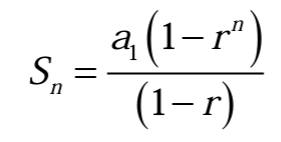
finite geometric series
sum of the terms in a geometric sequence
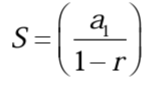
infinite geometric series
NOTE: if it converges there is a sum. why? it approaches a number but never equals it. the number it approaches = estimated sum. the ratio here is <1.
if it diverges, the ratio is >1, meaning the sum will just get larger and larger, so we have no estimated sum.