Math Yearly Error Cards - Term 4 Year 10
 Call Kai
 Learn
 Practice Test
 Spaced Repetition
 Match
 Flashcards
 Knowt Play
1/19

There's no tags or description
Looks like no tags are added yet.
20 Terms
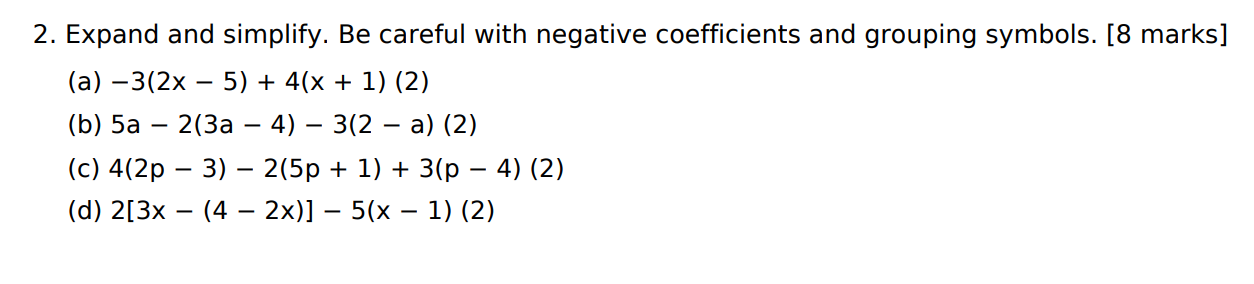
B and D
For B, the 5a isn’t apart of the expanding brackets
For D, the negative sign before the brackets, flips the ± signs


D and E
For D, i wrote (x-2) instead of (x-3), silly mistake, read the question
For E, i forgot to also cancel out the 2 ‘a’s to make the answer 1


D
when dividing 3xy by 3xy, i wrote as 0, when it is 1


A, B and D
for A, i for some reason just forgot about the denominator, and gave the answer without it
for B, i found the denominator by finding the LCM, which i found to be 24, when its actually 12. I also cancelled out the 24 and 8, but i can only cancel out the entire numerator since not every sign is a multiply.
for D, there was a minus sign in front of second fraction meaning when you combine the fractions every ± sign in the numerator flips.


D
when removing the brackets, I need to flip the ± signs in x² - 9, since there was a minus sign before the bracket


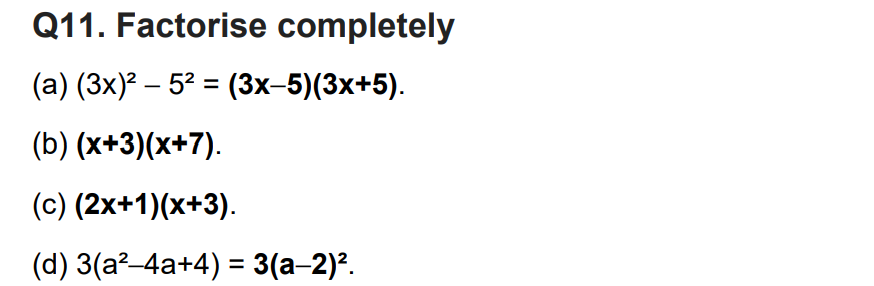
A, B and D
for A, for some reason i thought you have to divide both numbers by the same number when you are supposed to make them both squared and then make (a+b)(a-b)
for B, again here i thought i had to divide b and c by the same number when obviously i just find 2 numbers that add to b and multiply to c, which were 3 and 7.
for D, when i got the final (3a + 6)(a - 2), i didn’t realise you could further factorise the first bracket.

A
I forgot to identify the null factor law when getting, (x+3)(x+4). I also tried completing the square since i didn’t find x, where i forgot that the number should be ± when bringing square to other side. You can also use quadratic formula.


C
I put the equation into my normal calculator which gave a decimal number when i should’ve put it into my cheater calculator


B
when eliminating i subtracted the equations when i should add. I know what to do by seeing whether + or - would cancel out one of the variables.

how to find the surface area of a cone
area of base + (π x r x l)
how to find the surface area of a sphere
4 x π x r²

A and C
for A, i didnt know that you could simply start adding/subtracting all like terms straight away
for C, i saw the trinomial and tried to factorise it when i need to be expanding the brackets then collecting like terms.

How to do polynomial long division by inspection
I only know how to do if divisor is ax ± b
write p(x) = d(x) *
whatever the first term in d(x) times what equals first term of p(x), write that
then, multiply that term you wrote by the second term in the divisor and see what you add or subtract to get next term in p(x)
repeat this step for the rest of the terms
How to know where a polynomial curve starts
for odd degrees, + means bottom left, - means top left
for even degrees, + means top left, - means bottom left
when sketching polynomials, what does it mean if a bracket is squared
the curves doesn’t pass the x-axis and bounces off that point.
what is multiplicity
the power a bracket in polynomial is
how to know how to sketch a curve with any multiplicity
all even powers bounces away, all odd powers cross through
the higher the power, the flatter the curve is

The mistake i made was firstly dividing p(x) by a factor, when the equations can actually be simplified by letting u = x² and then simply factorising trinomials. Or, i CAN divide, but THEN realise you can further keep factorising the quotient to get the answer. While factorising this way, i got a difference of square, which i wrote = (a+b)² but it equals (a+b)(a-b).

how to find the x-axis of the vertex of a curve
use -b/2a
how to know how many solutions and equations has
use discriminant = (-b² ± √(b² - 4ac))/2a