Measuring the Threshold
 Call Kai
 Learn
Learn Practice Test
 Spaced Repetition
 Match
Match Flashcards
 Knowt Play
1/14

There's no tags or description
Looks like no tags are added yet.
Name | Mastery | Learn | Test | Matching | Spaced | Call with Kai | Chat |
|---|
No analytics yet
Send a link to your students to track their progress
15 Terms
Just Noticeable Difference (JND)
A just noticeable difference (JND) is the SMALLEST difference in the amount of STIMULATION that a specific sense can DETECT

Just Noticeable Difference (JND)
Each unit represents a WHAT increment
Just Noticeable Difference (JND)
Each unit represents a CONSTANT increment

Weber’s Law
The size of a Just Noticeable Difference (JND) is a CONSTANT proportion of the SIZE of the initial stimulus

Weber’s fraction
∆𝐼 / 𝐼 = 𝐾
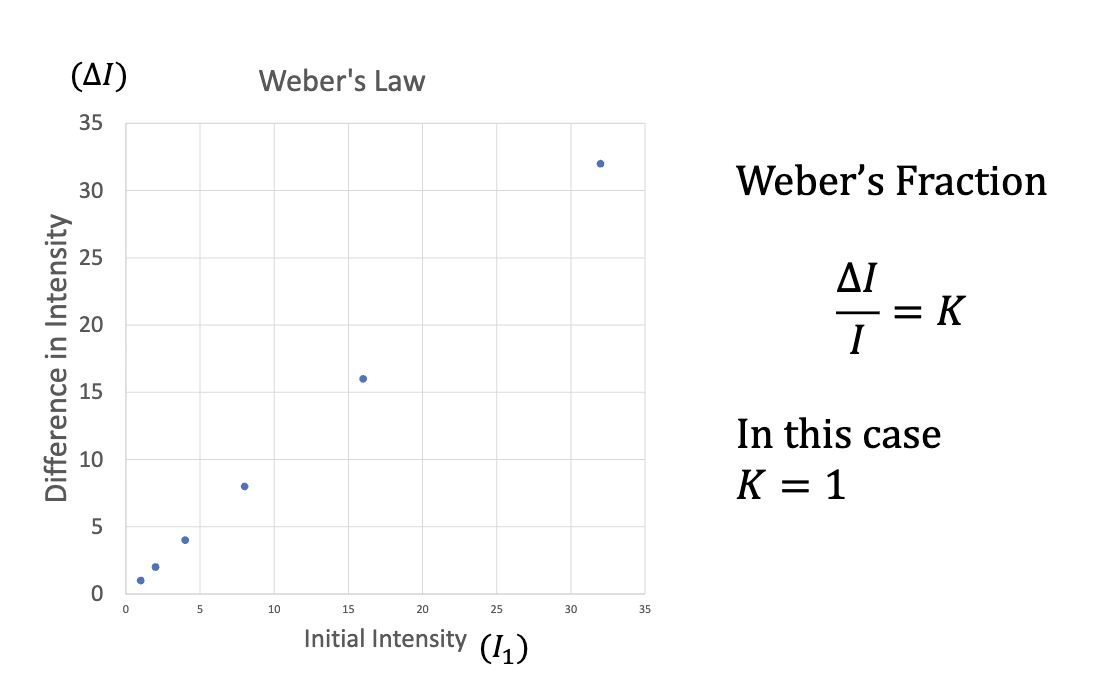
Weber’s Law
Constant increments in stimulus intensity produce WHAT in the perceived WHAT of sensation
Weber’s Law
Constant increments in stimulus intensity produce SMALLER INCREASES in the perceived MAGNITUDE of sensation

Fechner’s Law
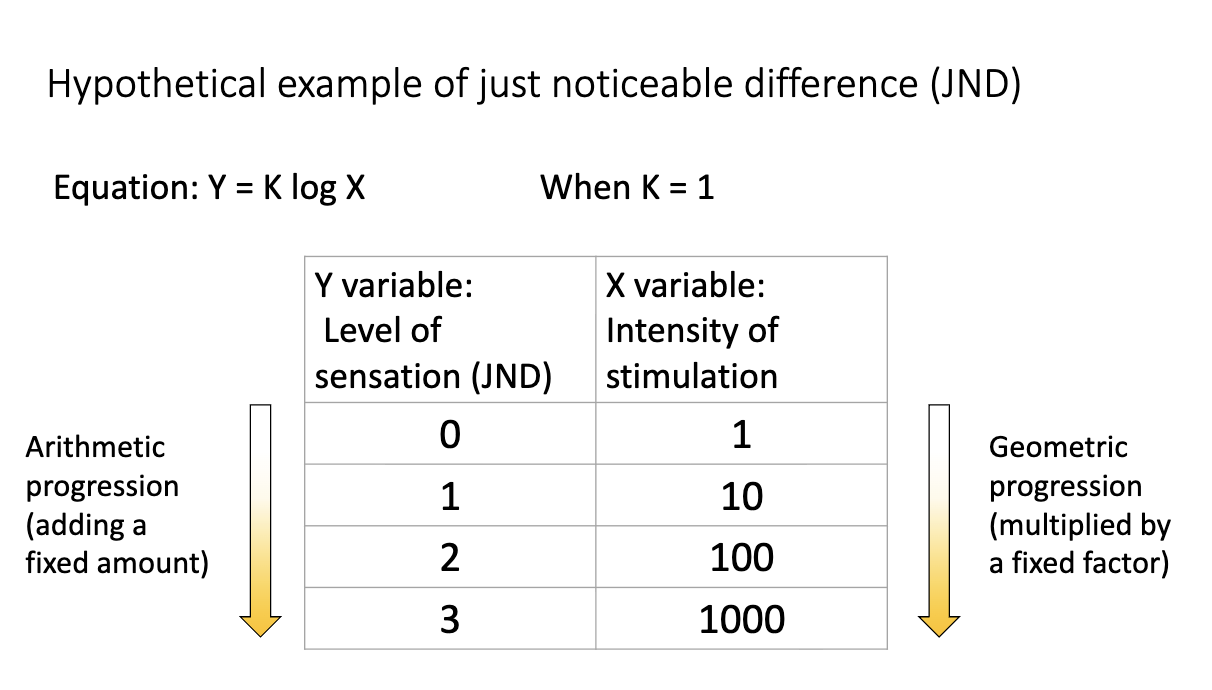
Subjective sensation is proportional to the LOGARITHM of the INTENSITY of the stimulus

Hypothetical example of just noticeable difference (JND)
Arithmetic progression (WHAT)
Geometric progression (WHAT)
Hypothetical example of just noticeable difference (JND)
Arithmetic progression (adding a fixed amount)
Geometric progression (multiplies by a fixed factor)
Implications of Fechner’s Law
S = WHAT
Psycho = WHAT
Implications of Fechner’s Law
S = K Log R
Psycho = PHYSICAL
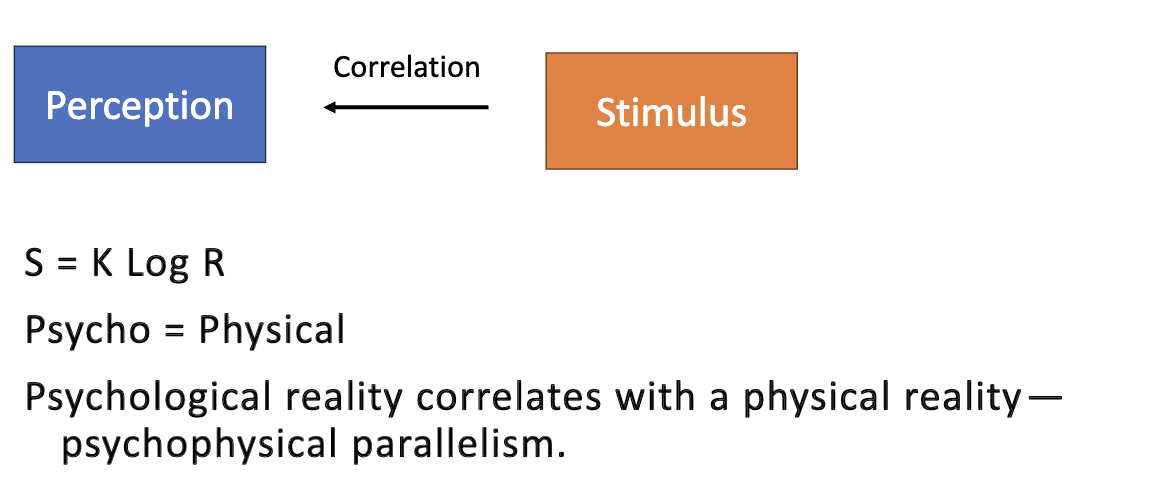
Implications of Fechner’s Law
Psychological reality correlated with a WHAT - WHAT parallelism
Implications of Fechner’s Law
Psychological reality correlated with a PHYSICAL REALITY - PSYCHOPHYSICAL parallelism
Stevens’ Power Law
Modern investigators have found that Weber’s Law is not WHAT for all WHAT.
Stevens’ Power Law
Modern investigators have found that Weber’s Law is not TRUE for all SENSES
Example:
The perception of pain is the OPPOSITE of what Fechner’s Law predicts. As shown in the graph, a slight increase in stimulus magnitude results in a great increase in perceived magnitude.
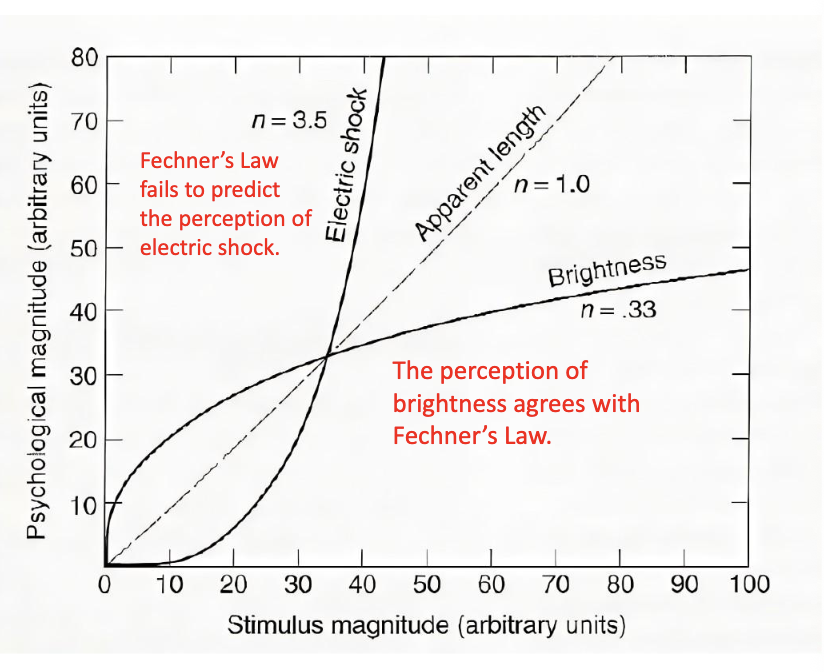
Stevens’ Power Law - Equation
P = KS^n
where
P = Perceived magnitude
K = a constant
S = stimulus intensity
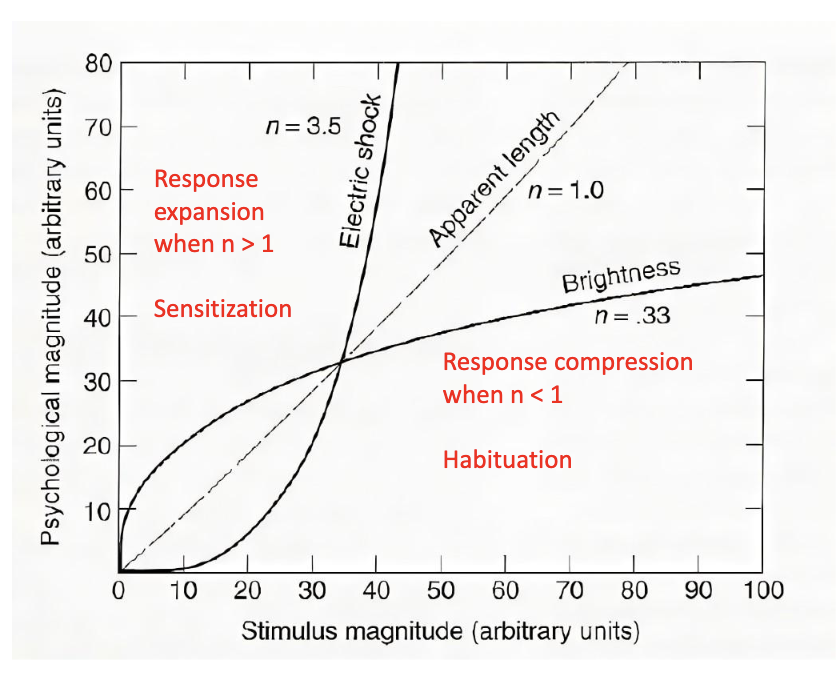
What are the two responses to Steven’s power law
WHAT
WHAT
What are the two responses to Steven’s power law
Response expansion - sensitization
Response compression - habituation

Response expansion - sensitization
n WHAT 1
Response expansion - sensitization
n > 1

Response compression - habituation
n WHAT 1
Response compression - habituation
n < 1

