Physiology Lab Final
 Call Kai
 Learn
 Practice Test
 Spaced Repetition
 Match
 Flashcards
 Knowt Play
1/52

There's no tags or description
Looks like no tags are added yet.
53 Terms
The Na/K+ ATPase is a primary active transporter. What does primary active transport mean in terms of energy requirements? Where is this pump located?
Primary active transport requires the energy stored in the high-energy bond of ATP to transport things against their gradient
This pump is located on the extracellular fluid face of the cells
What is secondary active transport? What is an example
Transport using membrane proteins that utilize the energy of one molecule
moving down its concentration gradient in order to move a second molecule against its concentration gradient
- An example is the sodium glucose transporter in the mammalian kidney (energy of Na+ to move glucose against its gradient)
Draw the transport mechanisms that were studied in the Malpighian tubule cells in
- 3Na+/2K+ - from cell to ECF - primary active transport (requires ATP)
- a-ketoglutarate (aKG) and Na+ from ECF to cell - secondary active transport (with Na+ gradient)
-CPR- from ECF to cell against aKG - secondary active transport (with aKG
gradient)
- CPR- into lumen against OH- or Cl- - passive transport
What effects on Chlorophenol red (CPR) transport would the following substances have?
a. A mitochondrial uncoupler - (example: DNP)
ATP production will be decreased, so the sodium-potassium pump will not function properly, and there will not be a gradient created to be used by the two secondary active transporters, so the amount of CPR will be decreased
What effects would the following substances have on Chlorophenol red (CPR) transport? b. An organic anion that is transported on the same membrane protein as CPR - (example: PAH)
Because CPR has to compete with PAH for the proteins to get into the cell and then the lumen, less will be present in the lumen
What effects on Chlorophenol red (CPR) transport would the following substances have? K+ free saline
- Na+/K+ will not function because there is no more K+ to bring in,
so a sodium gradient can not be created to be used by the secondary active transporters
What effects on Chlorophenol red (CPR) transport would the following substances have? Na+ free saline
eventually, the Na+/K+ ATPase will have no substrate to pump
to make the gradient; high levels of sodium outside won’t be able to be
maintained, and so secondary active transport will be less effective
Where does the CPR dye accumulate under normal transport conditions?
In the lumen of the malpighian tubules
What is a transducer and what is the difference between an active and passive transducer?
- Transducer: devices that convert physical or chemical phenomena into electrical signals
- Passive transducer: generates voltage directly
- Active transducer: requires an electrical input in order to produce a voltage signal
When is the use of an amplifier justified?
- Many biological systems the voltages generated are very low and difficult to detect
What is the difference between AC and DC mode? Give examples of situations in which each would be used.
- AC: alternating current; a high pass filter has been applied to the signal and the resulting signal is reported as changes in signal, not absolute value; useful for detecting rapid changes in a voltage that may slowly “wander” over time (many biological signals)
-DC: direct current; no filter has been applied, so the resulting signal is reported as an absolute value; allows detection of smaller and slower voltage changes, but also works best if the baseline voltage is steady over time
Draw and describe each of the steps involved in action potential generation.
-Depolarization that rapidly changes membrane potential from -70mV to +30mV caused by the rapid influx of voltage gated sodium channels
-Typically involves stimulation of the neuron by another neuron by a hormone or an environmental stimulus
What characteristics of annelid axons are unique compared to their chordate counterparts (myelination or lack thereof, ect.)
- Lack of myelination in invertebrates
- Increase nerve conduction velocity by being large in diameter
- Annelids: single median giant fiber and two lateral giant fibers
What were the approximate magnitude differences of the voltage changes recorded in this lab compared to the actual voltage changes that occurred across the axonal membranes? Why was there a difference?
- Recorded in lab: 6.6x10^5 mV at MGF threshold
- Actual: 100 mV
- There was a difference because we were measuring the action potential
extracellularly (measure the difference in potential between the outside of the axon and a reference point)
Be able to explain some of the hypotheses and evidence for why different people can hear, see, or taste the same stimuli but interpret it very differently.
Taste: Environmental influences that alter taste bud functioning; specific alleles at particular genetic loci; Physiological conditions such as dry mouth; The number of taste buds a person has and their concentration on the tongue; the relative numbers of different receptor types that make up the taste buds
See: We are all born with different proportions of cones which is why we see color differently even if we are not deficient
Hear: Laurel/Yanni people who cant hear Yanni often have hearing loss (damage to the connection between hair cells and the tectorial membrane closest to the oval window) or are listening to headphones that emphasize the bass
Understand how the various taste receptors work and what might happen if they are stimulated by different tastants due to chemical manipulation (e.g. miraculin)-
5 types of taste receptors (sweet, sour, bitter, umami, salty) each binds to specific proteins on food molecules to depolarize and transmit the signal to a primary gustatory neuron
miraculin binds to sweet receptors on your tongue, but does not alter the shape enough to make them fire, when we eat sour foods the H+ from the acid binds preferentially to the miraculin instead of the sour receptors which changes the shape of the sweet receptors enough to fire and allow us to taste sweet
What is our blind spot, how can it be found, and what causes it? Why is it so difficult to be able to find your blind spot?
- Our blind spot is where the optic nerve and blood vessels exit the eye called the optic disk; because of this, there are no photoreceptors in the area, so nothing can be seen here
- How to find it: cover one eye and hold test sheet at arms length while looking at directly at the cross with the dot next to the cross; with your eye focused on the cross, slowly bring the sheet closer until the dot disappears
- It is difficult to find your blind spot because higher level visual processing in the brain hides each blind spot from our perception by filling in the gap with visual information matching that of the surrounding area
Explain how the process of receptor adaption works. Make sure to discuss the details of how frequently action potentials are sent and the different types of adaptation that a receptor might have. How does adaptation affect our vision? How does it affect our proprioception?
- Sensory adaptation=receptor response declines under a constant stimulus
after image is an example
- Coding: intensity=frequency of action potentials
- Tonic (slow): keeps firing signals intensity and duration
- Phasic (fast): fires at onset/offset then stops
- Vision: light adaptation is fast, dark adaptation is slow (cones, then rods)
- Proprioception: phasic which is why we have the falling through the floor feeling
Describe the steps involved in muscle excitation-contraction coupling.
-The surface membrane of the muscle fiber is depolarized by an action potential triggered by ACh
-The action potential is conducted deep into the muscle fiber via the T tubules
-The action potential in the T-tubules alters the conformation of the DHP receptor, which in turn opens the RyR on the surface of the SR, allowing calcium to be released into the sarcoplasm
-The free calcium concentration in the sarcoplasm increases in concentration, eventually binding to troponin, which changes its configuration and allows cross-bridge formation between myosin and actin
-Force is generated as myosin heads form cross bridges with actin, undergo a conformational change, detach from actin, and change conformation back to its original state
- Once the CNS signal ceases, calcium is taken up again by the SR, cross bridge formation is inhibited, and muscle relaxes
What does an EMG measure?
Voltage change across the surface of muscle cells (muscle membrane
depolarization/change in membrane potential) Measures excitation phase of excitation-contraction coupling
How does the magnitude of EMGs measured on the skin most likely compare to the magnitude of an EMG taken from an electrode inserted into the muscle?
-External electrodes will not show as strong or focused of a signal as internal
electrodes
-Surface electrodes will not be as strong/focused as internal electrodes
-Surface electrodes detect activity of whole muscles, so relative signal strength is roughly proportional to the number of active muscle fibers
What factors determine the velocity at which a single muscle fiber of a given length (number of sarcomeres in series) contracts?
-Fiber type
-Load on the fiber
Note: if you increase load on a muscle, velocity of contraction decreases and amplitude of EMG increases (more motor units recruited)
How does motor unit recruitment relate to total force produced by the muscle and magnitude of the EMG recorded?
-As you increase the load on a muscle, more motor units are recruited up to a certain point
-As more motor units are recruited the total force produced by the muscle
increases
-Increased magnitude of the EMG signal is an indicator of increased motor unit recruitment and an indicator of increased force
What is meant by antagonistic muscle pairs? Give an example.
-Pairs of muscles that act to opposite effects
-When one is contracting the other is inactive and vice versa
-Example: biceps and triceps
What is the latent period?
-Delay between the start of muscle movement (action potential) and the
generation of force
What is the difference between an isotonic and an isometric contraction?
-Isotonic: fixed-load (allows measurement of shortening velocity), both force and movement
-Isometric: fixed-length (allows measurement of force production), force but no muscle movement or shortening
What is a length-tension curve, and what does it tell us about optimal
sarcomere/muscle length as it relates to force production?
-Shows the percent of maximum tension at difference lengths of the sarcomere
-Wherever the highest tension is, that is the length at which the sarcomere generates the most force
-There is a point in the middle of maximum force that corresponds to optimal length
-The maximum number of cross bridges is the optimal sarcomere length for force generation
What happened to the rate of muscle shortening as muscle load increased? Why did this occur?
-As load increases, the rate of muscle shortening decreases
-This is because the rate is dependent on how fast each cross bridge is able to
attach and release; when the load is heavier, they spend more time cycling
through as they generate more force
-
There needs to be more force generated per cross bridging, which slows it down
Why is force production high in a tetanic contraction? (simply saying summation of twitches is not sufficient)
-As load increases, the rate of muscle shortening decreases
-This is because the rate is dependent on how fast each cross bridge is able to attach and release; when the load is heavier, they spend more time cycling through as they generate more force
-There needs to be more force generated per cross-bridge, which slows it down
Why is force production high in a tetanic contraction? (simply saying summation of twitches is not sufficient)
-If a muscle is stimulated several times fast enough so it cannot relax between stimuli, the total force rises and remains elevated as long as the stimuli continue and the muscle does not fatigue
-The non contractile components of the muscle are fully stretched and most of the force generated by the cross-bridging can be measured
- Maintains high levels of calcium of cytoplasm
1. What factors influence arterial blood pressure?
Position (lying down, sitting, standing), exercise, age, weight
How is cardiac output calculated?
Heart rate/min times stroke volume
Describe the steps involved in measuring a person’s blood pressure with a sphygmomanometer.
-Wrap pressure cuff around bare upper arm, and close the valve on the arm by turning it clockwise
-Place the bell of the stethoscope below the cuff and over the brachial artery
-Blow up the cuff to around 160 mmHg, which will completely collapse the artery
-Open the valve slowly and begin to slowly lower the pressure in the cuff
-Appearance of thudding sound = systolic pressure
-Sound becomes muffled and reduced in intensity = diastolic pressure
Explain the effects of posture/body positioning on blood pressure.
-Blood pressure initially drops when you stand up; gravity pulls blood toward your legs and lower body, which reduces venous return and arterial pressure falls briefly
-Laying down will cause an decreased blood pressure because gravity isn’t pulling blood to legs (Venous return increases, leading to greater stroke volume and cardiac output)
What factors cause cardiac output and blood pressure to increase during exercise?
-Activates sympathetic response, which increase HR and contractile strength
Describe the functions, components, and distinctive characteristics of the innate and adaptive immune systems.
Innate:
-First line of defense, not pathogen specific
Three components: phagocytic (engulf foreign things), inflammatory (rapid
infiltration of leukocytes and plasma), and anatomic/physiologic (create
inhospitable environment for pathogens - mucus, skin, extreme pH,
antimicrobial proteins)
-Adaptive:
-Specific, targeted against specific pathogen, has a memory component
-Two parts: humoral (antibody mediated - antibodies are glycoproteins with
specific receptors for various epitopes, and they are produced by B cells)
and cell mediated immunity
What is the purpose of lysozyme and how did we measure its activity in lab?
-Purpose: aids in the innate immune response by attacking peptidoglycans in the cell walls of gram positive bacteria, causing them to lyse
-Tested different concentrations of lysozyme to see how much of the bacteria they would lyse using absorbance values; higher amounts of lysozyme meant lower absorbance, so more bacteria was lysed
What is the difference between humoral and cell-mediated immunity?
-Humoral - antibody mediated; B cells; pathogens in body fluids
-Cell-mediated - cell mediated; T cells; pathogens inside cells using T cells that
destroy infected cells
What is an antigen? What is an epitope?
-Antigen: something that triggers an immune response; recognized as foreign (non-self) by the immune system
-Epitope: regions of an antigen recognized by an antibody
Describe the basic principles of an ELISA.
-Used to quantify the level of a particular antibody or antigen in a sample
-Basic principles: sample with unknown amount of antigen or antibody is affixed to a surface; solution containing antibodies specific for the antigen or antibody are added to the container; detecting antibodies are enzyme linked and will convert a colorless substrate into a colored product; final step is to add the substrate to the well, and the amount of color produced is proportional to the amount of detecting enzyme present, which is proportional to the amount of target antigen or antibody present
What is the function of ADH?
-Antidiuretic hormone - released by the posterior pituitary; controls water
reabsorption in the nephrons and collecting ducts of the kidneys
-Change in fluid intake or loss can change the rate of release and consequently
change the rate of water excretion
How does specific gravity relate to osmolarity?
-Specific gravity represents the ratio of the density of all substances found in a
solution compared to water; pure water has a specific gravity of 1
-They are both measures of the amount of solute in the solution
-Specific gravity depends on number and size of particles, while osmolarity only depends on number

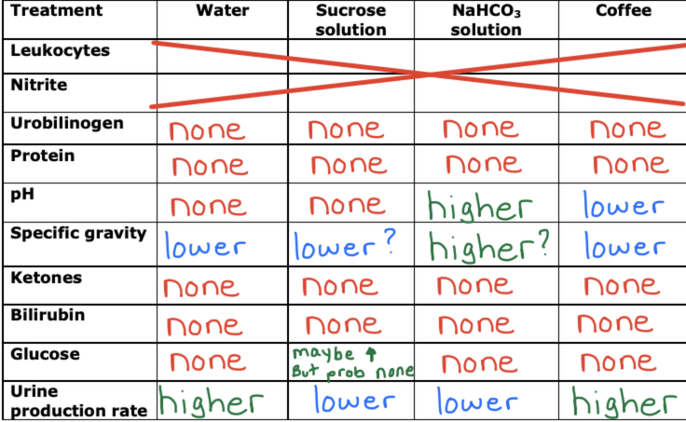
Describe how each of the treatments (coffee, sucrose, water, and sodium bicarbonate) affected (or were predicted to affect) urine production, pH, glucose, volume, and osmolarity.
What are the primary purposes of the primate female reproductive system?
-Supply mature gametes
-Provide for fetal development
What is menstruation?
-Cyclical process of female reproduction
-Commonly called this because it contains a monthly discharge of menses
(uterine discharge), shedding of the endometrial lining
Describe the phases of both the uterine and ovarian cycles, including any significant changes that occur in hormones that occur during these phases. Uterine cycle
-Uterine Cycle
-Menstrual phase - menstrual bleeding from the uterus
-Proliferative phase - following menstruation but prior to ovulation;
endometrium is proliferating and developing progesterone receptors
-Secretory phase - phase following ovulation in which progesterone
produced by corpus luteum maintains optimal uterine environment for the
embryo (nourishing secretions from endometrial glands, decreased
uterine sensitivity to contractile stimuli, closing of cervix)
from embryo maintains the corpus luteum)
Describe the phases of both the uterine and ovarian cycles, including any significant changes that occur in hormones that occur during these phases. Ovarian cycle
Ovarian Cycle:
-Follicular phase - period of oocyte maturation; driven by follicle stimulating
hormone; an FSH independent dominant follicle develops, which secretes
inhibin (inhibits FSH secretion) which causes other follicles to atrophy;
this dominant follicle then develops luteinizing hormone receptors-
Ovulation - LH is released from anterior pituitary, which causes rupture of
follicular membranes and the release of the dominant oocyte into the
oviduct
-Luteal phase - ruptured follicle transforms into corpus luteum, which
secretes progesterone, estrogen, and inhibin that prepares the uterus for
pregnancy; corpus luteum only lasts a few weeks, and if no pregnancy,
cycle begins again (if pregnancy, human chorionic gonadotropin released
from embryo maintains the corpus luteum)
FSH
drives the development of follicles
LH
causes the rupture of follicular membranes and the release of the dominant
follicle into the oviduct
Progesterone
helps thicken the uterine lining for pregnancy and keep it healthy and good for implantation
Estrogen
secreted by the corpus luteum, helps prepare uterine environment
What effects does hCG have on the corpus luteum? What happens to the corpus luteum without hCG present?
-Maintains it so it can continue to keep hormones for supporting developing
embryo
-Without hCG, the corpus luteum dies and stops releasing hormones
How does a woman’s basal body temperatures change throughout her menstrual cycle and how do these temperatures reflect hormonal changes in her body?
-Progesterone raises temperature, so BBT rises during luteal phase