Review Notes: Intermediary metabolism - Coordinated Regulation of Glycogen Metabolism
 Call Kai
 Learn
 Practice Test
 Spaced Repetition
 Match
 Flashcards
 Knowt Play
1/32

There's no tags or description
Looks like no tags are added yet.
33 Terms
Purpose of Glycogen
glycogen = readily mobilized form of glucose
stored in granules in the cytosol (larger granules in the liver)

→ glycogen is used an an easy store of glucose:
In liver cells: used for other tissues
in muscle cells: used for itself, thus it DOESNT enter bloodstream
small amounts are found in the brain
note: glycogen is the major storage form of glucose that makes up 10% of the et wight of liver (~100g)
Why don’t we store fat in muscle?
bc:
storing fat in muscle takes too much time
bc fat can only be broken down AEROBICALLY - thus its Not useful in muscle during times of need (hypoxic conditions)
Purpose of Glycogen in Liver cells vs. Muscles cells
Liver glycogen: used to regulate blood glucose levels
usually depleted by a 24-hr fast
used by other tissues
Muscle glycogen: used as a rapid source of energy under hypoxic conditions
used by muscle cells, mostly during hard aerobic exercise
only works for ~20sec, then its depleted after 90min
→ when glycogen runs out we maintain blood glucose thru Alanine (AA) breakdown in muscles for gluconeogenesis - breaks down AA’s to form glucose
Forming Glycogen: Linking Glucose residues
→ glucose residues in glycogen are linked by glycosidic bonds
main chains are α(1→4)
branched chain are α(1→6)

→ monosaccharides are linked together via condensation where a hemiacetal reacts with an alcohol to release water
forms glycoside bonds that can be broken through hydrolysis

→ glycogen has NO true reducing end & many non-reducing ends
glycogen’s “reducing” end ISNT truly reducing, as its attached to a glycogenin protein

Glycogenolysis: The Breakdown of Glycogen
Purpose: glycogen is broken down to G6P in the cytosol that enters the ER lumen via T1, allowing G6Pase to generate free glucose in the liver & kidney
glycogen breakdown is catalyzed by glycogen phosphorylase & glycogen debranching enzyme
involves hydrolysis & phosphorolysis
final rxn uses phosphoglucomutase to form G6P for uses in liver (PPP or glucoeno) & muscle (glycolysis)
Components of Glycogen breakdown:
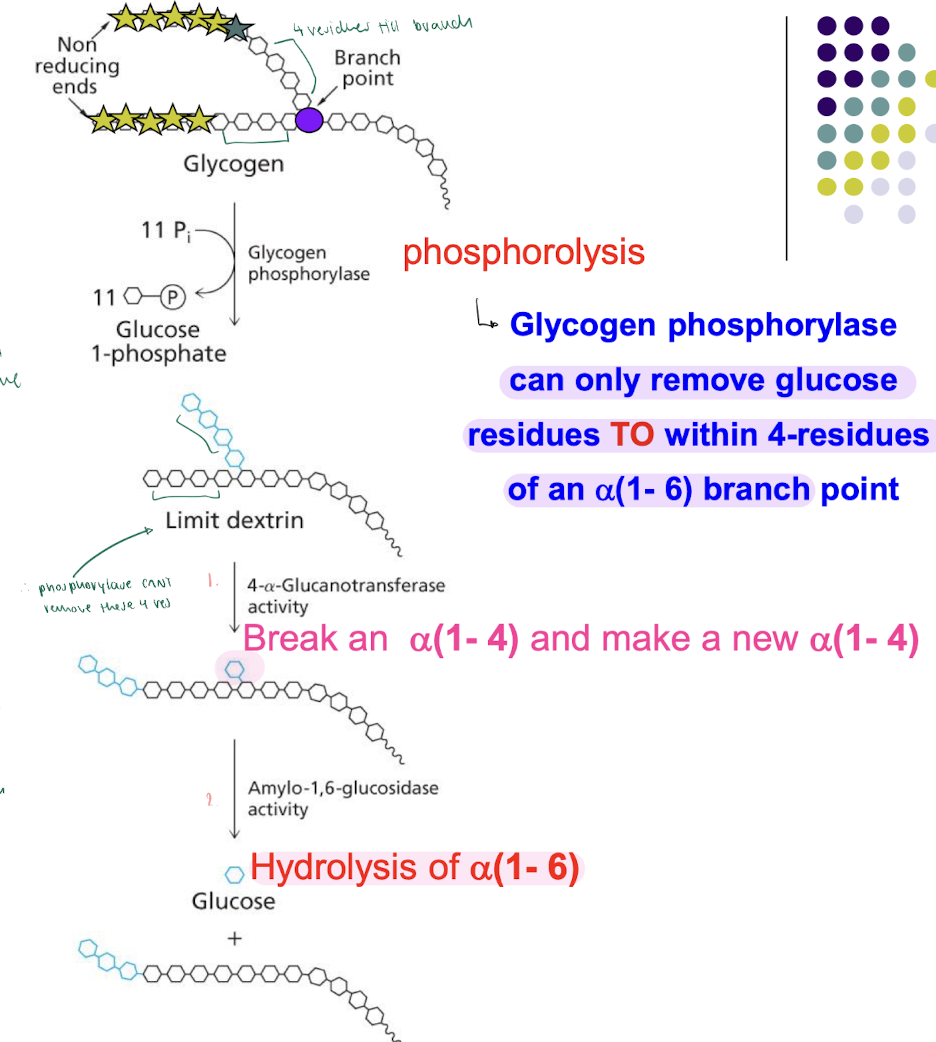
Glycogen Phosphorylase = catalyzes the phosphorolysis of the α(1→4) glycosidic bonds
uses phosphorolysis (breaks bond with Pi)
using Pi to break glycogen is advantageous bc it saves an ATP, thus its important when hypoxic bc that ATP can be used for muscle contraction
removes glucose residues from the non-reducing end & can only remove them till within 4 residues of an α(1→6) branch point
IRREVERSIBLE
main enzyme in glycogenolysis

note: if an exam mentions “phosphorylase” its talking abt glycogen phosphorylase
Glycogen debranching enzyme =
uses hydrolysis instead bc it cant use phosphorylase since theres NO PM transporter for phosphorylated sugar
2 activities:
glucotransferase activity, where it breaks an α(1→4) bond of the branch & forms an α(1→4) bond on main chain
gluosidase activity, where it uses H2O to break an α(1→6) bond → removing a branch point
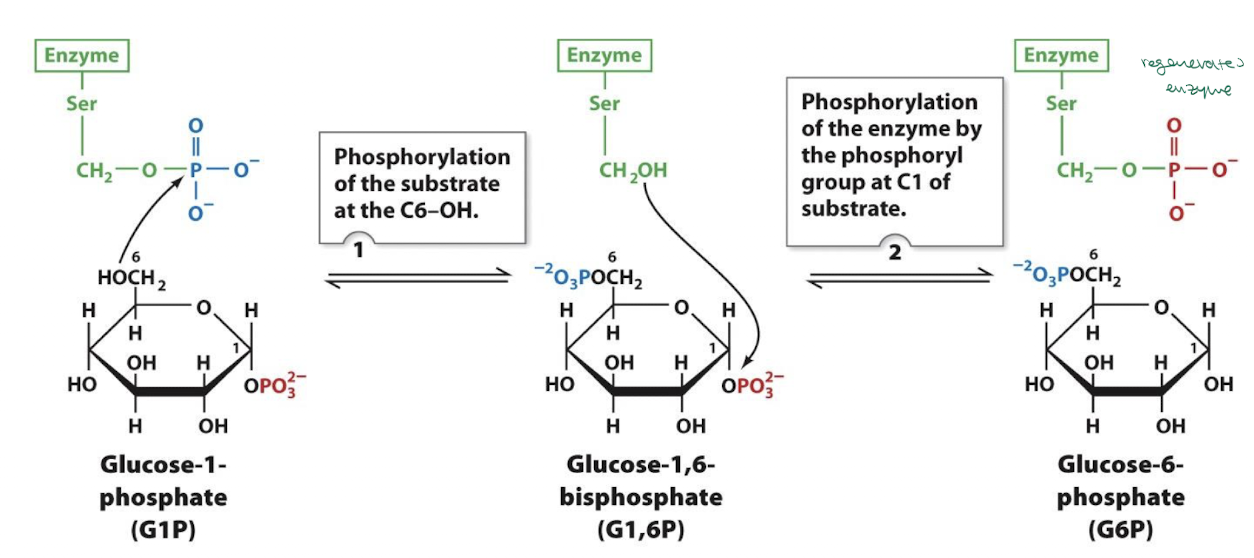
Phosphoglucomutase = converts G1P to G6P as the final rxn in glycogenolysis
catalyzes a reversible rxn
the enzyme phosphorylates C6 on G1P & dephosphorylates c1 of G1,6P to form G6P
G6P produced is used in:
muscle cells for glycolysis → energy
liver cells for the PPP or gluconeogenesis (need both for answer)
Glycogenolysis: The Breakdown of Glycogen - process
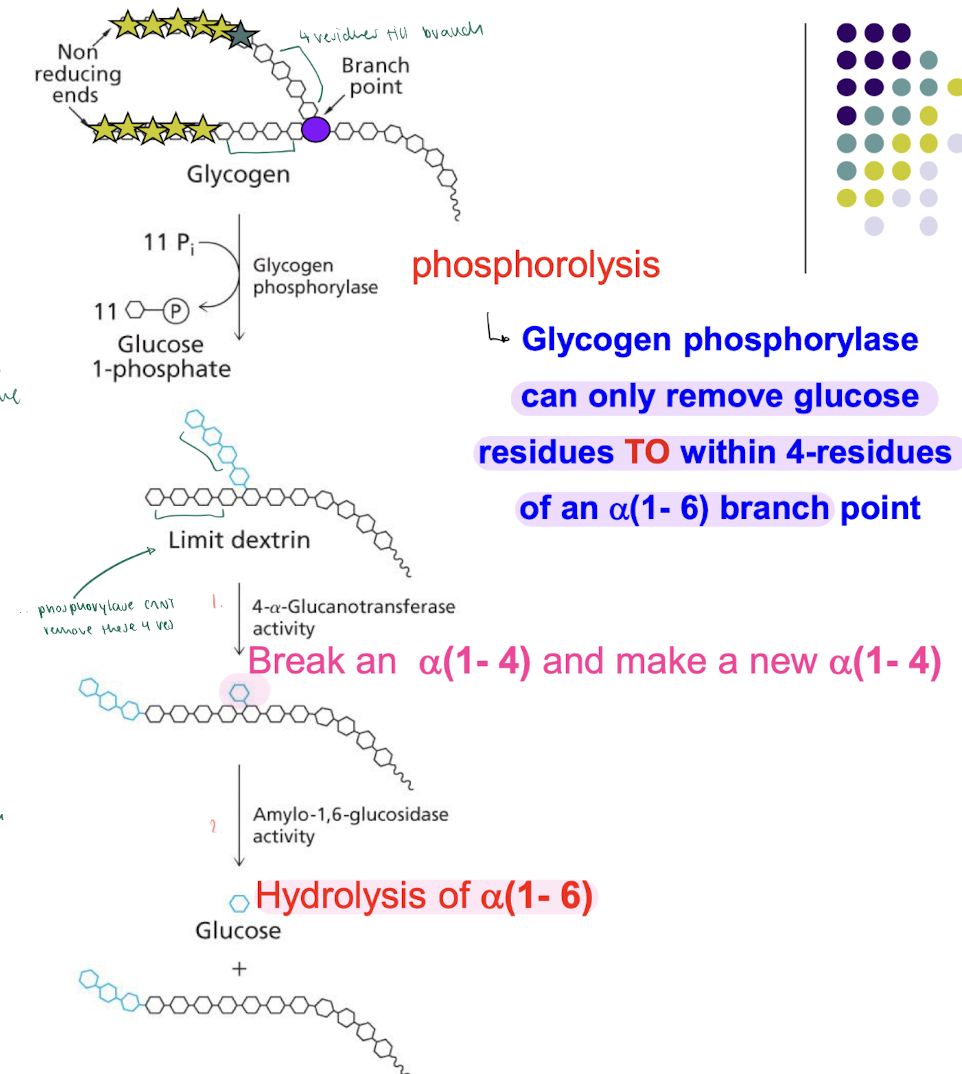
glycogen phosphorylase uses Pi to break α(1→4) bonds, removing glucose residues from the non-reducing ends (up to 4 residues of a branch point)
uses Pi (phosphorolysis) + produces G1P
glycogen debranching enzyme’s glucotransferase activity breaks an α(1→4) bond of branch & makes a new α(1→4) bond at non-reducing end of main chain
glycogen debranching enzyme’s glucosidase activity uses hydrolysis to break an α(1→6) branch point
→ now the phosphorylase can fxn again bc the branch point is removed (no longer limited up to 4 residues of that branch point)
phosphoglucomutase converts the G1P produced into G6P
in liver: G6P is used in the PPP or gluconeo
in muscle: G6P is used in glycolysis for energy
note: in this rxn the enzyme is dephoshorylated then rephosphorylated

How does glycogen phosphorylase vs. Glycogen debranching enzyme’s glucosidase activity differ in breaking glycosidic bonds?
Glycogen phosphorylase uses phosphorolysis (Pi) to break α(1→4) bonds in glycogen
advantage of using Pi: saves an ATP, thus its important when hypoxic bc that ATP can be used for muscle contraction

Glycogen debranching enzyme’s glucosidase activity uses hydrolysis (H2O) to break an α(1→6) bond for a branch point
when starch or glycogen is broken down in the GIT it must use hydrolysis bc it cant use a phosphorylase since there ISNT a PM transporter for phosphorylated sugar
by removing this branch point, the phosphorylase can continue to fxn as its no longer limited up to 4 residues of the brach point removed

Glycogenolysis: Substrate-transport Model in Liver & Kidney cells
Substrate-transport Model = 3 transporters in the lumen & 1 transporter in the PM for converting G6P to glucose that enters the blood stream
purpose: glycogen is broken down to G6P in the cytosol (via 3 enzymes of glycogenolysis) that then enters the ER lumen via T1, allowing G6Pase to generate free glucose in the liver & kidney
process of G6P from cytosol entering the blood stream as glucose:
G6P from glycogenolysis in the cytosol enters the ER lumen via G6P transporter (T1)
G6Pase’s active site in lumen converts G6P → glucose + Pi
glucose 6-phosphatatse (G6Pase) is kept in the ER membrane w its active site in the lumen to bind G6P
Glucose exits the ER lumen into the cytosol via T2 & then passes thru the PM via GLUT2 into the bloodstream
Pi exits the ER lumen into the cytosol via T3

→ therefore, G6P produced in cytosol of liver/kidney must enter the ER lumen via T1 to be converted by G6Pase into glucose, which then re-enters the cytosol via T2 before it passes thru the plasma membrane via GLUT2 into the bloodstream
this DOESNT occur in skeletal muscle, bc muscle cells DONT express the G6Pase enzyme → thus G6P remains inside muscle cells and is used for energy instead of being used for blood glucose levels
Glycogen Synthesis
glycogen is composed of glucose units that are added in multiple steps:
glucose is converted by HK/GK into G6P using ATP
G6P is then converted by phsophoglucomutase into G1P
G1P is converted to UDP-glucose by UDP-glucose pyrophosphorylase → added to glycogen chain
process breaks a P-O-P, then forms a P-O-P
rxn is pulled fwd by hydrolyzing the PPi produced


→ 2 major sources of G6P for glycogen synthesis:
ingested glucose
gluconeogenesis from lactate, NOT AA’s
→ another source of G1P for glycogen synthesis is from galactose:
uses UDP-glucose to get galactose into glycolysis
process:
galactose is converted by galactokinase into galactose-1-P + UDP-glucose using ATP
transferase converts them into:
UDP-galactose → epimerase converts it back into UDP-glucose to continue
G1P → UDP-glucose added to glycogen by UDP-glucose pryophosphorylase for glycogen synthesis

Reasons for adding a Nucleotide to a sugar: Suitability of sugar nucleotides (UDP-glucose) for biosynthetic reactions
reasons:
formation is irreversible, thus it contributes to the irreversibility of pathways where they’re intermediates
the nucleotide moiety undergoes non-covalent interactions with the enzyme, thus it contributes to the catalytic activity
its a good leaving group (UDP is a better leaving group bc its releases more energy)
tagging some hexoses with a nucleotide group sets them aside for certain pathways
ex. tagging them for glycogen synthesis
Glycogen Synthesis: Formation of UDP-glucose from G1P and UTP
→ UTP for the formation of this sugar nucleotide (UDP-glucose) is regenerated using NDK
requires ATP to reform UTP from UDP

Glycogen Synthesis: role of Glycogen Synthase
note: this occurs once UDP-glucose is formed from the previous rxns
Glycogen Synthase = catalyzes ONLY the formation of α(1→4) glycosidic bonds
attaches c1 of UDP-glucose to c4 of the non-reducing end of glycogen to add another residue
HAS to occur at non-reducing end & can only add glucose to a chain that is 4+ residues long
once UDP-glucose is used, we have to regenerate UTP using NDK to reform UDP-glucose from G1P and UTP
→ glycogen synthase is the main regulatory enzyme of glycogen synthesis & catalyzes the 1st unique step of glycogen synthesis
the other enzymes (GK/HK, phosphoglucomutase, UDP-glucose pyrophosphorylase & inorganic pyrophosphatase) are all involved in other pathways, thus not unique

Glycogen Synthesis: role of Glycogen Branching Enzyme
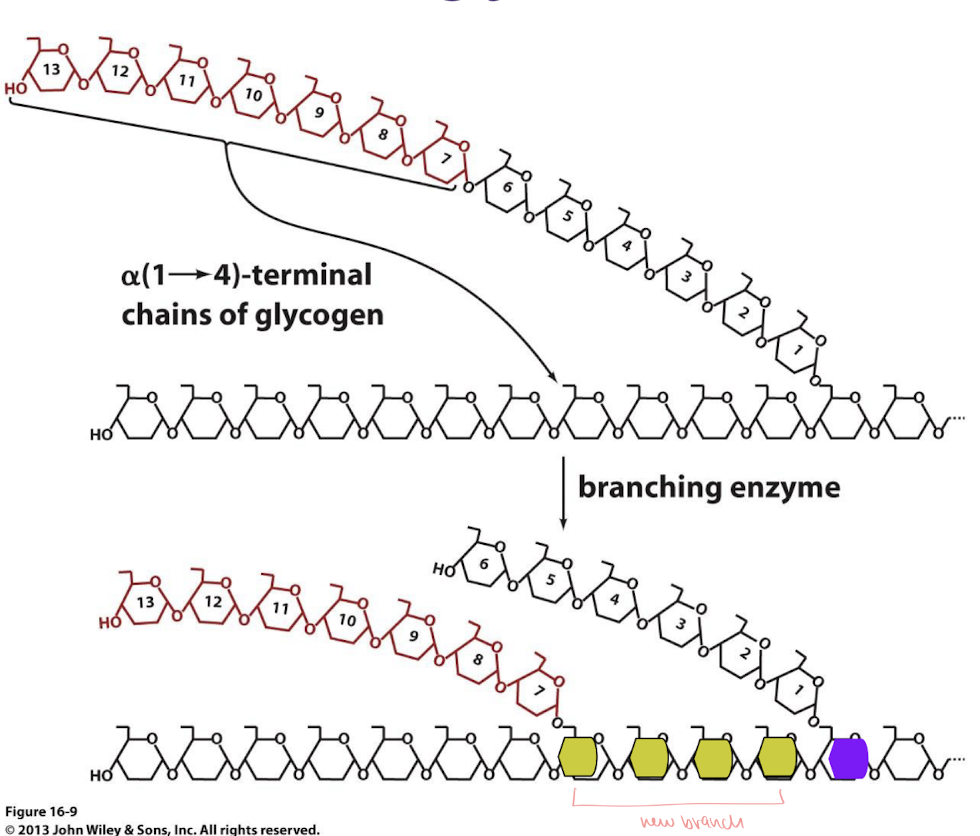
Glycogen Branching Enzyme = creates α-1,6 glycosidic branches by breaking an α(1→4) bond to create another α(1→6) glycosidic branch
moves chains of 7-8 residues to form a new branch
results in an additional non-reducing end after forming a new branch

Functions of branching:
creates more non-reducing ends that are accessible for synthesis & degradation
makes it more soluble & compact
reduces osmotic pressure: stores less water with glucoses linked in glycogen than if each glucose was stored individually (1g of glycogen is stored w approx 3g of water)
Rules for branching:
move 6-8 resides to form a new branch
when creating a new branch, they must come from a chain of 10+ residues bc at least 4 residues must be left behind
must have 4+ residues separating branches
Glycogen Synthesis: Role of Glycogenin
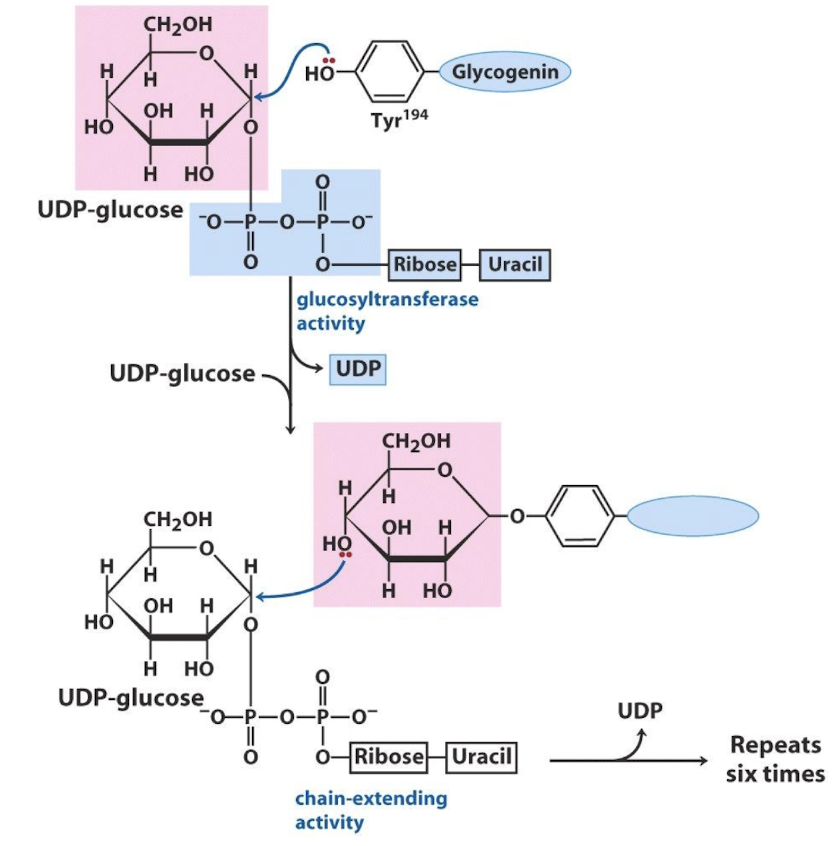
Glycogenin = primes the initial sugar residues in glycogen to form the glycogen chain by catalyzing the transfer of glucose from UDP-glucose to its own Tyr residue
this initial transfer of glucose onto glycogenin occurs 6-7 times where the non-reducing end’s -OH attaches to UDP-glucose’s c1
after this occurs 6-7 times, glycogen synthase & branching enzyme come in to form a longer glycogen chain with branches
Structure of Mature Glycogen
mature glycogen particles have 12 tiers of branches:
~2 branches per tier & ~13 residues per branch
outer tier is unbranched
steric hindrance stops the glycogen particles from growing w/o a limit
Glycosome= each glycogen granule and its associated enzymes
Q. what is the net number of NTP molecules used in the synthesis of glycogen starting from glucose?
glucose → glycogen
glucose + ATP -HK/GK→ G6P + ADP
G6P -phsophoglucomutase→ G1P
G1P + UTP -UDP-glucose pyrophosphorylase→ UDP-glucose + PPi → 2Pi
energy released from PPi → 2Pi pulls first rxn fwd
UDP-glucose + glycogen (n) -glycogen synthase→ UDP + glycogen (n+1)
regenerating UTP : UDP + ATP → UTP + ADP
THUS:
gross # of NTP used: 3
net # of NTP used: 3 - UTP generated = 2
Glycogen Synthesis vs. Glycogen Breakdown
→ the synthesis & breakdown of glycogen ARENT the reverse of one another, as they only share 1 enzyme: phosphoglucomutase (reversibly converts G6P ←→ G1P)
the separate pathways of glycogen synthesis & breakdown also much greater flexibility in terms of energetics & regulation
Breakdown of Glycogen:
debranching enzyme
glycogen phosphorylase (uses Pi): has 2 forms
phosphorylase a is MORE active
phosphorylase b is less active
phosphoglucomutase: G1P → G6P

Synthesis of Glycogen:
before 1: glucose → G6P via HK/GK
phosphoglucomutase: G6P → G1P
UDP-glucose pyrophosphorylase (uses UTP that must be regenerated using ATP)
PPi -inorganic pyrophosphatase→ 2 Pi pulls 1st rxn fwd
forms UDP-glucose
glycogen synthase (releases UDP)
forms α(1→4) bonds linking glucose residues
branching enzyme
forms α(1→6) bonds to create branches
Regulation of Glycogen Breakdown:
reminder: glycogen phosphorylase uses Pi to break α(1→4) bonds, removing glucose residues from the non-reducing ends (up to 4 residues of a branch point)
→ Glycogen phosphorylase is regulated allosterically & by covalent mod
phosphorylase has 2 forms:
phosphorylase a: more active when serine side chain is phosphorylated
see with high glucagon levels in the liver & high epinephrine, calcium, and AMP levels in muscle
phosphorylase b: less active when serine side chain is dephosphorylated
see with high insulin, G6P & Glucose levels
Regulation of glycogen phosphorylase
→ more ACTIVE when in its a-form bc phosphorylase b kinase is active
covalent modification: glucagon (in liver) & epinephrine (in muscle) phosphorylate PKA that then phosphorylates b kinase → activating glycogen phosphorylase a to increase glycogen breakdown
allosteric: signals inside muscle cells of high calcium and high AMP levels allosterically activate b kinase → activating glycogen phosphorylase a to increase glycogen breakdown

→ LESS active when in its b-form bc phosphorylase a phosphatase (PP1) is active
insulin (in liver & muscle) activates PP1 → making phosphorylase less active bc we want to store glycogen bc of high blood sugar
allosteric: G6P & glucose allosterically activate PP1 → making glycogen phosphorylase less active bc it signals that we want to store glycogen bc theres enough glucose
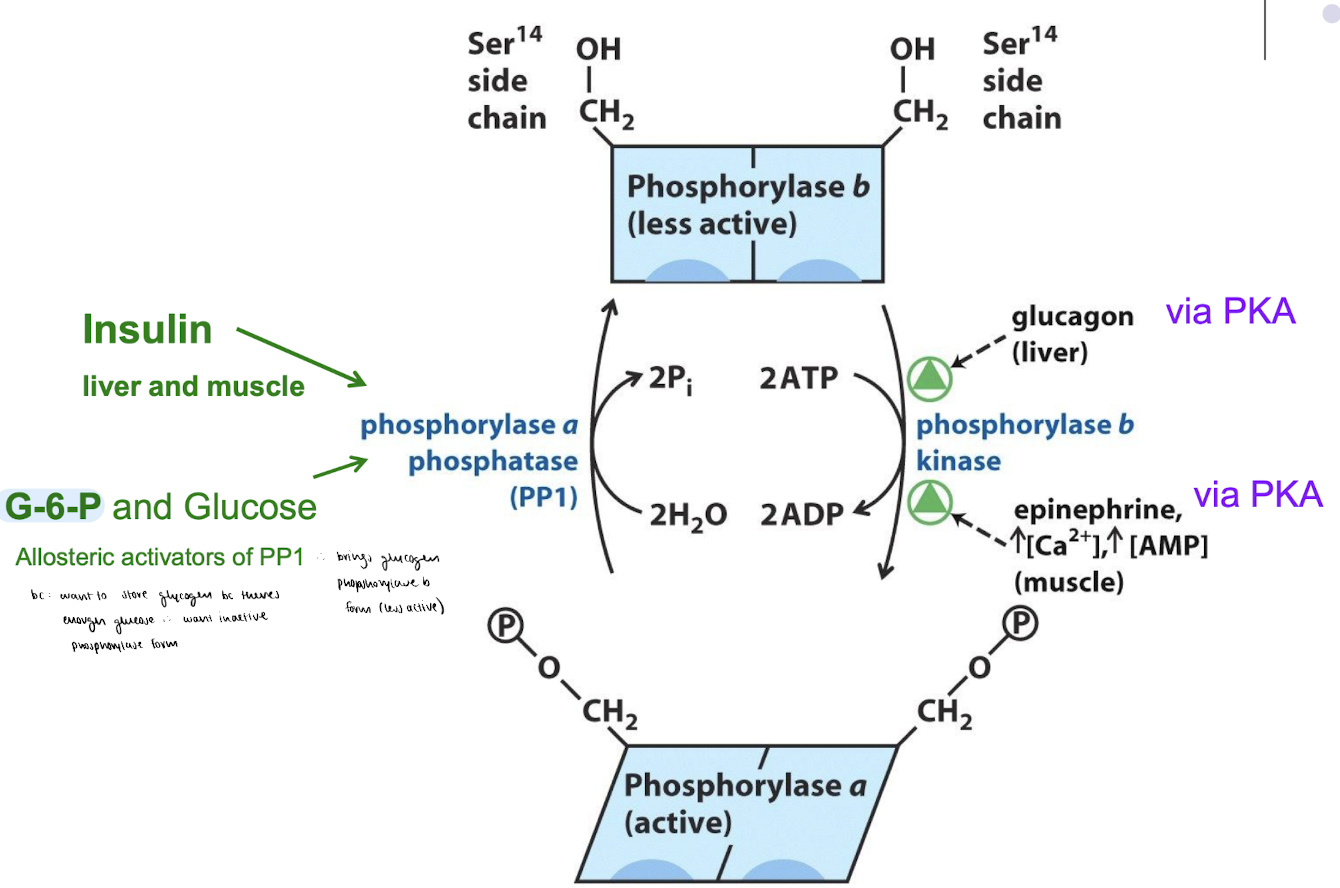
Enzymes involved in Glycogen phosphorylase activity
phosphorylase b kinase: uses 2 ATP to phosphorylate glycogen phosphorylase → forms phosphorylase a thats ACTIVE
THUS, more active glycogen breakdown to get glucose
activated by phosphorylation from PKA
deactivated by PP1 being active
Phosphorylase a phosphatase (PP1): uses 2 H2O to remove remove P from glycogen phosphorylase → forms phosphorylase b thats less active
also dephosphorylates b kinase → keeping b kinase less active & glycogen phosphorylase less active → less glycogen breakdown
Regulation of Glycogen Breakdown: Effect of Epinephrine (muscle) or glucagon (liver) on Glycogen Phosphorylase
both signals result in the phosphorylation of PKA that then phosphorylates b kinase → forming glycogen phosphorylase a form to increase glycogen breakdown
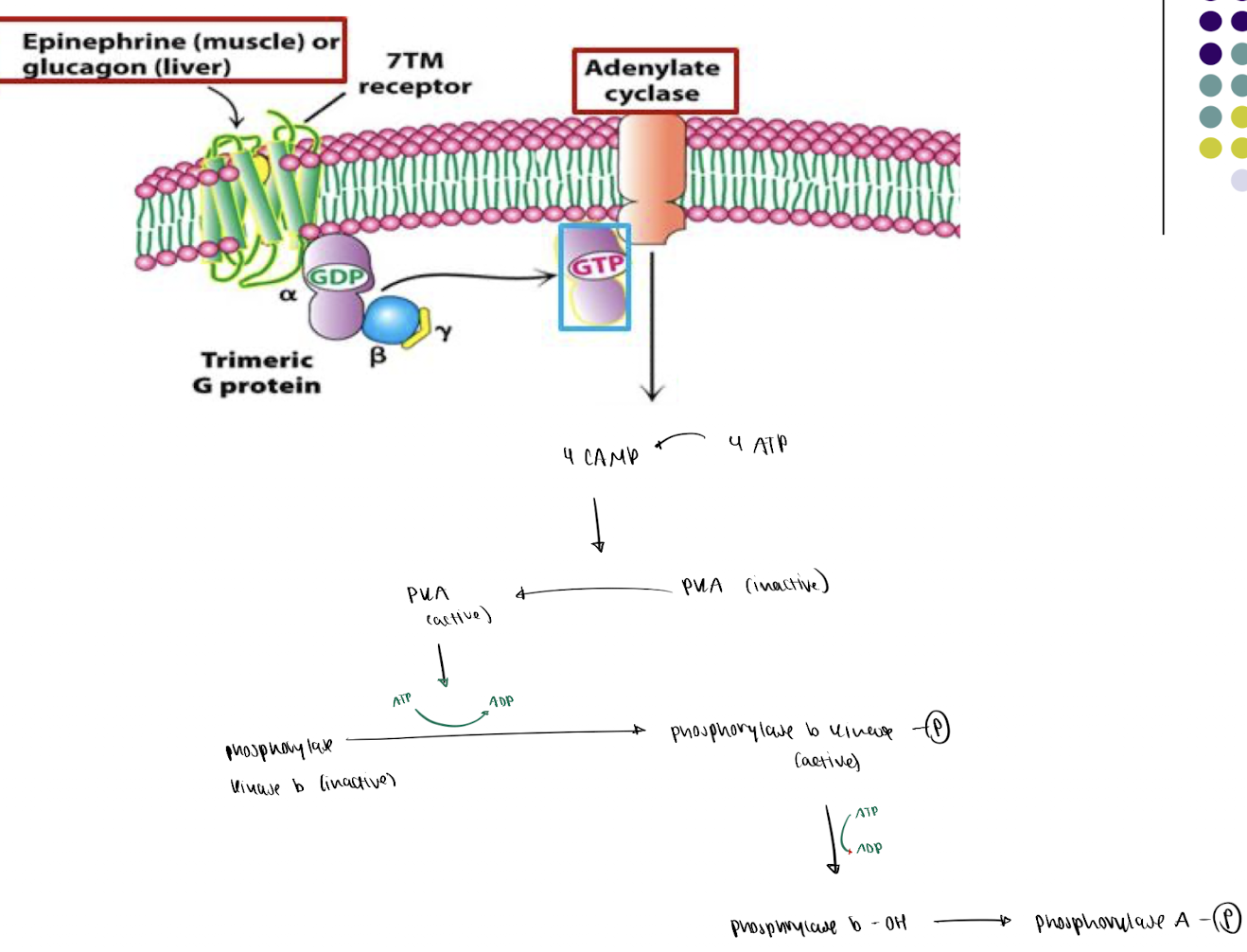
signal cascade:
epinephrine (muscle) or glucagon (liver) signal binds to trimeric G protein receptor → GDP to GTP
α-subunit dissociates with GTP attached and activates adenylate cyclase
AC converts 4 ATP → 4 cAMP
4 cAMP activate PKA
PKA uses ATP to phosphorylate & activate phosphorylase b kinase
active phosphorylase b kinase uses ATP to phosphorylate the b form of glycogen phosphorylase (inactive) → phosphorylase a (active)
more active breakdown of glycogen
Q. PP1 also dephosphorylates phosphorylase b kinase. What effect will this have on glycogen phosphorylase?
phosphorylase b kinase is used, when active & phosphorylated, to phosphorylate glycogen phosphorylase from its b form to more active a form using 2 ATP
THUS, when phosphorylase b kinase is dephosphorylated by PP1 its kept in its less active form → keeping glycogen phosphorylase in its less active dephos. form

Regulation of Glycogen Breakdown: Differences in Allosteric regulation of Glycogen Phosphorylase in Liver vs Muscle
Phosphorylase a: less sensitive to allosteric effectors
glucose acts as an allosteric inhibitor of phosphorylase a especially in the liver → prevents glycogen breakdown as theres enough glucose by activating PP1 to form phosphorylase b instead
Phosphorylase b: more sensitive to allosteric effectors
thus when dephos. you’re more sensitive to allosteric regulation
Isozyme of Glycogen phosphorylase found in muscle is MORE sensitive than in the liver bc the muscle stores glycogen for itself:
in resting cells: ATP & G6P inhibit phosphorylase (don’t need glycogen breakdown)
in cells that needs energy: AMP in an allosteric activator of phosphorylase (want to breakdown glycogen)
muscle phosphorylase b is MOST sensitive to AMP - activates b kinase to form phosphorylase a to breakdown glycogen
liver phosphorylase b is INSENSITIVE to AMP, bc the liver doesn’t care abt its own energy levels it only cares abt other tissues shown through blood glucose levels - thus glycogen breakdown ISNT activated by low energy levels (AMP) in the liver bc its glycogen stores are for other tissues

Regulation of Glycogen Breakdown: Role of Glycogen Phosphorylase in the Liver
reminder: glycogen phosphorylase uses Pi to break α(1→4) bonds, removing glucose residues from the non-reducing ends (up to 4 residues of a branch point)
used when we need glucose
→ glycogen phosphorylase in the liver acts as a glucose sensor & allows us to conserve glycogen if other glucose sources are available
when glucose is present & binds to phosphorylase a’s allosteric sites it signals that we don’t need glycogen broken down → insulin activates PP1 to form the less active phosphorylase b form
process:
Phosphorylase a with empty allosteric sites: R state & MOST active
buildup of glucose
Phosphorylase a with glucose bound in allosteric cites: T state & less active form of phosphorylase a
insulin activates PP1 → form phosphorylase b + release 2 Pi
Phosphorylase b (dephos) w glucose bound: T state & the LEAST active form

Regulation of Glycogen Breakdown: Glycogen Phosphorylase Conversion vs. Transition
conversion b/w phosphorylase’s b (dephos) ←→ a (phos) is COVALENT
via phosphorylation/dephos
transition b/w T ←→ R state is ALLOSTERIC
each phosphorylase form has a T & R state via allostery
phosphorylase kinase & phosphatase are most active when phosphorylase a/b are in their T-states
ex. phosphorylase a’s T-state (less active) is easier to dephosphorylate to b form then when its in its R state (very active)
a form: more active glycogen breakdown
R state: very active
T state: less active
b form: less active glycogen breakdown
R state: active
T state: inactive

Definitions of enzymes involved in Glycogen Breakdown
Phosphorylase - breaks a bond by attack of Pi (phosphorolysis)
Kinase = transfers phosphate onto a substrate, usually from ATP as a donor (phosphorylation)
Phosphatase = removes phosphate by hydrolysis of phosphoester bond
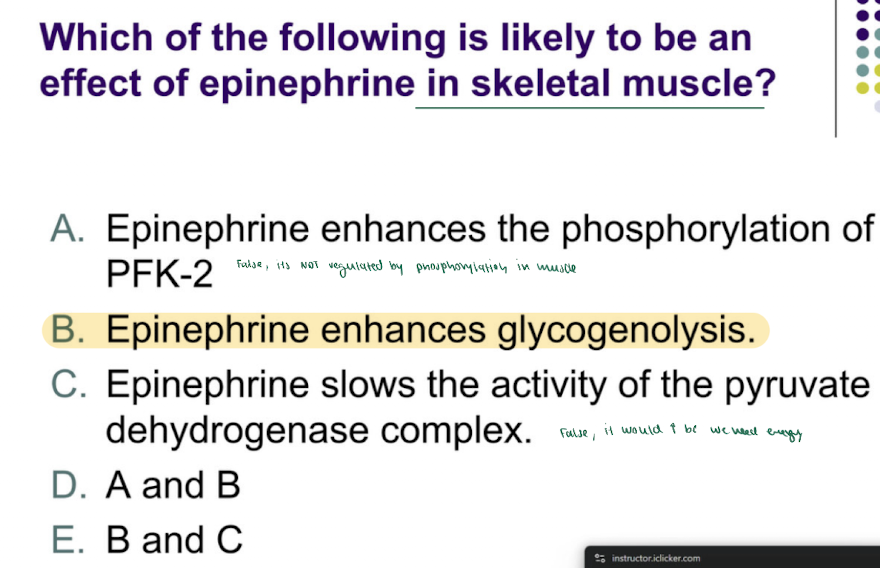
Q. which of the following is likely to be an effect of epinephrine in skeletal muscle?
a. epinephrine enhances the phosphorylation of PFK-2
b. epinephrine enhances glycogenolysis
c. epinephrine slows the activity of the pyruvate dehydrogenase complex
d. A and B
e. B and C
Answer: B, epinephrine activates phosphorylase b kinase in muscle cells resulting in the phosphorylation of glycogen phosphorylase (forms phosphorylase a) that makes glycogen breakdown more active (uses Pi to break α(1→4) bonds)
epinephrine DOESNT enhance the phosphorylation of PFK-2 in skeletal muscle, as its NOT regulated by phosphorylation in muscle
epinephrine INCREASES the activity of the PDC bc it signals we need energy
Regulation of Glycogen Synthesis: Control of Glycogen Synthase
Glycogen synthase = tetramer with 9 Ser resides on each subunit that can be phosphorylated
Glycogen synthase b (INACTIVE): phosphorylated by phosphorylase b kinase
glucagon signal activates PKA → PKA phosphorylates and activates b kinase → kinase uses ATP to phosphorylate glycogen synthase, deactivating it
PKA directly phosphorylates glycogen synthase → deactivated
AMPK phosphorylates glycogen synthase → deactivated
Glycogen synthase a (ACTIVE): dephosphorylated by PP1
insulin activates PP1 → PP1 dephosphorylates glycogen synthase, activating it
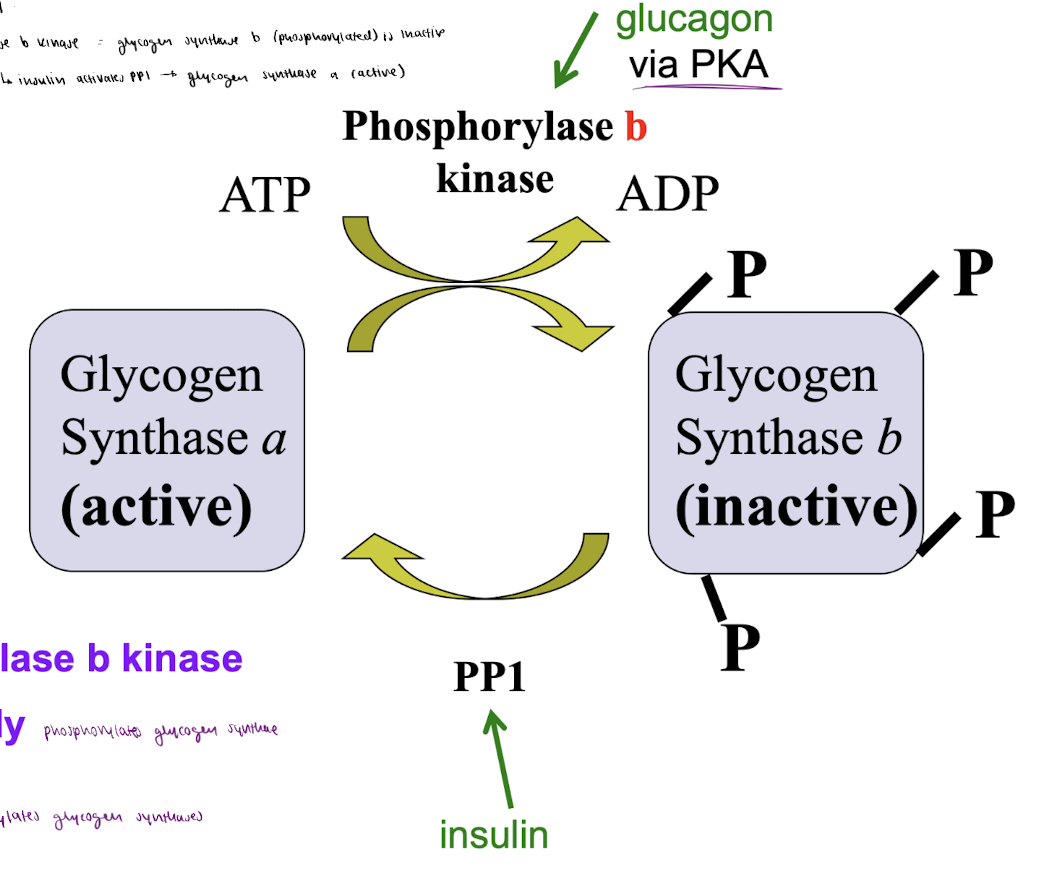
Glycogen Synthesis & Degradation are RECIPROCALLY Regulated
→ reciprocal regulation of glycogen synthesis & degradation
Glycogen synthesis occurs when: synthase a is sped up & phosphorylase b is slowed via dephos
G6P activates PP1 → PP1 dephosphorylates synthase a & phosphorylase b → glycogen synthesis is sped up
Glycogen Degradation/breakdown occurs when: phosphorylase a is sped up & synthase b is slowed via phosphorylation
phosphorylase b kinase uses ATP to phosphorylate both synthase b (slowed) & phosphorylase a (sped up)
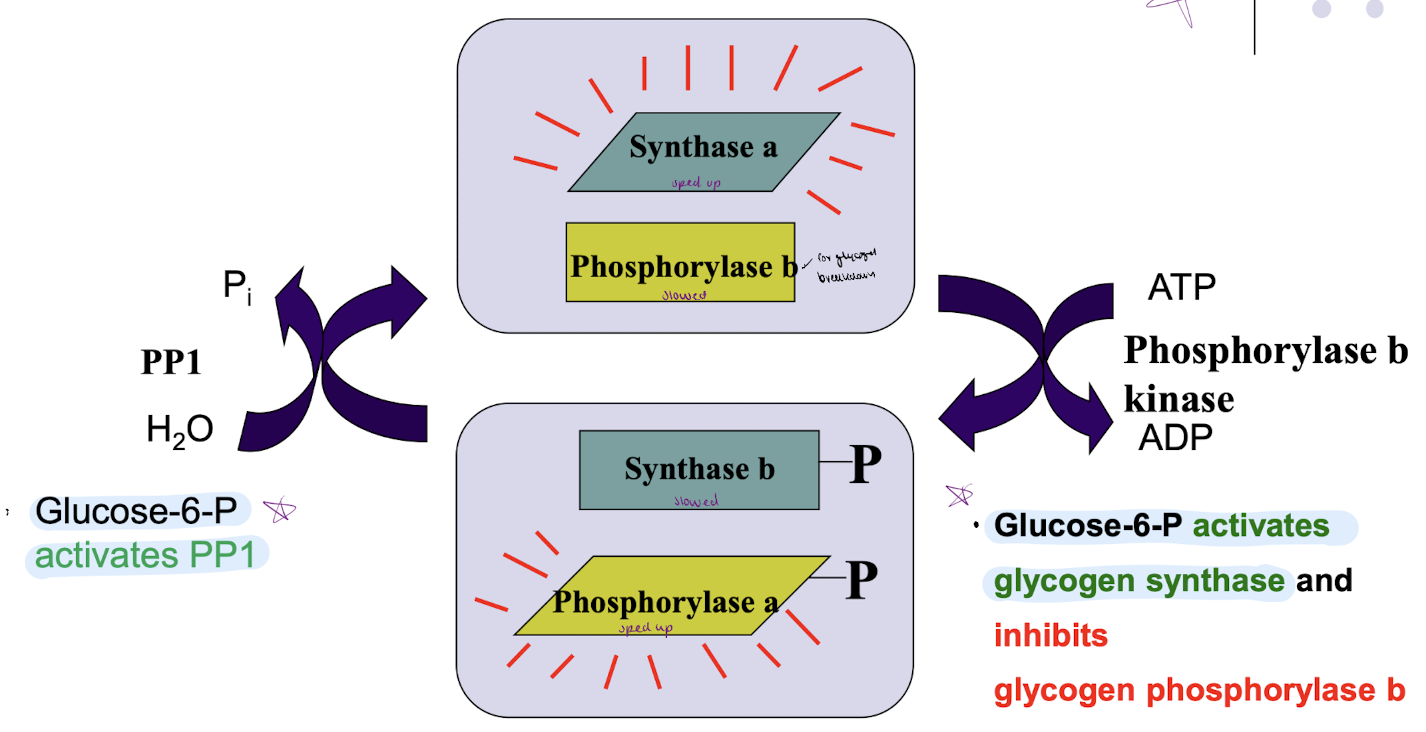
role of G6P in glycogen synthesis & degradation: high levels of G6P push cell twds storing glycogen, as G6P activates PP1 resulting in the activation of glycogen synthase, while inhibiting glycogen phosphorylase b
Regulation of Carbohydrate Metabolism in Hepatocytes (liver cells)
Liver cells with HIGH blood glucose:
→ high blood glucose increases insulin & GLUT2 allows more glucose into liver cells:
Effect on glycogen breakdown: insulin increases PP1 → decreasing phosphorylase b kinase, thus decreasing glycogen phosphorylase as its not phosphorylated → resulting in DECREASED glycogen breakdown
Effect on glycogen synthesis:
insulin increases PP1 → increasing glycogen synthase (active bc dephos) → INCREASES glycogen synthesis
GLUT2 allows more glucose into liver cells → increasing [glucose] inside cells → INCREASES glycogen synthesis
Effect on Glycolysis:
insulin increases the synthesis of GK, PFK-1 & PK (enzymes in glycolysis) → increasing glycolysis
GLUT2 allows more glucose into liver cells → increasing [glucose] inside liver cells → increased glycolysis
overall:
decreases glycogen breakdown & increases glycogen synthesis
increases F-2,6-BP levels (via PFK-2) → increases glycolysis
decreases gluconeogenesis

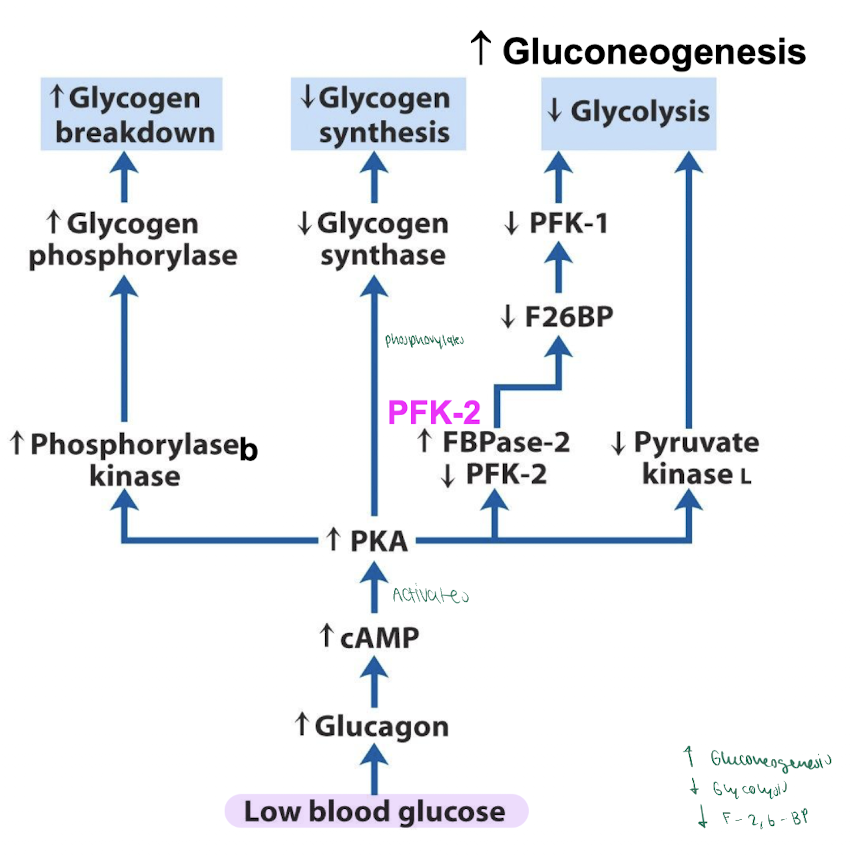
Liver cells with LOW blood glucose:
→ low blood glucose increases glucagon resulting in increased cAMP that activate PKA
Effect on Glycogen breakdown: high PKA activates phosphorylase b kinase → activates glycogen phsophorylase a → INCREASED glycogen breakdown
Effect on Glycogen synthesis: high PKA phosphorylates synthase b → SLOWS glycogen synthesis
Effect on glycolysis:
high PKA → decreases PFK-2 & increases FBPase-2 → creasing F26BP → decreasing PFK-1 → DECREASED glycolysis
high PKA → decreases PK-L → decreased glycolysis
Effect on Gluconeogensis: INCREASED gluconeogensis
overall:
increases glycogen breakdown & decreases glycogen synthesis
decreases F-2,6-BP levels (via decreased PFK-2) → decreased glycolysis
increases gluconeogensis
Von Gierke Disease
Von Gierke Disease = G6Pase deficiency in liver cells
Effect on blood glucose: low blood glucose would occur (hypoglycemia)
G6P cant be hydrolyzed to free glucose by G6Pase in ER lumen to enter bloodstream as glucose (substrate-transport model), thus its trapped in liver cell
Effect on glycogen metabolism in liver: results in buildup of G6P, which activates glycogen synthase & PP1, while inhibiting glycogen phosphorylase b → enhanced glycogen synthesis & decreased glycogen breakdown
note: deficiency in G6Pase is known as glycogen storage disease type 1a
3 other protein deficiencies are associated with this storage disease:
G6P transporter (T1) - as its allows G6P from cytosol to enter ER lumen to be covered by G6Pase to glucose
Glucose transporter (T2) - as it allows the G6P converted by G6Pase in the ER lumen to re-enter the cytosol
Pi transporter (T3) - as it allows the Pi formed by G6Pase in ER lumen to enter the cytosol

Q. the enzyme glycogen phosphorylase:
a. catalyzes a cleavage of beta(1→4) bonds
b. catalyzes a hydrolytic cleavage of alpha(1→4) bonds
c. is a substrate for a kinase
d. uses glucose 6-phosphate as a substrate
e. uses glucose as a substrate
Glycogen phosphorylase
substrates: glycogen & Pi
products: glycogen (n-1 residues) & G1P
→ catalyzes a phosphoryltic cleavage of alpha(1→4) bonds, NOT hydrolytic or beta(1→4) bonds
answer: c, glycogen phosphorylase is a substrate for phosphorylase b kinase that uses 2 ATP to phosphorylate glycogen phosphorylase forming its active a-form

Q. Which of the following statements regarding glycogen metabolism is false?
a. in muscle, glycogen synthesis is activated by Ca2+ ions
b. glycogen phosphorylase is activated via phosphorylation
c. glucagon stimulates glycogenolysis
d. A and B
e. B and C
answer: A, in muscle glycogen BREAKDOWN is activated by Ca2+ ions
bc Ca2+ in muscle allosterically activates phosphorylase b kinase that activates glycogen phosphorylase’s active a form
glycogen phosphorylase is activated via phosphorylation by phosphorylase b kinase
glucagon does stimulate glycogenolysis (breakdown of glycogen), as it activates PKA that phosphorylates phosphorylase b kinase → phosphorylating glycogen phosphorylase & activating it to increase glycogen breakdown when we need glucose (signalled by glucagon)
Q. is the energy required to synthesize glycogen from G6P greater than the energy obtained when glycogen is degraded to G6P? explain
→ Yes, the energy required to synthesize glycogen starting from glucose-6-phosphate (G6P) is greater than the energy obtained when glycogen is degraded back into G6P.
why: theres a net cost of 1 UTP consumed per glucose residue added when starting from G6P (or 2 ATP equivalents if starting from free glucose, where the initial HK step costs 1 ATP)
whereas degradation of glycogen results in a net gain: 0 ATP consumed/produced during the breakdown to G6P.
Note: If G6P is converted to free glucose in the liver via G6Pase for export, or if G6P enters glycolysis, it yields net ATP later, but the immediate cleavage step itself yields no energetic input
Synthesis (Glycogenesis from G6P):
G6P → G1P: Catalyzed by phosphoglucomutase (near-equilibrium) & no net ATP/GTP consumed or gained.
G1P + UTP → UDP-glucose + PPi: Catalyzed by UDP-glucose pyrophosphorylase.
The subsequent hydrolysis of pyrophosphate PPi → 2Pi by inorganic pyrophosphatase pulls this reaction fwd, effectively consuming 1 high-energy nucleoside triphosphate equivalent (UTP, equivalent to 1 ATP).
UDP-glucose + Glycogen (n) → Glycogen (n+1) + UDP: Catalyzed by glycogen synthase.
UDP + ATP → UTP + ADP: Nucleoside diphosphate kinase uses 1 ATP to recycle the UDP back into UTP.
Degradation (Glycogenolysis to G6P):
Glycogen (n+1) + Pi → Glycogen (n) + G1P: Catalyzed by glycogen phosphorylase via phosphorolysis.
Because the glycosidic bond is cleaved by Pi rather than water, the glucose unit leaves already phosphorylated as G1P without consuming any ATP.
G1P → G6P: Catalyzed by phosphoglucomutase (reversible, no energy consumed or produced).
Q. which of the following molecules will generate the largest amount of ATP (or equivalents) if aerobically catabolized to CO2 and H2O in hepatocytes?
a. PEP
b. lactate
c. 3-phosphoglycerate
d. Acetyl-CoA
e. 1,3-BPG
in liver cells, thus must consider that the malate-aspartate shuttle will be used so cytosolic NADH produced will be 2.5 ATP → THUS lactate generates more ATP in liver
note: if this was in muscle cells it would be 1,3-BPG that generates the largest amount of ATP bc of the glycerol-3-phosphate shuttle system

why:
1,3-BPG (14.5 ATP): Generates 2 direct ATP in glycolysis (via phosphoglycerate kinase & pyruvate kinase) + 0 cytosolic NADH. Once it becomes pyruvate, mitochondrial oxidation yields 12.5 ATP (4 NADH + 1 FADH₂ + 1 GTP). Total = 14.5 ATP.
Lactate (15 ATP): Generates 0 direct ATP in glycolysis, but LDH produces 1 cytosolic NADH when converting lactate to pyruvate.
In Hepatocytes (Malate-Aspartate Shuttle): That cytosolic NADH is worth 2.5 ATP.
Adding the 12.5 ATP from pyruvate oxidation gives 15 ATP (beating 1,3-BPG's 14.5 ATP).
In Skeletal Muscle (Glycerol-3-Phosphate Shuttle): That cytosolic NADH is only worth 1.5 ATP (bc electrons are passed to FAD/Complex II).
Adding the 12.5 ATP from pyruvate gives 14 ATP, meaning 1,3-BPG (14.5 ATP) wins in muscle!

