Chapter 1: A view of Life
 Call Kai
 Learn
 Practice Test
 Spaced Repetition
 Match
 Flashcards
 Knowt Play
1/29

Earn XP
Description and Tags
LIU EENG304
30 Terms
What is evolution?
Processes by which populations change
overtime.
What does evolution depend on?
Evolution depends on the transmission of genetic information from one generation to another.
What are the three basic themes of biology?
Evolution
Information transfer
Energy for life.
What does evolutionary theory help us understand about organisms?
How millions of species came to be, and understand the structure, function, behaviour, and relationships of organisms.
In what ways is genetic information transferred?
Genetic information is transferred:
• Within cells
• Within organisms
• Among organisms
• From one generation to another
What is the primary source of energy for life on Earth?
The sun
How is energy transferred within ecosystems?
from producers to consumers
What is the function of the plasma membrane in a cell?
surrounds and protects the cell, and separates it from the external environment.
What role does DNA play in the cell?
• Transmits information from one
generation to the next
• Contains 4 types of nucleotides
• Makes up genes
• Codes for proteins
What are organelles and what do they do?
Organelles are internal structures within the cell that carry out specialised functions.
What are prokaryotic cells and what are their key features?
Prokaryotic cells are single-celled organisms like bacteria and archaea (harsh environment), and lack membrane-bound organelles. These cells do not have a nucleus.
What are eukaryotic cells and what are their key features?
Eukaryotic cells have organelles enclosed by membranes and a nucleus that contains DNA.
Characteristics of life are:
Growth and development
Self regulated metabolism
Response to stimuli
Reproduction
Growth and development
• Biological growth– Increases size and/or number of cells.
• Development– Changes that take place during an organism’s lifetime.
Self regulated metabolism
• Metabolism– All the chemical activities of the organism.
• Homeostasis– Homeostatic mechanisms regulate and balance the internal environment.
Response to stimuli
Stimuli– Physical or chemical changes in the internal or external environment– Cause the organism to respond
Reproduction
• Asexual reproduction (binary fission)– Low genetic variability
• Sexual reproduction– High genetic variability
Biological organization is
hierarchical and includes
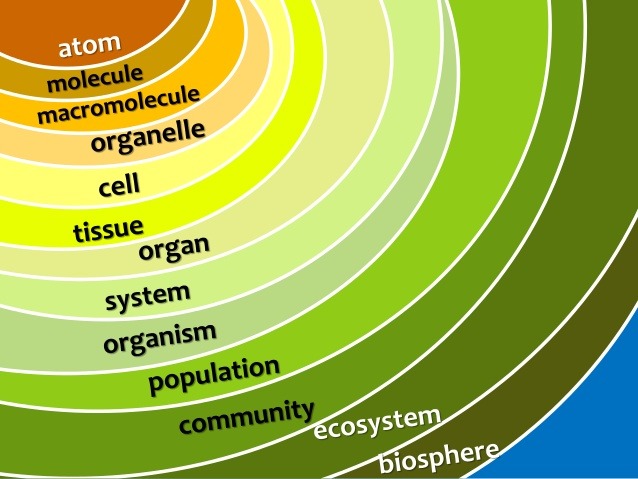
How is information transferred through the body?
DNA
Chemical and electrical signals:
– Proteins
– Hormones
– Cell signalling
– Neurotransmitters
Autotrophs
Producers,
- Make their own food
- Transform light energy to chemical energy
through photosynthesis
Photosynthesis equation
CO2 + water + light → sugars + oxygen
Heterotrophs
Decomposers, break down wastes and dead organisms.
Consumers, use energy stored by producers through cellular respiration.
Note the heterotrophs cannot make their own food.
Cellular respiration equation
sugars + oxygen → CO2 + water + energy
How is ATP produced?
The breakdown of glucose in cells produces ATP.
The tree of life includes
three domains and six kingdoms.
Are viruses living organisms?
Nope
What are the 3 domains? the 6 kingdoms?
Domains: Bacteria, Archaea, Eukarya
Kingdoms: Bacteria, Archaea, Protista, fungi, plantea, animalia
What are Bacteria? Archaea?
Bacteria are simple unicellular organisms.
Archaea are simple unicellular organisms that live in extreme environments.
What are Protista? Fungi ?
Protista are unicellular but are more complex then Bacteria and Archaea.
Fungi are unicellular or multicellular and absorb food.
What are Plantea ? Animalia?
Plants are multicellular and make their own food.
Animals are multicellular and take in their food.