Cell Bio Test 2
 Call Kai
 Learn
 Practice Test
 Spaced Repetition
 Match
 Flashcards
 Knowt Play
1/146

There's no tags or description
Looks like no tags are added yet.
147 Terms
What is myogenesis
Skeletal muscle development
What are the steps for myogenesis
Mesodermal cells become muscle precursor cells.
These cells differentiate into myoblasts.
Myoblasts migrate to the areas where muscles will form.
Myoblasts fuse together to form long, multinucleated cells called myotubes.
Myotubes develop myofibrils and organized sarcomeres.
Myotubes mature into functional skeletal muscle fibers
What are myoblasts
Immature muscle cells that can divide and differentiate.
What are Myotubes:
Developing muscle cells formed by the fusion of myoblasts.
What are myofibers
Mature skeletal muscle cells.
What are myogenic regulatory factors
Transcription factors that control muscle differentiation, including MyoD and myogenin
What are satellite cells
Muscle stem cells responsible for muscle repair and regeneration.
What is the skeletal muscle organization from largest to smallest
Whole muscle: The entire muscle.
Fascicle: A bundle of muscle fibers.
Muscle fiber: One individual muscle cell. It contains multiple nuclei.
Myofibril: Long structures inside muscle fibers made of repeating sarcomeres.
Sarcomere: The functional contractile unit of muscle.
Myofilaments: Actin (thin) and myosin (thick) filaments.
What is a sarcomere
the basic functional unit of skeletal muscle contraction. It extends from one Z-disc to the next.
What is a z disc
Marks the boundaries of a sarcomere; anchors thin filaments
What is an A band
Contains the entire length of thick myosin filaments
What is an I band
Contains only thin actin filaments
What is the H zone
Contains only thick myosin filaments
What is the M line
Holds thick filaments in the center
What is titin
Helps stabilize myosin and provides elasticity
What happens during muscle contraction
The sliding filament theory explains muscle contraction.
Myosin heads attach to actin.
Myosin pulls actin toward the center of the sarcomere.
Thin filaments slide past thick filaments.
The sarcomere shortens.
What do the bands do during contraction
A band stays the same length.
I band gets shorter.
H zone gets shorter and may disappear.
Z-discs move closer together.
Actin and myosin filaments do NOT get shorter. They slide past each other.
What is excitation-contraction coupling
the process that connects an electrical signal in a muscle cell to the physical contraction of that muscle
What is the process of excitation-contraction coupling
A motor neuron sends an action potential toward the muscle fiber.
The motor neuron releases acetylcholine (ACh) into the neuromuscular junction.
ACh binds to receptors on the muscle cell membrane (sarcolemma).
This causes an action potential to travel along the sarcolemma.
The action potential travels down the T-tubules.
The signal activates voltage-sensitive proteins called DHPRs, which activate ryanodine receptors (RyRs) on the sarcoplasmic reticulum.
The sarcoplasmic reticulum (SR) releases stored calcium ions (Ca²⁺) into the cytoplasm.
Calcium binds to troponin on the thin filament.
Troponin changes shape, moving tropomyosin away from the myosin-binding sites on actin.
Myosin can now bind to actin, and contraction begins.
How do the muscles relax
Calcium is pumped back into the sarcoplasmic reticulum by SERCA pumps.
Calcium detaches from troponin.
Tropomyosin returns to blocking the myosin-binding sites.
Cross-bridge formation stops, and the muscle relaxes.
Why is ATP necessary for muscle contraction and relaxation
It provides energy for myosin movement and allows myosin to detach from actin.
What are the 7 steps of the cross bridge cycle
Exposure of binding sites: Calcium binds to troponin, moving tropomyosin and exposing binding sites on actin.
Cross-bridge formation: Myosin heads attach to actin.
Power stroke: Myosin pivots and pulls actin toward the center of the sarcomere. ADP and phosphate are released.
ATP binds: A new ATP molecule binds to the myosin head.
Detachment: Myosin releases actin because ATP binding lowers its affinity for actin.
ATP hydrolysis: ATP is broken down into ADP and phosphate, providing energy to recock the myosin head.
Cycle repeats: If calcium and ATP are available, myosin can attach again and continue pulling actin.
What are the 3 muscle types
skeletal
cardiac
smooth
What are the differences between the muscle tissues
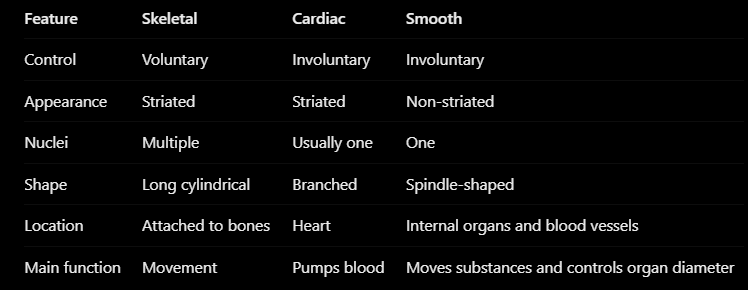
What are some functional adaptations of skeletal muscle
Produces voluntary movement.
Can generate powerful contractions.
Contains many mitochondria depending on fiber type.
Has satellite cells for repair.
What are some functional adaptations of cardiac muscle
Has intercalated discs that connect neighboring cells.
Contains gap junctions that allow electrical signals to spread.
Contracts rhythmically without conscious control.
Has many mitochondria to support continuous activity.
What are some functional adaptations of smooth muscle
Found in blood vessels, digestive tract, bladder, and other organs.
Can maintain contractions for long periods.
Does not contain organized sarcomeres.
Uses calcium-calmodulin to activate myosin light-chain kinase (MLCK), which regulates contraction.
What is pompe disease
a genetic lysosomal storage disease caused by a deficiency of the enzyme acid alpha-glucosidase (GAA)
What happens in Pompe disease
A mutation in the GAA gene causes reduced or absent enzyme activity.
Lysosomes cannot properly break down glycogen.
Glycogen accumulates inside lysosomes.
Lysosomes become enlarged.
Muscle cell structure and function become disrupted.
Patients develop progressive muscle weakness.
What are the symptoms of pompe disease
Muscle weakness.
Low muscle tone (hypotonia).
Breathing difficulties.
In severe infantile cases, enlarged heart (cardiomyopathy).
What are the many functions of epithelial tissue
Protection.
Absorption.
Secretion.
Filtration.
Diffusion.
Sensory reception.
What are the classifications by the number of layers of epithelial tissue
Simple epithelium: One cell layer; good for absorption, diffusion, and filtration.
Stratified epithelium: Multiple layers; primarily protection.
Pseudostratified epithelium: Appears multilayered, but every cell touches the basement membrane.
Transitional epithelium: Changes shape when stretched, such as in the urinary bladder.
What are cell junctions
connect cells to each other or to the extracellular matrix. They help maintain tissue structure and communication.
What are the 5 types of junctions
Tight junctions
Adherens junctions
Desmosomes
Gap junctions
Hemidesmosomes
How do you remember all the junctions
Tight = sealing.
Adherens = actin attachment.
Desmosomes = strong cell-to-cell attachment.
Gap = communication.
Hemidesmosomes = cell-to-basement-membrane attachment.
What is the function of connective tissue
supports, connects, protects, and binds other tissues.
What is loose connective tissue
Areolar: Supports and cushions organs.
Adipose: Stores fat, provides insulation, and cushions organs.
Reticular: Forms supportive frameworks in lymphoid organs.
What is dense connective tissue
Dense regular: Parallel collagen fibers; tendons and ligaments.
Dense irregular: Collagen fibers arranged in multiple directions; dermis.
Elastic: Contains abundant elastic fibers; large arteries
What are the supporting connective tissues
cartilage & bone
What is cartilage
Flexible support.
Hyaline cartilage: Joints, nose, trachea.
Elastic cartilage: External ear.
Fibrocartilage: Intervertebral discs.
What is fluid connective tissue
Blood: Transports gases, nutrients, and wastes.
Lymph: Returns tissue fluid to circulation and supports immune function.
What are the important cells with connective tissue
Fibroblasts: Produce fibers and extracellular matrix.
Adipocytes: Store fat.
Chondrocytes: Maintain cartilage.
Osteocytes: Maintain bone.
Macrophages: Engulf pathogens and debris.
What are the two main components of bone matrix
organic component
inorganic component
What is the organic component of the bone matrix
Primarily type I collagen.
Provides flexibility and tensile strength.
Helps bone resist stretching and pulling forces.
What is the inorganic component of the bone matrix
Mainly hydroxyapatite crystals.
Made primarily of calcium phosphate.
Provides hardness and compressive strength.
What are the three major bone cells
1. Osteoclasts – Break down bone
2. Osteoblasts – Build bone
3. Osteocytes – Maintain bone
What is bone remodeling
the continuous process of breaking down old bone and replacing it with new bone.
It is important for:
Maintaining bone strength.
Repairing microscopic damage.
Adjusting bone to mechanical stress.
Regulating blood calcium and phosphate levels.
How bone remodeling occurs
Activation: Osteoclast precursors are recruited and activated.
Resorption: Osteoclasts attach to bone and release acids and enzymes to break it down.
Reversal: Resorption stops, and the bone surface is prepared for new bone formation.
Formation: Osteoblasts deposit new osteoid.
Mineralization: Calcium and phosphate are deposited into the matrix, hardening the bone.
What is calcium homeostasis
Calcium homeostasis is the regulation of calcium concentration in the blood.
Calcium is necessary for:
Muscle contraction.
Nerve signaling.
Blood clotting.
Cell signaling.
Bone strength.
The body uses hormones to regulate blood calcium.
What happens when blood calcium is low
The parathyroid glands release parathyroid hormone (PTH).
PTH increases blood calcium through three main mechanisms:
Bone
Kidneys
Intestines
How does PTH work in the bone
PTH acts on osteoblast-lineage cells.
These cells increase RANKL signaling.
RANKL stimulates osteoclast formation and activity.
Osteoclasts break down bone, releasing calcium into the blood.
How does PTH work in the kidneys
Increase calcium reabsorption, meaning less calcium is lost in urine.
Increase phosphate excretion.
Stimulate production of active vitamin D (calcitriol).
How does PTH work in the intestines
PTH indirectly increases calcium absorption by stimulating active vitamin D production.
Calcitriol increases calcium absorption from food in the intestines.
The result: Blood calcium increases toward normal.
What happens when blood calcium is High
The thyroid gland releases calcitonin from its parafollicular (C) cells.
Calcitonin:
Inhibits osteoclast activity.
Decreases bone resorption.
Can promote calcium deposition in bone.
Helps lower blood calcium.
What is vitamin D’s role when blood calcium is high
Vitamin D is obtained from food or produced in the skin.
It is converted in the liver to 25-hydroxyvitamin D.
It is converted in the kidneys to active vitamin D (calcitriol).
Calcitriol increases intestinal absorption of calcium and phosphate.
What are primary cells
cells taken directly from an organism's tissue and grown in a laboratory.
What are the characteristics of primary cells
Closely resemble the cells in the original tissue.
Maintain many normal cellular functions.
Have a limited lifespan.
Usually undergo a limited number of cell divisions.
Can be more difficult and expensive to maintain.
What are established cell lines
cells that have acquired the ability to divide indefinitely or for an extended period.
What are the characteristics of established cell lines
Can divide for many generations.
Easier to maintain and reproduce.
Often grow faster than primary cells.
May have genetic mutations or abnormal chromosome numbers.
May not behave exactly like normal cells.
What are viral vectors
modified viruses used to deliver genetic material into cells.
How do viral vectors work
Scientists modify a virus to remove or disable genes responsible for causing disease.
A therapeutic or experimental gene is inserted into the viral vector.
The vector enters the target cell.
The genetic material is delivered into the cell.
The cell uses the delivered genetic instructions to produce a protein or alter gene expression.
What are some common viral vectors
Adenovirus
Delivers DNA, usually remains outside the host genome, often produces strong but temporary expression
Retrovirus
Can integrate genetic material into the host genome
What are advantages with viral vectors
Very effective at entering cells.
Can deliver genes to cells that are difficult to transfect.
Some vectors allow long-term gene expression.
What are disadvantages with viral vectors
Can trigger immune responses.
Some have limited DNA carrying capacity.
Integration into the genome can cause unintended mutations.
Production and safety testing can be complicated
What is transduction and transgene
Transduction: Delivery of genetic material into a cell using a viral vector.
Transgene: A gene introduced into a cell or organism
What is genome editing
involves making intentional changes to an organism's DNA to:
Remove a faulty gene.
Correct a mutation.
Insert a new gene.
Change gene expression.
What are the 2 natural DNA repair mechanisms
1. Non-homologous end joining (NHEJ)
2. Homology-directed repair (HDR)
What are the differences between NHEJ and HDR
NHEJ | HDR |
|---|---|
Joins broken DNA ends | Uses a DNA template |
More error-prone | Can be precise |
Can create gene knockouts | Can correct or replace DNA |
Does not require a repair template | Requires a homologous template |
What are programmable nucleases
enzymes that can be directed to specific DNA sequences to cut DNA.
The most familiar example is CRISPR-Cas9.
How does CRISPR work
Scientists design a guide RNA (gRNA) that matches the DNA sequence they want to target.
The guide RNA binds to the Cas9 protein.
The guide RNA directs Cas9 to the matching DNA sequence near a PAM sequence.
Cas9 cuts both strands of the DNA.
The cell repairs the DNA using NHEJ or HDR.
The repair process creates the desired genetic change.
What are the advantages of genome editing
Can target specific genes.
Can help correct disease-causing mutations.
Useful for studying gene function.
Can improve crops and potentially treat genetic disorders.
CRISPR is relatively easy to redesign for different targets.
What are the disadvantages of genome editing
Off-target effects can occur (cutting unintended DNA sequences).
DNA repair may produce unexpected changes.
Delivery into the correct cells can be difficult.
Some changes may have unknown long-term effects.
Ethical concerns exist, particularly with editing human embryos or germline cells.
How does cancer develop
when cells accumulate genetic and molecular changes that allow them to grow and divide uncontrollably.
What are the 2 major types of cancer related genes
Proto-oncogenes
2. Tumor suppressor genes
How do proto-oncogenes work
Normal genes that promote cell growth and division.
Become oncogenes when mutations or other changes cause excessive activity.
Can act like a gas pedal stuck down
How do tumor suppressor genes work
Normally slow cell division, repair DNA, or trigger apoptosis.
Cancer can develop when these genes lose their function.
Act like brakes on cell division.
What are the differences between benign and maligant tumors
Benign Malignant
Noncancerous Cancerous
Usually localized Can invade nearby tissue
Does not metastasize Can metastasize
Often grows slowly Can grow rapidly
What is metastasis
when cancer cells spread from the original tumor to distant parts of the body.
What is tumor heterogeneity
means that cells within the same tumor are genetically and behaviorally different from one another.
Not every cancer cell is identical.
What are some differences in cancer cells
Genetic mutations.
Growth rates.
Ability to invade surrounding tissue.
Ability to resist treatment.
Protein expression.
Metabolic activity.
What is intratumoral heterogeneity
Differences between cells within the same tumor.
What is intertumoral heterogeneity
Differences between tumors in different patients, even when they have the same cancer type.
What is spatial heterogeneity
Differences between different regions of a tumor.
What is temporal heterogeneity
changes in tumor cell populations over time.
What is clonal evolution
explains how cancer cell populations change over time.
A normal cell develops a mutation that gives it a growth advantage.
That cell divides and produces many genetically similar daughter cells (a clone).
Some daughter cells acquire additional mutations.
Different subclones develop within the tumor.
Some subclones gain advantages, such as faster growth or resistance to treatment.
These more successful clones become more common over time.
Why is tumor heterogeneity and clonal evolution
Tumor heterogeneity makes cancer difficult to treat.
For example:
A chemotherapy drug may kill most cancer cells.
A small group of resistant cells may survive.
These cells continue dividing.
The tumor grows back, but now contains a larger proportion of treatment-resistant cells.
What is the cancer classifications and origins
Cancer type | Origin |
|---|---|
Carcinoma | Epithelial tissue |
Sarcoma | Connective tissue, bone, muscle, or other mesenchymal tissue |
Leukemia | Blood-forming tissues |
Lymphoma | Lymphatic/immune system |
Melanoma | Melanocytes |
What is cancer grading
Grading describes how abnormal cancer cells look under a microscope and how differentiated they are.
Low grade: Cells look more like normal cells and are usually better differentiated.
High grade: Cells look very abnormal, are poorly differentiated, and often behave more aggressively.
What is cancer staging
Staging describes how far cancer has spread throughout the body.
A common system is TNM:
T (Tumor): Size and extent of the primary tumor.
N (Nodes): Whether cancer has spread to nearby lymph nodes.
M (Metastasis): Whether cancer has spread to distant organs.
What is the sustaining proliferative signaling hallmark
Cancer cells continuously send or receive growth signals.
What is the Evading growth suppressors hallmark
Cancer cells ignore signals that normally stop cell division.
What is the resisting cell death hallmark
Cancer cells avoid apoptosis.
What is the enabling replicative immortality hallmark
Cancer cells maintain telomeres, often through telomerase, allowing continued division.
What is the inducing angiogenesis hallmark
Cancer cells stimulate the formation of new blood vessels to obtain oxygen and nutrients.
What is the Activating invasion and metastasis hallmark
Cancer cells invade nearby tissue and spread to distant organs.
What is the Deregulating cellular energetics hallmark
Cancer cells alter their metabolism to support rapid growth.
What is the Avoiding immune destruction hallmark
Cancer cells evade or suppress the immune system.
What is the Genome instability and mutation hallmark
Cancer cells accumulate mutations that promote tumor development
What is the tumor promoting inflammation hallmark
Inflammatory cells and signals can support cancer growth and progression.
What are cancer stem cells (CSC)
small population of cells within some tumors that have the ability to self-renew and produce different types of cancer cells within the tumor.