NURS2602 Exam 2 Study
 Call Kai
 Learn
 Practice Test
 Spaced Repetition
 Match
 Flashcards
 Knowt Play
1/40

Earn XP
Description and Tags
lec = said in lecture/slide (self-made) ,, SG = on study guide
41 Terms
Pros vs cons of unionization in nursing (lec+SG)
Pros
Unions have collective power of all the nurses
Unionized hospitals have higher pay and higher paytime off. Nurse satisfaction higher. Low turnover rate.
Grief is less
RESEARCH SHOWS THAT unionized hospitals have better pt outcomes (ex lower… falls, pressure ulcer)
Cons
Bc Kaiser has a strong union, it is hard to get a permanent position. It is very hard to fire someone who is permanent.
What type of questions should you ask yourself when job seeking? (lec)
who am i? what type of work environment would i thrive in? What values does the facility have? (ex catholic hospital vs abortion) So consider the facility’s mission statement and philosophy
location. benefits (like if they will pay for your adv education). salary.
Nursing care model - case manager, total care, team based (see table 5.1)
(she emphasized knowing those 3, but the book does show 4 other models)
(lec)
***SHE SAID REVIEW THE TABLE FOR EXAM 2, i rewrote it in easier words to understand in my own table shown here
this table is also on the bottom of my google doc

Magnet hospitals. What is it? What are special features of magnet hospitals? (lec+SG)
Magnet hospital: the “golden standard” institution for nursing excellence, quality pt care, professional nursing practice.
Features that distinguish magnet hospital:
Low staff nurse turnover rate (meaning most nurses choose to stay at that hospital)
Nurses have high job satisfaction
Patient to nurse ratio is lower
Will often only hire BSN nurses
Usually unionized
Many have a new nurse residency program.
Excellent pt outcomes
Concerning scope of practice, what can nurses do and cannot do? (lec)
This was asked on the lec slide
Ch 5 in book just says this: Institutions and hospitals are giving nurses more responsibility for making policies/protocols. Employees are more involved now in decision making.
And just remember that everything nurses do should be within their scope


Healthcare agency classified by: length of stay (lec+SG)
outpatient, acute care, inpatient care, skilled nursing care, long-term care
outpatient (or ambulatory) care
anything that req <24 hrs of care
ex) office visit, urgent care, therapy
acute care
immediate, short term care for a severe injury, requiring strong monitoring/intervention to stabilize a pt’s condition
inpatient care
stay is up to a month
skilled nursing care
care for 30-90 days, helping pts with specific needs (functional, mental illness, chronic disease, rehab)
long-term care
permanent care for ppl who need help with ADLs

Healthcare agency classified by: private vs public (lec+SG)
Governmental = public
This is a local, county, state, or federal institution (including military and veteran facilities)
Proprietorship = private and profit making
Proprietary corporation: when stockholders own shares of a healthcare agency, therefore the agency is managed in the best interest of the stockholders
Sole proprietorship: an individual person or family owns/operates the agency, thus they are the ones who benefit

nonprofit healthcare agency (self made)
this is ran by religious and philanthropic groups and community orgs
acuity definition
how sick a person is //
measures the severity of a patient's illness and how urgently they need medical or nursing care
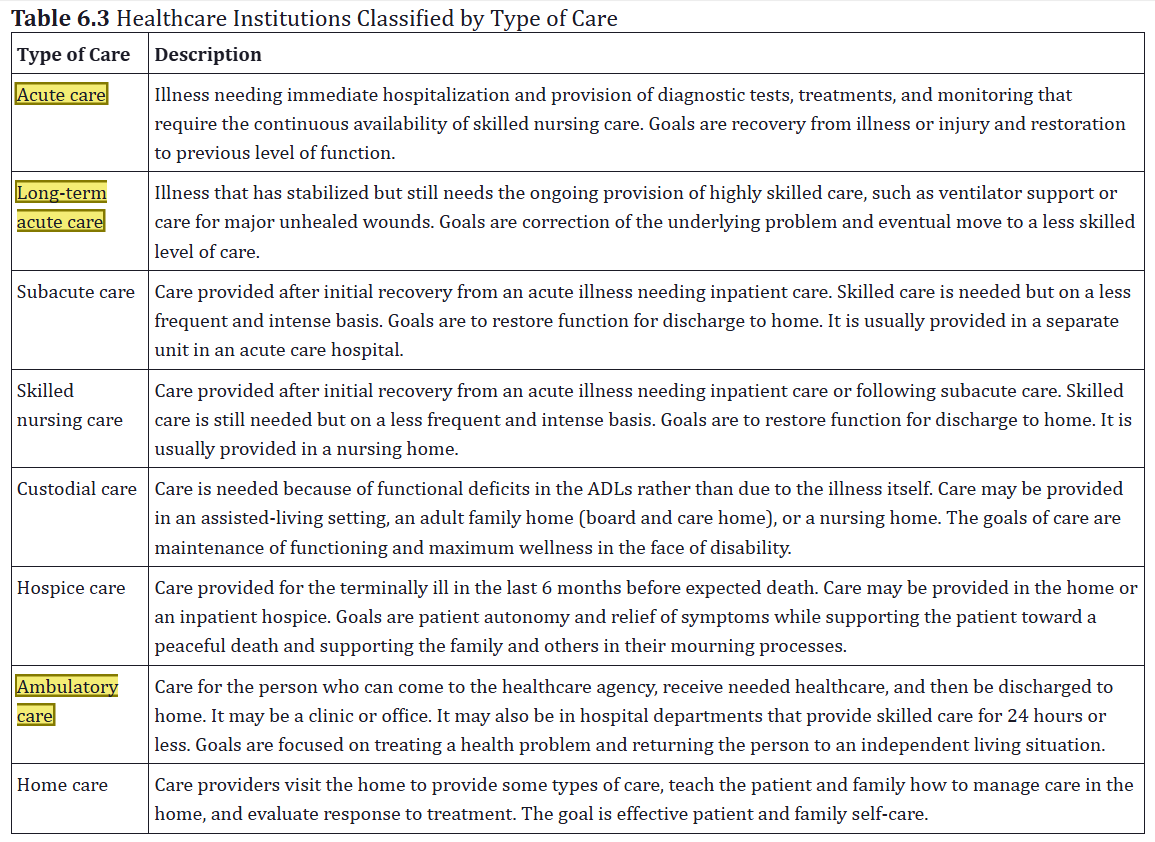
Healthcare agency classified by: patient acuity (lec+SG)
acute care, long-term care, ambulatory care, community
(her ppt emphasizes these 4 but the table in the book does have others)
acute care: need immediate care with a goal of illness recovery and restoration to previous level of functioning
long-term (acute) care: illness is stabilized but still needs care. think NURSING HOME
ambulatory care: a clinic or office where a person can come, receive healthcare, then be discharged to go home. goal is to treat problem and return to independent living in <24 hrs
community: best example of community nurse = SCHOOL NURSE
Describe the scope of practice for a nurse practitioner at school.
Nurse practitioner like at CSUSB for example can prescribe us medicine (ex lorazapan if we have bad text anxiety ONCE)
What are the diff health insurance plans? Contrast all of them.
Private, medicare (federal), medicaid (federal+state)
Private:
most insurance companies are private and profit-making companies.
the cost of these private plans has increased (idrk what else to know about this)
Medicare: for older adults (65+) / disabilities
federal
Medicaid: based on low income and financial need
federal AND state
money comes from federal, but each state gets to decide how to use it.
What 3 payment methods are used during healthcare? Contrast them and consider conflicts within each. (lec+SG)
Fee-for-service. Prospective. Capitation.
Fee-for-service: the insurance company will pay the provider for each service they give
a con is that private, for-profit hospitals can give us additional services, making it less affordable and inconvenient.
Prospective: the insurance company will pay the provider a set, predetermined amount based on the title of care/condition—same for every dx.
Ex) Insurance says that for pneumonia treatment, we’ll pay out the doctor $200. No matter what.
Situation A: The treatment will actually cost the doctor $100. So, they get to keep the spare $100 leftover to do whatever they want.
Situation B: The treatment actually costs $300. The $200 from insurance doesn’t cover everything, so the hospital has to pay the remaining $100 to make up the whole treatment cost.
Capitation: the insurance will pay the provider for each person signed up under their plan, whether or not that person uses any healthcare services.
A criticism of this situation is that the provider might try to make services as cheap as possible to avoid overshooting. Consider the ex where insurance pays the provider $500 per patient per month (no matter how many services that pt needs)
Situation A: A pt is in good condition therefore they only need $100 worth of care. This puts the provider in a good spot (they have a spare $400 for themselves)
Situation B: The pt’s treatment needs exactly $500. This means the insurance and provider break even.
Situation C: the pt needs extreme intervention, so their treatment will cost $800. This overshoots by $300, meaning the provider has to pay the $300 themselves. The provider may be cheap and instead want to save money, so they might delay or deny care services for their own financial interest. (This is bad for the pt)

Describe the relationship between length of pt stay and a hospital’s money.
The more a pt stays in hospital, the more money the hospital loses.
cost vs access vs quality (lec)
example) underserved populations cant afford medication. so they go to emergency department since u will be treated regardless of ur ability to pay
why would hospitals be incentivized to have good quality indicators? (self made)
medicare bases funding of hospital based on QUALITY INDICATORS
Define quality indicators and provide examples. (self made)
Quality indicator: a MEASURABLE outcome used to judge QUALITY of healthcare
Examples) infection rates, mortality, complications, safety events, or patient outcomes to evaluate how well it's performing
it is bad if pts get readmitted for the same diagnosis within the first __# hours post-discharge (lec)
72
self-reported outcomes (lec)
subjective pt response to how effective their provided care was
this relates to quality indicators
law vs policy (lec slide)
LAW
MUST be followed (legally enforced by gov authority)
Enforced with penalties for non-compliance
POLICY
Just a guideline for decision-making (NOT legally enforced)
HIPPA: Federal (LEC SLIDE, she emphasized this)
Protects pt personal info; privacy and confidentiality
Do not complain about pt in the hallway bc it will violate HIPPA. Others: elevator, hospital cafeteria, social media
Take clinical group photo only outside of hospital. NO INSIDE.
No pic with nurse/pt. No exchanging contact infos.
You can only share info about pts to those staff who are directly gonna work with that same pt (ex with ur relief nurse during break)
Nurse Practice Act (NPA): State (SLIDE, she emphasized this)
NPA: decides the nurses’ legal scope of practice
Are the following acts federal or state: HIPPA, NPA
HIPPA is a federal act (all states follow those rules)
Nurse Practice Act (NPA) is different for each state, meaning that each state has its own limits for their nurses’ legal scope of practice
Criminal law vs civil law, definitions (SLIDE, she emphasized this)
Criminal law
This concerns the welfare of the public
Judged by DISTRICT ATTORNEY (DA)
The DA can press charges of a crime against someone with criminal behavior
DA / govt prosecutes nurse for a crime
Civil law
This concerns conduct between private individuals or businesses
Anybody (family friends, or the PT ) can press charges for violation of civil law
Pt sues nurse for harm
example violations of criminal law in nursing
CRIMINAL LAW
distribution/use of opioids
altering controlled drug records, falsification
any nursing error that results in serious injury or death of a pt can be tried by criminal courts
Torts definition
Torts are under CIVIL LAW.
Tort: when one party harms another person, resulting in things like physical harm, psychological harm, harm to reputation.. Torts can be intentional (where the outcome was planned) or unintentional
intentional torts (describe assault, battery, false imprisonment, invasion of privacy, disclosure of info, defamation of character, misrepresentation and fraud, infliction of mental/emotional distress)
assault = (fighting) -threat
battery = also fighting - actual violence
false Imprisonment: restraining someone’s order for no good cause.
ex) like they keep using their call light so u lock them in a room faaarrr from the nursing station. or like if they request another trip to cafeteria, u think they ate too much, and then u break their wheelchair
invasion of privacy = (like if a celebrity is ur pt)
disclosure of information = (u should only provide vague info if ur not sure if a visitor is rlly related to pt)
• defamation of character = someone makes a false statement about u which damages ur reputation
• misrepresentation and fraud = (someone pretends they’re an NP and practices without any license. or if an RN uses their public trust to try selling a product simply for profit; this is outside of scope of practice so is misrep/fraud).
• infliction of mental/emotional distress
CONSIDER THAT torts may not be intentional if its done with intent to help pt safety
unintentional torts definition/general idea (2 categories)
1) Negligence: an unintentional tort where a caregiver fails to give responsible care, thus leading to harm
MOST COMMON CAUSE FOR NEGLIGENCE: nursing burnout due to pt workload (patient to nurse ratio)
2) Malpractice
– Harm
– Duty
– Breach of Duty
– Causation
These 4 criteria must be met to sue a nurse for malpractice.
What 4 criteria must be met to sue a nurse for malpractice?
– Harm: pt is injured.
– Duty: the nurse is someone responsible for that pt.
– Breach of Duty: the nurse failed to fulfill their duty of care.
– Causation: the harm is a result of the breach of duty.
NONexample) pressure injuries. vs…
Example) emiliano is pt. u suppsoed to give him 2mg every 2 hours. but u get assigned 4 heavy pts. so u accidentlaly give emiliano 20 mg every 2 hours. 3 DOSES. after the 3rd dose, emiliano is pale, nonresponsive. he died. so its malpractice.
Common Unintentional Torts
Medication errors
Falls
Failure to report significant changes in patient’s conditions (u need to report the changes and take them seriously if there is a sudden change like her example of sepsis)
Failure to follow provider’s prescription
Failure to follow established standard procedure
What actions to Do When Harm Occurred to Patient?
Patient SAFETY FIRST -> Report -> Document
Personal vs employer liability
To consider personal liability, we think
Was policy followed?
OR did we change policy for pt safety and make a judgment call instead
Employer liability…
Was there a staffing issue?
Can we blame systematic contributing factors (like adequate amount of bed alarms, medication placement) ?
autonomy (lec+SG)
we do NOT follow whatever pt wants; pts must have ADEQUATE INFO, be WELL INFORMED
We start with what the pt alr knows (not what we think is the right decision)
beneficence (lec+SG)
the intervention we provide to pt should be based on the BEST INTEREST of the pt.
our intervention must BENEFIT the pt
justice (lec+SG)
is about being fair, but this is a very grey area. there are sm criteria that can define “fair”
what 3 ethical concepts are most critical to nursing? (lec)
autonomy, beneficence, justice
ethical decision making (study guide) what questions should we ask ourselves / what process do we think through to make decisions?
What is the ethical problem?
Assessment: gathering data
What options do we have?
ex) can we transfer pt to another facility?
Outcomes and impact of those options
Make decision
Outcome evaluation
fidelity
being professional by keeping promises and fulfilling any committments
veracity
being honest / transparent
ex) if we do smth wrong like give wrong med, we should admit it
ex) u have cancer
who establishes nursing code of ethics? (she said we MUST KNOW)
ANA is the one who creates code of ethics, setting the standard for the nursing profession