Week 3 -Pre2: Cellular Respiration and Fermentation P1
 Call Kai
 Learn
Learn Practice Test
 Spaced Repetition
 Match
Match Flashcards
 Knowt Play
1/21

There's no tags or description
Looks like no tags are added yet.
Name | Mastery | Learn | Test | Matching | Spaced | Call with Kai | Chat |
|---|
No analytics yet
Send a link to your students to track their progress
22 Terms
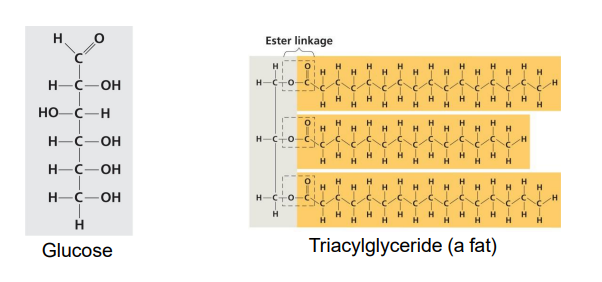
Does a gram of sugar or a gram of fat have more potential energy to be released through redox reactions?
Fats, as they are less oxidized (i.e., have more C-H bonds and fewer C-O bonds)


What process is this an overview of?
Cellular Respiration

What type of isomers are 3-phosphoglycerate and 2- phosphoglycerate?
structural isomers
Aerobic respiration:
consumes oxygen as a reactant
Anerobic respiration:
replaces oxygen with another inorganic molecule.
Oxidation
loss of electrons
Reduction
gain of electrons
LEO GER: loss of elections = ______; gain of elections = ______
Oxidation; reduction

Electron donor = ______________
Electron acceptor = _______________
reducing agent; oxidizing agent
Organic molecules with many C-H bonds are ______ sources of _____
good; energy
What are FADH2 and NADH
electron carriers
NAD+ (_______ Form)
oxidized
NADH (______ Form)
reduced
What is the goal of cellular respiration?
to fully oxidize glucose (take away all its electrons)

Dehydrogenases:
Redox reactions that form NADPH. Enzymes that transfer 2 electrons and a proton from an organic compound to NAD+ , producing NADH

Top: ______________ Bottom: _____________
becomes oxidized; becomes reduced
What is glycolysis?
breakdown of glucose into two molecules of pyruvate
Substrate-level phosphorylation:
direct way your cells make energy by the transferring a phosphate group from a molecule straight to ADP to make ATP.
What is the investment phase of glycolysis?
the investment phase of glycolysis is the initial stage where two ATP molecules are consumed to phosphorylate glucose.
what is the payoff phase in glycolysis
the stage in glycolysis where four ATP molecules are produced through substrate-level phosphorylation, resulting in a net gain of two ATP. (because two are needed to restart glycolysis) This phase ultimately converts into two molecules of pyruvate while also generating NADH.
This is the process of ? Glucose + 2 NAD+ + 2 ADP + 2 phosphate → 2 ATP + 2 NADH + 2 H+ + 2 H2O + 2 pyruvate
glycolysis, which breaks down glucose.