how are stereotypes perpetuated
 Call Kai
 Learn
 Practice Test
 Spaced Repetition
 Match
 Flashcards
 Knowt Play
1/28

There's no tags or description
Looks like no tags are added yet.
29 Terms
social categorisation definition
the process of assigning people to groups based on social categories e.g. age, gender, race, religion, nationality
define stereotypes
the collection of traits that society associates with a particular social group/widely shared generalisations about members of a social group
stereotypes
slow to change
generally change in response to wider social, political or economic changes
acquired at early age
become more pronounced and hostile when there is social tension and conflict between groups - extremely difficult to modify
not inaccurate or wrong - serve to make sense of particular intergroup relations
define prejudice
the term we use for a negative attitude held towards a social group or its members
define discrimination
refers to negative behaviours towards a person because of their group membership
the -isms
terminology for stereotyping/prejudice/discrimination
sexism
ableism
racism
ageism
accentuation principle
categorisation of stimuli produces a perceptual accentuation of intra-category similarities and inter-category differences on dimensions believed to be correlated with the categorisation
the accentuation effect is enhanced where the categorisation has importance, relevance or value to the participant
more pronounced when people are uncertain about the dimensions of a judgement
why do we categorise
in order to understand
because it is adaptive for survival - allows us to identify members of groups that are or are not allied with our own
ingroup vs outgroup
ingroup - groups with which an individual feels a sense of membership, belonging and identity
outgroup - groups with which an individual does not feel a sense of membership, belonging and identity
how are stereotypes formed?
social constructs learnt from parents, peers, media etc.
social explanations - stereotype content model (Fiske et al. 2002)
cognitive explanations - illusory correlation
the stereotype content model
argues that stereotype content reflects changes in society
the Princeton Trilogy Studies tracked stereotype change in Princeton students for 70 years - most ethnicity and nationality-based stereotypes have changed
stereotypes are classified along two key dimensions of warmth and competence
Warmth
about intent and linked to competition for resources
low competition → perceptions of positive intentions → high warmth stereotypes (friendly, trustworthy, honest, likable)
high competition → perceptions of negative intentions → low warmth stereotypes (unfriendly, devious etc.)
competence
about capability and is linked to the group’s status in society
high status → perceptions of high capability → high competence stereotypes (intelligent, skilled, efficient, assertive, confident)
low status → perceptions low capability → low competence stereotypes (e.g. unintelligent, weak)
illusory correlation
Hamilton and Gifford (1976) argued that when two ‘statistically infrequent’ events are paired, the correlation between the two is overestimated due to their distinctiveness → false illusory correlation

Hamilton & Gifford (1976) study
method
participants read statements describing behaviour of Group A and Group B, sampled from real world
Group B had less statements due to being a smaller group, but the same proportion of positive to negative behaviours (9:4)
participants were presented with the statements again and asked to indicate whether the behaviours were performed by Group A or B
prediction
Group B/neg behaviours should be most distinctive, should lead to participants overestimating the number of negative behaviours performed by group B
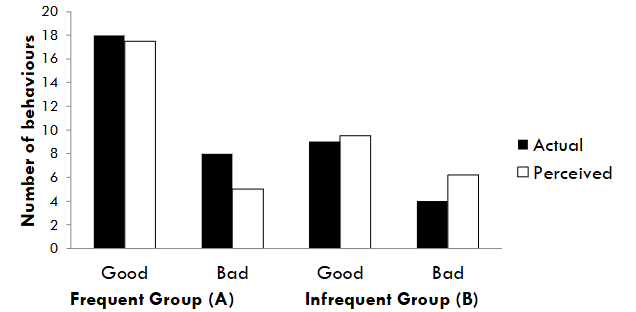
social and cog explanations for formation of stereotypes
stereotype activation
the degree to which a stereotype is accessible in the mind
stereotype application
the actual use of activated stereotypes in judgement e.g. forming an impression
measuring stereotype application
measures that assess whether someone uses stereotypes in judgements e.g. might ask a participant to form an impression of an outgroup member and then rate the degree to which they possess certain stereotypic traits
measuring stereotype activation
lexical decision task - a common measure of stereotype activation
why do people stereotype?
a device that simplifies information processing and reduces cognitive load - a mental short cut for streamlining social perception
Macrae et al. (1994)
method
dual task paradigm
cognitive resources are divided between two simultaneous tasks
if main task uses less cog resources, there is more left for the secondary task
study 1
participants were given names and personality traits and asked to form impressions of people while listening to an audio track
experimental condition - given category labels and could thus use stereotypes in impressions e.g. Julian, artist: temperamental
control conditions: not given category labels and thus couldn’t use stereotypes in impressions e.g. Julian: temperamental

why do people stereotype
stereotypes may serve a justification function
System Justification Theory (Jost and Banaji, 1994) argues that people want to believe that social systems are fair and legit.
stereotypes can help rationalise any inequality that exists
empirical evidence for why we stereotype and why they persist
biases in exposure to information
stereotypes may bias the information we seek, in a way that confirms the stereotype
Johnston & Macrae (1994)
method
impression formation task: participants were presented with a list of questions that they were told came from interviews with physics students
‘forced group’ - read all questions and answers
‘controlled group’ - select and read as many as needed to confidently form an impression of physics students
participants then rated stereotype consistent and stereotype inconsistent traits on how descriptive they were of the group
results
participants in ‘controlled’ condition chose to view more stereotype confirming than stereotype-disconfirming questions
participants in the ‘controlled’ condition rated the group of physics students higher on stereotypic traits than participants in the ‘forced’ condition
interpretation
people are more likely to seek out stereotype confirming information and this increases their endorsement of stereotypes which may be one reason why stereotypes persist
biases in interpretation of information
ultimate attribution error - Pettigrew 1979
negative/stereotypic behaviours are attributed to disposition
positive/counter-stereotypic behaviours are attributed to situation
what is stereotype threat
the concern experienced by a person when there is a possibility that they may act in a way consistent with negative stereotypes
consequences of stereotype threat
affects performance on stereotype-relevant tasks
can affect learning on stereotype-relevant activities and tasks and disengagement from the stereotyped domain
appropriate methods for evaluating effect of stereotype threat on performance in stereotyped domain + empirical evidence
application of stereotype threat to explain real world phenomena