Forest Ecology Exam 1
 Call Kai
 Learn
 Practice Test
 Spaced Repetition
 Match
 Flashcards
 Knowt Play
1/104

There's no tags or description
Looks like no tags are added yet.
105 Terms
What is forest ecology?
the study of complex interactions between living organisms and non-living environments within a forest ecosystem
How do trees affect the environment?
they clean air, regulate local temperatures, and store carbon dioxide
How does the environment affect trees?
it shapes tree survival, growth patterns, and affects tree health through physical, chemical, and environmental factors
How do canopies grow forests?
they capture sunlight, protect the understory, regulate moisture and temperature, and create healthy soils
3 ways clear-cutting is good for a forest ecosystem
provides sunlight for shade-intolerant species
creates early successional habitat for wildlife
controls disease and pest outbreaks
3 ways clear-cutting is bad for a forest ecosystem
causes soil erosion and water degradation
loss of biodiversity and habitat destruction
disruption of the carbon cycle
What is a forest?
a large area of land covered with dense growth of trees and understory vegetation
What kinds of effects did railroads have on forests in the 1800s?
massive deforestation, direct timber consumption, expansion of the logging industry, environmental and ecosystem degradation
Examples of environmental degradation due to railroad production
erosion of topsoil and organic matter, excessive heat, light, drying of soils, railroads created sparks, fires spread, left exposed mineral soil with little organic matter
How do our current forests reflect history?
geologic - bedrock and soils
climate - temperature and precipitation
humans - management
What distinguishes different forest types?
climate, temperature, precipitation, latitude, dominant tree species
What is the dominant forest type in our region of PA?
northern hardwoods and appalachian oak
Describe a few ways (ecologically and in terms of ownership patterns) that Eastern forests differ from Western forests. Why do ownership patterns matter?
western forests are characterized by massive amounts of public land such as National Parks under control of the federal government while eastern forests are made up of smaller pieces of private lands
Describe and explain some human impacts that you think have the greatest legacy on current forests, and why.
human impacts on forests leave footprints on our current forests such as their structure, biodiversity, and resilience
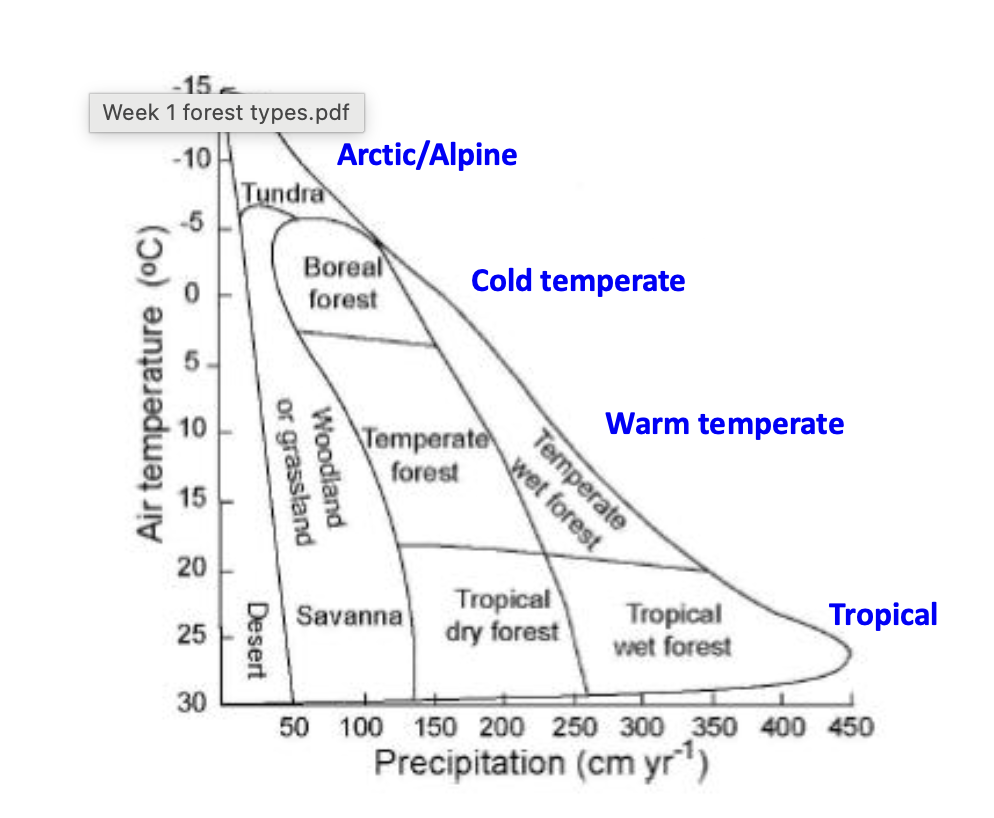
What is this image depicting?
the whittaker biome diagram which classifies global biomes based on average annual temperatures and precipitation
Woody
produce perennial tissue (wood/bark)
Herbaceous
no wood, soft and flexible green stems and die back in winter
Deciduous
tree or shrub that drops leaves for a portion of the year
Evergreen
keeps green leaves or needles all year long
Conifer
woody tree or shrub that produces cones and has needle-like leaves
Hardwood
tree or shrub that produces enclosed seeds and has a complex cellular structure with pores or vessels like oaks and maples
Softwood
a coniferous tree that produces seeds without a protective coating
Broadleaf
flowering plants that have flat leaves that produce seeds inside of fruits
Needle
coniferous trees with narrow, pointed needle-like leaves
Vegetation
consists of all plant species in a region and the way those species are spatially or temporally distirbuted
Formation
a vegetation type that extends over a large region characterized by the growth form of the dominant plant
Associations / Community Types
subdivision software associations of the collection of all plant populations coexisting in a given habitat
Globally, or at ecosystem scales, we classify forests based on…
climate or growth forms
Regionally, we classify forests based on…
dominant tree species or species assemblages

What is this image depicting?
altitudinal zonation of habitat types and forest structure
What is orogeny?
the process of mountain building driven by the convergence of tectonic plates
Topography affects the quantity of materials received and the movement of…
radiation/temperature
water
soil particles
soil nutrients
organic matter
Factors affecting radiation and temperature
latitude
seasonality
aspect
elevation
temperature inversions
slopes

What is this image depicting?
solar radiation and water retention across different slope angles and terrain aspects
Adiabatic Cooling
lowering of air temperatures through evaporation which absorbs heat without adding external thermal energy - lose 6C/1000 m
Temperature Inversions
a weather condition where a layer of warm air sits over a cooler layer near the ground
Why are valleys in PA colder at the bottom than at the top?
cold air pooling, rapid ground cooling, sinking cold air, temperature inversions
How do slopes affect material movement?
leaching of soils near ridge due to water movement
accumulation of water and nutrients downhill
coarser, rockier soils and shallow bedrock on ridges
finer soils and sediments accumulating in valleys creating a deeper organic layer

What is this image depicting?
physiographic gradient diagram
Big Horn Mountains, WY - Case Study
elevation/temperature gradient - lower foothills are warmer and more arid that transition into cooler evergreen forests then freezing alpine tundra
topographic aspect/solar exposure gradient - north-facing slopes receive less solar radiation, which retains more soil moisture, supporting dense conifer forests. south-facing slopes receive intense sun exposure with high evaporation rates
Top 5 reasons why forest ecologists should know about soils
soils grow plants, plants feed animals
good soils grow plants faster than poor soils
soils can be improved or degraded
> 99% of the biotic diversity of a forest is found in the soil
forest ecosystems can be sustained only if soils are sustained
What is soil “made of”?
minerals, soil organic matter, living organisms, gas, and water
Mineral Material
derived from bedrock geology
Organic Matter
derived from decomposition of living organisms
Soil Composition
45% mineral
20-30% air
20-30% water
5% organic
Soil are often about half…
pores
How do soil particles become soil?
they mix with organic matter, water, air, and living microorganisms
Soil Pores
open spaces created between irregularly shaped soil partices and soil aggregates
Available water =
capillary water
Unavailable water =
hygroscopic water
Which has a higher number of pores - coarse or fine soils?
fine soils
Which has a higher average pore size - coarse or fine soils?
coarse soils
Which has more gravitational water - coarse or fine soils?
coarse soils
Which has more hygroscopic water - coarse or fine soils?
fine soils
Which has more capillary water - coarse or fine soils?
fine soils
Available Water
the amount of moisture stored in the soil that plant roots can absorb and use for growth
Unavailable Water
the moisture present in the soil that is held too tightly by soil particles for plant roots to use

What is this image depicting?
effect of soil texture on soil water retention capabilities
Where do you find the most fine roots and why?
O and A layers because of nutrients and oxygen
What creates dark brown/black colors in soil layers?
organic materials
What creates the gray/bleached colors in soil layers?
leaching from the Ae horizon
What creates the dark red color in soil layers?
iron
Soil Profile
O Layer → A Layer (topsoil) → B Layer (subsoil) → C Layer (bedrock)
Humus
soil layer that is chemically resistant, dark in color, stable, creates structure, chemically hangs on water and nutrients, buffers pH, supports microbes
Where do atmospheric nutrients come from?
nitrogen and carbon
Where do nutrients from weathering come from?
phosphorus, potassium, magnesium, iron, and calcium
How are nutrients held/released in soil?
macronutrients have a positive charge, base cations, clay and organic soils have negatively charged surfaces
What is soil organic matter?
plant cell walls broken down by microorganisms and products are CO2, humus, and mineralized nutrients
Cation Exchange Capacity
amount of cations that can be held by a soil
How do plants get nutrients?
negatively charged clay particles bind mineral cations, protons bind to clay and release cations into soil, protons are pumped from roots
Soils with low CEC
higher sand content, low organic matter, leach easier, hold less water
Soil with high CEC
high clay and organic matter content, hold more nutrients, hold more water
What are the primary soil orders in PA?
alfisols, inceptisols, utisols
Plants CANNOT use…
the organic form
Plants CAN use…
the mineral form
Nitrogen rich tissues decompose…
faster due to the C:N ratio in leaves
Tree strategies to deal with low nutrients
resorption from leaves and wood, retain leaves for longer, chemical defenses, N fixation, mycorrhizae
Mycorrhizae Fungi
symbiosis between plants and fungus
Tree Ecophysiology
how trees adapt or respond to environmental changes in resources
Photosynthesis
6CO2 + 12H2O + photons → C6H12O6 + 6O2 + 6H2O
Respiration
C6H12O6 + 6O2 + 6H2O → 6H2O + 12H2O → photons
Primary controls over production
temperature, water, nutrients
Secondary controls over production
microclimate, soils, physiography, species differences
Tree growth is the same as…
net primary productivity
Photosynthesis relies on…
gas exchange
Steeper gradient =
more rapid movement of gases
Vapor Pressure Gradient
the difference in water vapor pressure between the wet interior of the lead and the surrounding dry air - driving force of transpiration
Options for reducing water loss?
stomata underneath leaf, fewer stomata, CAM plants, reduce leaf surface area, reduce vapor pressure gradient by creating a boundary layer

What is this image depicting?
rate of net photosynthesis

What is this image depicting?
comparison of ecological adaptations between shade intolerant and tolerant species
Photosynthesis is limited by…
the quantity and quality of light reaching leaves and the risk of water loss
Plants can control the amount of light used for…
photosynthesis and rates of gas transfer across leaf surface
Allocation
how plants and trees distribute NPP among different tissues in response to environmental change
Xylem
dead, move water and minerals up trees
Phloem
sieve cells, alive, move sugars and nutrients up and down trees
Gymnosperms
narrow, smaller, water moves through pits, not as good at moving water
Angiosperms
wider, water moves through pits and perforations
Roots serve 3 major functions
structural support for tree
uptake of water and nutrients
root storage of sugars
Taproot
large, central dominant root, from which other roots sprout laterally
Trees with taproots
pines, oaks, hickories, walnuts